
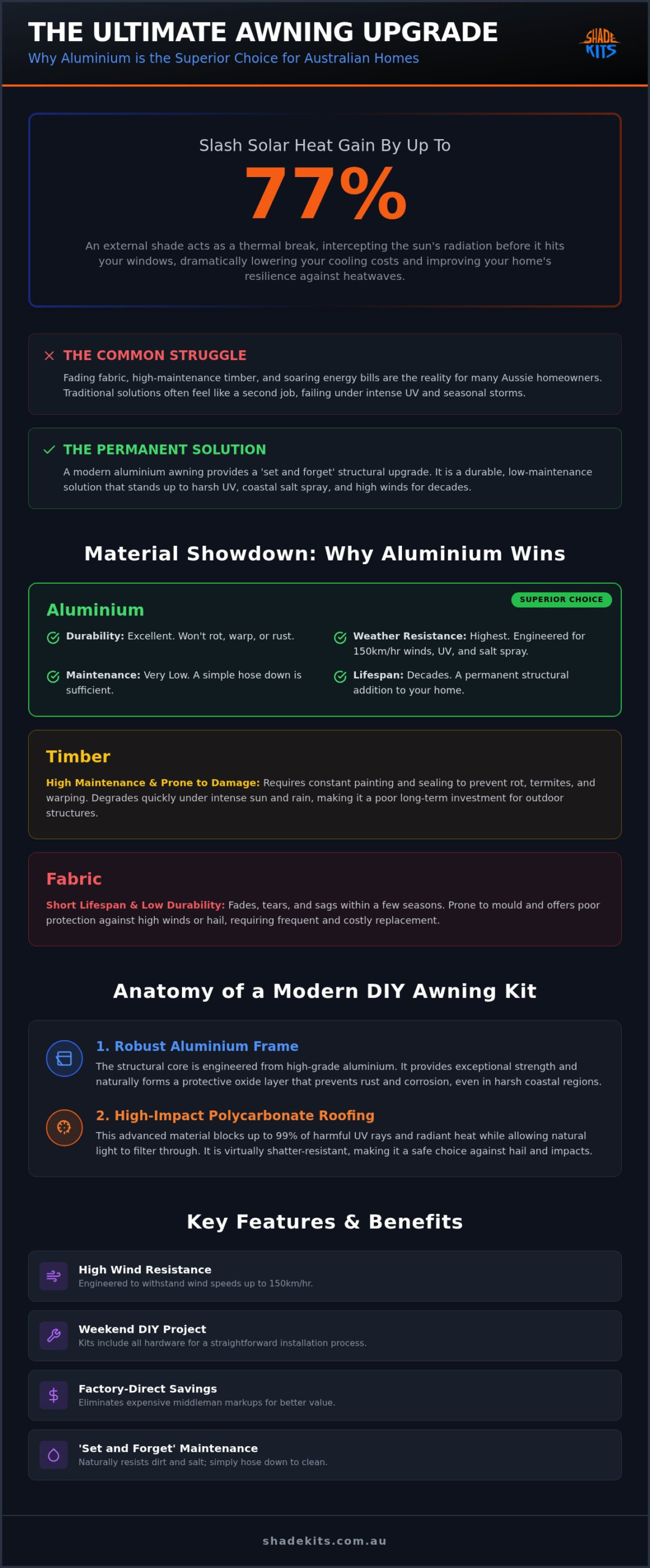
Did you know that installing a suitable window shade can reduce solar heat gain in your home by up to 77%? For many Australian homeowners, the reality of summer involves retreating indoors while fabric awnings fade and tear under the intense UV glare. You’ve likely felt the frustration of high-maintenance timber structures or seen your energy bills climb as heat pours through unprotected glass. It’s a common struggle, but your outdoor fixtures shouldn’t feel like a second job. Choosing a durable aluminum awning offers a permanent, structural solution that stands up to everything from coastal salt spray to 150km/hr winds.
We understand that you want a shade solution that lasts decades without the constant need for repairs. This 2026 guide will show you how to achieve professional results with a straightforward DIY kit, helping you slash cooling costs and improve your home’s resilience. We will explore the latest National Construction Code standards for fire safety, compare modern architectural styles, and provide a clear roadmap for a successful weekend project. By the end, you’ll know exactly how to select a low-maintenance system that keeps your home cool and protected for the long haul.
To understand the value of this investment, we first need to look at the basics. What is an awning? Historically, it’s an overhanging cover used to provide shade and shelter. In the modern Australian context, a high-quality aluminum awning has evolved into a permanent, structural fixture. These systems feature a robust aluminium frame paired with high-impact roofing, usually polycarbonate. Unlike the heavy, rattling metal slats of the 1970s, today’s versions are sleek and architectural. They are designed as precision-engineered DIY kits that prioritise both form and function.
The market has shifted significantly toward metal structures over the last decade. Timber requires constant painting and is prone to rot. Fabric eventually sags or tears. Aluminium provides a structural solution that simply doesn’t warp or succumb to the elements like organic materials do. A modern kit is a complete package. It includes the structural frame, the UV-resistant roofing panels, and all the specialised mounting hardware needed for a secure fit. It’s a comprehensive system designed to last decades rather than just a few seasons.
While fabric options offer a soft look, they often fail when faced with the harsh Australian climate. Metal wins every time when it comes to structural integrity during heavy rain or high winds. You won’t have to deal with mould growth, sagging material, or the flapping noises that keep you awake during a storm. Maintenance is another major differentiator. While fabric requires specialised cleaning or replacement, you can simply hose down your aluminum awning to remove dust or salt spray. This prevents the “tired” or faded appearance that eventually plagues almost all cloth solutions, ensuring your home maintains its kerb appeal for years.
Most modern aluminium kits incorporate polycarbonate roofing for a very specific reason. This material allows natural light to filter into your home while blocking the majority of radiant heat. It creates a bright, airy space without the “oven effect” associated with solid metal sheets. Polycarbonate is also incredibly tough. It is virtually shatter-resistant, making it a safe choice for properties prone to hail or for backyards where kids are playing. By combining a rigid metal frame with these advanced panels, you get a shade solution that balances visibility with superior thermal protection.
Australia’s climate is famously unforgiving, particularly for homes along the coastline where salt spray and humidity are constant. Choosing the right materials is critical for long-term value. Aluminium is a standout performer because it naturally resists corrosion by forming a protective oxide layer that prevents rust. This property is vital when you consider that most Australian residents live within 50 kilometres of the ocean. When researching building materials for Australian homes, you’ll find that aluminium’s ability to withstand these conditions without warping or rotting makes it a superior choice for external fixtures. It also provides excellent UV stability, ensuring it won’t break down or become brittle under our intense sun.
Beyond salt air, our structures must face the “East Coast Low” and seasonal storms. A modern aluminum awning is engineered for structural integrity, with some designs capable of withstanding wind speeds up to 150km/hr. This resilience ensures your shade solution remains a permanent part of your home, rather than a liability during a high-wind event. This structural strength is complemented by the thermal properties of the metal. While steel can absorb and hold heat, aluminium reflects a significant portion of solar radiation, preventing the structure itself from becoming a radiator next to your windows.
The science of solar heat gain is simple: once the sun hits your window glass, the heat is already inside. Installing an aluminum awning acts as a “thermal break,” intercepting radiation before it reaches the interior. Research indicates that installing a suitable external shade can reduce solar heat gain by up to 77%, which significantly lowers the internal temperature of your rooms. By keeping the sun off the glass, you reduce the strain on your air conditioning system, leading to lower energy bills and a more sustainable home. This is especially important during heatwaves when every degree of temperature reduction counts.
Hail is a recurring threat in many parts of Australia, often leading to shattered windows and damaged vehicles. Aluminium frames provide the necessary backbone for high-impact polycarbonate roofing, which is virtually shatterproof. This combination offers a level of safety that fabric or glass can’t match. If you’re looking for this same level of resilience to protect a vehicle, the CarCave provides a mobile alternative for vehicle protection. For those looking to secure their windows and patios, browsing our range of durable shade kits is the first step toward a more resilient home.
Moving from the technical benefits of the material to the practicalities of acquisition, the factory-direct model has changed how Australians improve their homes. By sourcing your aluminum awning directly from the manufacturer, you eliminate the middleman and the associated retail markups. This approach makes high-end structural solutions accessible to a much broader range of budgets. According to the Australian Aluminium Council, the industry has seen a clear shift toward these streamlined supply chains, which prioritise efficiency and material quality over traditional showroom overheads.
One of the biggest advantages of a modern kit is standardisation. Unlike buying raw materials and attempting to fabricate a structure from scratch, these kits are precision-engineered. Every rail, post, and bracket is designed to fit together perfectly, ensuring structural integrity that is difficult to achieve with a “bits and pieces” approach. Because these systems are managed from a central hub, they can be delivered nationwide, reaching your doorstep whether you’re in a metropolitan centre or a regional town. This transportability ensures that every Australian home can access the same level of weather protection regardless of location.
The financial benefit of a DIY solution extends far beyond the initial purchase price. When you choose to install the structure yourself, you bypass the significant cost of professional labour. In Australia, hiring a specialist tradie for installation typically costs between $75 and $100 per hour. For a standard window or patio project, these costs can add up quickly. A pre-drilled kit respects the value of your time by simplifying the assembly process, allowing you to achieve a professional result over a single weekend. It’s a pragmatic way to add value to your property without the stress of managing contractors or unexpected site fees.
When your kit arrives, you’ll find it’s a complete system designed for straightforward assembly. We ensure that every component is accounted for, from the structural aluminium rails to the UV-resistant polycarbonate panels. You don’t need a workshop full of specialised machinery to get the job done. Most projects only require basic household tools like a drill, a level, and a tape measure. Each kit includes comprehensive instructions that guide you through the mounting and assembly process step-by-step. This level of support ensures that even if you aren’t a seasoned “weekend warrior,” you can still complete the installation with total confidence.
Choosing the right style for your home is about more than just aesthetics; it’s about matching the structure to your specific lifestyle needs. An aluminum awning should feel like a natural extension of your architecture. To achieve this, you need to consider how the projection of the unit affects both shade and visibility. In many Australian regions, a deeper projection is necessary to block the harsh afternoon sun, yet you must balance this with the need to maintain your garden views and natural airflow. Getting the measurements right ensures the structure performs its thermal duties without making your interior feel dark or cramped.
Colour coordination is another vital step in the selection process. Most modern kits are available in a range of neutral tones designed to complement popular Australian palettes, such as those found on contemporary render or traditional brickwork. If you are already planning larger property improvements, such as installing DIY carport kits Australia, choosing an awning with a matching frame colour creates a unified, professional appearance across your outdoor spaces. This consistency is what separates a standard DIY job from a high-value home renovation that adds genuine kerb appeal.
The primary difference between these two styles lies in their structural intent and mounting requirements. Window awnings are typically smaller, fixed units designed to sit directly above glass panels to prevent heat transfer. They are excellent for increasing privacy from nearby neighbours without completely blocking your outlook. In contrast, patio covers are larger structures that often require additional post support to create a functional outdoor living area. For a more detailed breakdown of these options, you can explore our guide on Awning vs Awnings to see which shade solution fits your floor plan best.
The profile of your roofing affects both the look of the structure and its long-term performance. While flat designs offer a minimalist, modern aesthetic, angled profiles are often superior for managing water runoff and preventing the buildup of leaf debris. You also need to decide between clear and tinted polycarbonate. Clear panels maximise light transmission, which is ideal for south-facing windows that struggle for brightness. Tinted or “grey” panels are better for north-facing areas where glare reduction is the priority. By matching the roofing profile to the architectural era of your home, you ensure the addition adds lasting value. You can browse our full range of awning kits to find the perfect profile for your next project.
Maintaining your outdoor structures shouldn’t be a chore that eats into your weekends. One of the most compelling reasons to choose an aluminum awning is its “set and forget” nature. While other materials degrade under the pressure of the Australian sun, aluminium remains structurally sound for decades with minimal intervention. This longevity also makes it a sustainable choice for the eco-conscious homeowner. Aluminium is 100% recyclable; your investment doesn’t just protect your home, it also minimises your long-term environmental footprint.
Periodic inspections of the mounting hardware are recommended to ensure the system remains watertight. Checking the seals and tightening any bolts once a year is usually all that’s required to maintain the structural integrity of your kit. This proactive approach ensures that your window or patio remains protected even during the most severe weather events. It’s a small time investment that pays off in decades of reliable performance.
The frequency of your cleaning schedule depends largely on your location. For coastal homes, salt spray can accumulate on the frame and roofing panels, potentially dulling the finish over time. In inland areas, dust and pollen are the primary concerns. Follow these simple steps to maintain your structure:
Aluminium is immune to many of the issues that plague traditional building materials. It doesn’t suffer from the “dry rot” or termite damage common in timber structures, nor does it stretch or mildew like fabric. The secret to this resilience lies in the factory finish. Powder coating is a factory-applied finish that provides superior weather protection. This finish is specifically engineered to withstand the high-UV zones found across Australia, ensuring the colour remains vibrant for years. When you invest in a quality aluminum awning kit, you’re buying a product designed to outlast almost every other external feature of your property.
Investing in a permanent shade solution is a practical step toward improving your home’s energy efficiency and long-term resilience. We’ve explored how a modern aluminum awning provides a structural “thermal break” that reduces heat gain while standing up to the harshest coastal conditions. By choosing a factory-direct DIY kit, you bypass expensive labour costs and middleman markups, ensuring you get high-quality materials delivered straight to your door.
These kits are specifically engineered for local conditions, offering a “set and forget” durability that timber or fabric simply can’t match. Whether you’re shielding a single window or extending your outdoor living space, the process is designed to be straightforward for any weekend warrior. You can browse our range of durable DIY Aluminium Awning Kits today and benefit from our Australia-wide delivery and factory-direct pricing. Taking control of your home’s climate protection has never been more accessible. We’re here to help you achieve professional results with ease.
Aluminium awnings are not significantly noisier than other permanent structures. While you might hear the gentle patter of rain, modern polycarbonate roofing panels are designed to dampen impact sound. Unlike the thin, uninsulated metal sheets used in the past, these rigid structures don’t vibrate or drum loudly. It’s a much quieter experience than traditional corrugated iron, allowing you to enjoy the sound of a storm without it becoming a distraction inside your home.
You can certainly install an aluminum awning kit yourself if you have basic DIY skills. These kits are specifically engineered for straightforward assembly, featuring pre-drilled components and all the necessary specialised hardware. Most homeowners find that a standard window unit can be installed in just a few hours using common household tools like a drill, a level, and a tape measure. It’s a manageable weekend project that provides a professional finish without the tradie’s price tag.
Aluminium is naturally resistant to rust, making it the ideal choice for coastal properties. Unlike steel, it does not oxidise into red rust when exposed to salt air and moisture. Instead, it forms a thin, protective layer that prevents further corrosion. When combined with a high-quality powder-coated finish, your structure is double-protected against the harsh Australian sea spray, ensuring it remains structurally sound and visually appealing for decades without the risk of rot.
Installing an external shade can reduce solar heat gain in your home by as much as 77%. By stopping the sun’s rays before they hit your window glass, the awning prevents the greenhouse effect that traps heat indoors. You’ll notice a significant drop in room temperature during summer heatwaves, which directly translates to lower energy bills. It’s one of the most effective ways to improve your home’s thermal efficiency without relying solely on air conditioning.
The main difference lies in the scale and primary purpose of the structure. An awning is typically a smaller, wall-mounted unit designed to shade a specific window or door from sun and rain. A pergola is generally a larger structure, often supported by posts, intended to define an outdoor living area like a deck or patio. While both provide shade, an aluminum awning is a compact solution for thermal control and window protection.
Most small window awnings are considered exempt development in Australia and don’t require formal council approval. However, regulations vary between states; for example, in Victoria, structures under 20 square metres are often exempt if they meet specific height requirements. If your project is exceptionally large or sits on a heritage-listed property, it’s a good idea to check your local council’s website. We always recommend verifying local rules for any structure over 10 square metres.
You can keep your awning looking new by using a soft cloth and plenty of fresh water. It’s important to avoid abrasive scouring pads or harsh chemical cleaners, as these can scratch the powder-coated finish or the polycarbonate panels. A simple bucket of warm water mixed with a mild, pH-neutral detergent is all you need to remove dust and salt spray. Regular rinsing with a garden hose will also prevent grime from building up over time.
While DIY kits come in standardised modules, many designs offer a degree of flexibility. You can often join multiple modules together to cover wider spans or trim the polycarbonate panels to fit specific widths. It is critical to measure your required projection and width accurately before ordering. Modular systems are a pragmatic choice because they allow you to achieve a custom look while benefiting from the precision and cost-effectiveness of factory-engineered components.