
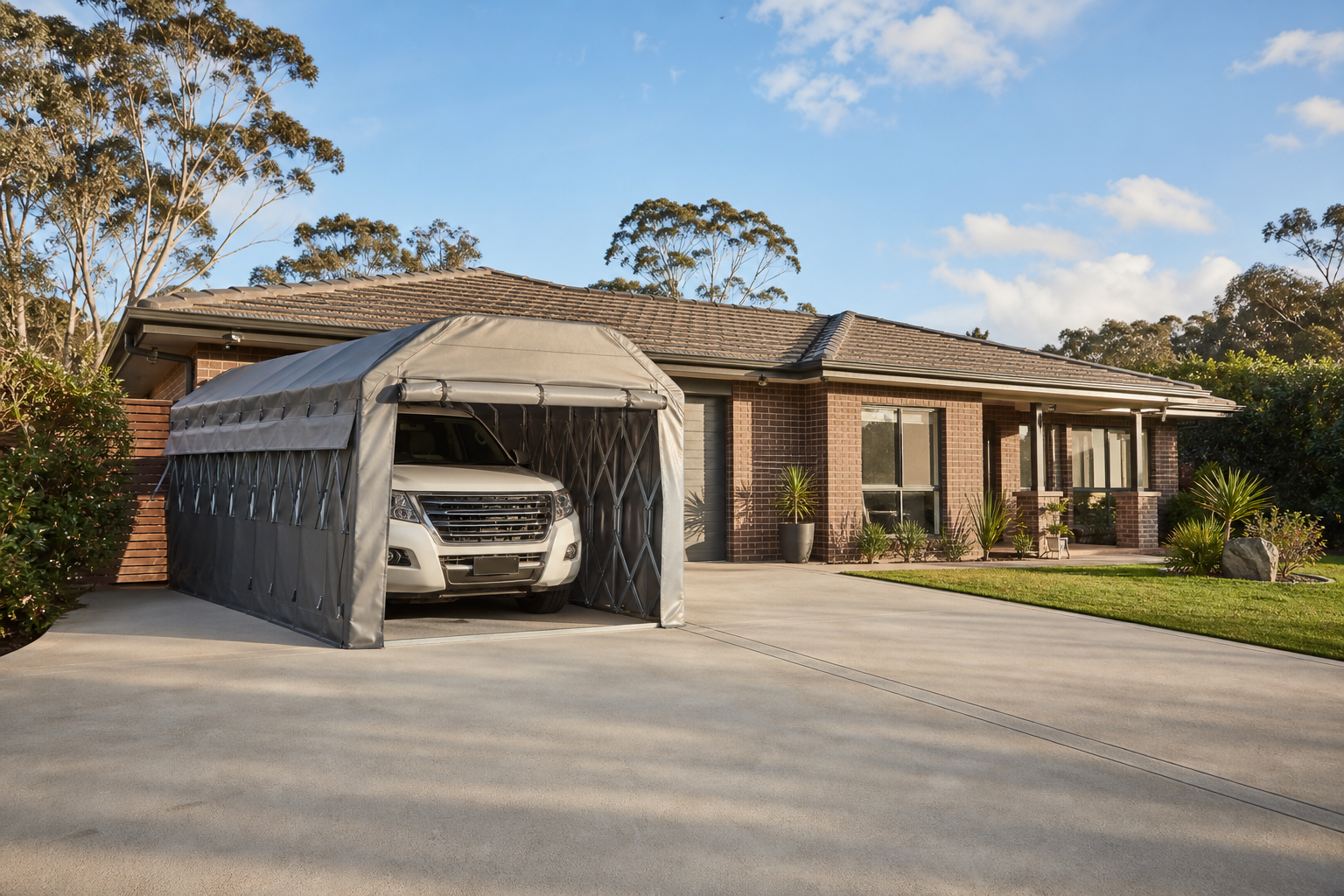

Buying your first dedicated vehicle shelter can feel overwhelming — especially when permit requirements, wind ratings and anchoring methods all sound like a foreign language. If you’ve been comparing carports, soft covers and permanent garages only to hit a wall of council paperwork and builder quotes, the CarCave foldable garage deserves a serious look. It sits in a unique sweet spot: fully enclosed weatherproof protection that doesn’t require permanent construction, delivered as a kit you can install in a single day.
This guide is written specifically for first-time buyers who want clear, honest comparisons and plain-English compliance guidance. We’ll walk through every decision point — from choosing manual versus automatic operation, to understanding exactly what your local council may need — so you can move from research to confident purchase without second-guessing yourself.
A standard carport gives you a roof. A fitted car cover gives you fabric. Neither delivers what most vehicle owners actually want: a fully enclosed, lockable shelter that keeps rain, hail, sap, bird droppings and prying eyes away from their pride and joy. The CarCave foldable garage bridges the gap between a cheap tarp and a $30,000+ permanent brick-and-colorbond build.
Here’s how the three options stack up for a typical suburban driveway:
| Feature | Car Cover | Carport | CarCave Foldable Garage |
|---|---|---|---|
| Full enclosure | Partial | No | Yes |
| Lockable security | No | No | Yes |
| Council approval usually needed? | No | Yes | Often exempt* |
| Hail protection | Minimal | Roof only | Full sides + roof |
| Portability / removability | High | Low | Moderate |
*Temporary/collapsible structures are treated differently by many councils — see the compliance section below for details.
If you’re renting, living under body-corporate rules, or simply want protection without months of building approvals, the CarCave offers a compelling middle ground. Read our detailed foldable garage vs carport comparison for an even deeper dive.
CTA: Explore the full CarCave range at Shade Kits
Cheap imported “pop-up garages” regularly fail after the first serious storm. The reason is simple: they aren’t engineered for Australian wind actions under AS/NZS 1170.2. The CarCave range available through Shade Kits uses a galvanised steel scissor-frame mechanism rated for wind regions common across most of metropolitan and regional Australia. Before purchasing, we recommend confirming your specific wind region — which you can check by postcode — and requesting the relevant wind rating and compliance documentation from our team.
Beyond wind, the marine-grade PVC fabric used in CarCave units is UV-stabilised to resist the intense solar radiation that degrades cheaper polyethylene covers within a single summer. The fabric also provides a genuine barrier against hail impact — not hailstones the size of golf balls, but the regular pea-to-marble-sized hail that causes the majority of paint and panel damage across Sydney, Melbourne, Brisbane and Adelaide storm seasons. For coastal properties, galvanised steel frames resist salt-air corrosion far better than powder-coated mild steel alternatives, though a periodic freshwater rinse is still good practice.
CTA: Request wind rating and compliance documentation for your postcode
This is one of the first decisions you’ll face, and it’s worth getting right. Both options use the same frame and fabric — the difference is how you open and close the unit.
Manual CarCave: You walk to the rear of the unit, release the ground lock, and push/pull the concertina frame along its tracks. It takes roughly 30–60 seconds and requires minimal effort thanks to the counterbalanced scissor mechanism. This option has a lower upfront cost and zero ongoing electrical requirements. It’s ideal if you use the shelter once or twice daily and don’t mind the short physical interaction.
Automatic CarCave: A battery-powered motor drives the frame open or closed at the press of a remote control — similar to a conventional garage door opener. The rechargeable battery typically lasts for dozens of cycles between charges, and a solar trickle-charge panel can be added to keep it topped up indefinitely. Crucially, every automatic unit includes a manual override, so a flat battery or power interruption never leaves you locked out. The automatic option suits buyers who value convenience, have mobility considerations, or simply want to operate the unit from inside their vehicle.
Compare the automatic package features and pricing here.
CTA: Compare manual vs automatic packages side by side
Nothing kills buyer confidence faster than uncertainty about whether your vehicle will actually fit. The CarCave is available in several standard sizes designed around the most popular Australian vehicle categories. Internal clearances — not just overall dimensions — are what matter, because you need door-opening room, mirror clearance and headroom for roof racks or aerials.
Before ordering, measure your vehicle’s total height (including any roof accessories), total length (bumper to tow-bar tip), and width with mirrors extended. Then compare these against the internal dimensions listed in our detailed fitment chart. If you’re between sizes, always go up — the extra space costs less than you’d think and prevents daily frustration.
CTA: Send us your driveway photo for personalised sizing advice
First-time buyers often worry that a foldable structure will blow away in the first decent breeze. Proper anchoring eliminates that risk entirely — and you don’t necessarily need a concrete slab to achieve it. Here’s how the three most common base options compare:
| Base Type | Pros | Cons |
|---|---|---|
| Concrete slab | Strongest anchor point; chemical or mechanical bolts; cleanest finish | Most expensive base; permanent; may trigger council interest |
| Pavers / existing hardstand | Often already in place; anchoring brackets available | May need specific paver-anchor kits; uneven surfaces need levelling |
| Ground screws into soil/gravel | Fastest install; removable; no concrete work; lowest cost | Soil type matters; may not suit all wind regions |
Our installation and anchoring guide walks you through each method with diagrams and recommended hardware. If you’re installing on soil and live in a higher wind region, ground screws rated for the expected uplift loads are essential — generic tent pegs won’t cut it.
CTA: Download the free site prep and measurement checklist (PDF)
A shelter is only as good as its ability to keep unwanted visitors out. The CarCave’s security starts at the ground: integrated ground-locking pins secure the frame to the anchoring rail, preventing the unit from being lifted or slid open without authorisation. When fully closed and locked, the enclosed fabric skin and rigid frame create a visual and physical deterrent that a carport or cover simply cannot match.
The anti-lift frame design means the scissor mechanism cannot be forced upward from the outside. Combined with a keyed padlock-compatible locking point, the CarCave keeps opportunistic thieves and curious neighbours well away from your vehicle. For insurance purposes, check with your insurer whether a lockable foldable garage qualifies for a “garaged vehicle” classification — many owners have reported reduced premiums after installing one, though this varies between providers.
CTA: View the full security feature breakdown
The frame is hot-dip galvanised steel — not painted, not powder-coated over mild steel, but genuinely galvanised for long-term corrosion resistance. This is the same coating technology used on highway guardrails and marine infrastructure, and it’s a key differentiator from budget imports that rust within months of coastal or high-humidity exposure.
The fabric skin is a heavy-duty, UV-stabilised PVC with marine-grade characteristics. It’s engineered to resist prolonged sun exposure without becoming brittle, and its waterproof membrane keeps rain, dew and condensation from reaching your vehicle. Ventilation channels integrated into the design promote airflow to minimise internal condensation — a common problem with fully sealed cheap covers that can trap moisture and encourage mould. If you’re in a bushfire-prone area, ask our team about the fabric’s fire-retardant properties and how they relate to AS 1530.2 testing requirements.
CTA: Ask our team about fabric specs and fire-retardant compliance
Every CarCave ships as a complete kit with all hardware, anchoring components and step-by-step instructions. A competent DIYer with a helper can typically complete a standard installation in four to six hours, depending on the base type and anchoring method chosen. You’ll need basic tools — a drill, socket set, spirit level and tape measure cover most of it.
If you’d rather not do it yourself, Shade Kits can connect you with experienced installers in most metro and major regional areas across NSW, QLD, VIC, SA, WA and TAS. Professional installation typically adds a modest fee and can often be scheduled within the same delivery window. Check estimated delivery and install lead times for your postcode.
CTA: Check delivery and install lead times for your postcode
This is the section that causes the most anxiety for first-time buyers — and understandably so. Nobody wants to invest in a structure only to receive a council removal order weeks later. Here’s the good news: because the CarCave is a collapsible, non-permanent, relocatable structure, it is treated differently from fixed garages and carports by most Australian councils.
Many local government areas classify collapsible or foldable shelters as temporary structures or domestic equipment (similar to shade sails, gazebos or portable sheds) that do not require a Development Application or building permit — provided they meet certain criteria, such as not being permanently affixed to the ground, not exceeding height limits, and not encroaching on setback boundaries. However, rules vary significantly between states, territories and individual council areas. There is no single national rule that applies everywhere.
Our strong recommendation: Before purchasing, contact your local council’s planning or building department and describe the CarCave as a collapsible, non-permanent vehicle shelter. Ask whether it requires approval and whether any conditions (setbacks, height, fire zone overlays) apply. Our team can provide product specification sheets and diagrams to support your enquiry. For strata or body-corporate properties, you’ll also need committee approval — the CarCave’s quiet operation and clean appearance work in your favour here.
CTA: Book a free site check call with a CarCave specialist for permit guidance
Building a permanent single garage in Australia typically costs $20,000–$40,000+ once you factor in slab, construction, council fees and time. The CarCave delivers comparable protection at a fraction of that cost, with no building permits in most cases and installation measured in hours rather than weeks. While exact pricing depends on size, manual vs automatic configuration, and delivery location, you can get a tailored quote in minutes through our online configurator or by calling the team directly.
For buyers who prefer to spread the cost, flexible finance options are available, letting you protect your vehicle now and pay over time. Pre-approval is fast and straightforward.
CTA: Get an instant quote — enter your vehicle and driveway measurements
The CarCave range comes backed by a comprehensive manufacturer warranty covering the frame, fabric and mechanical components. Replacement covers, locking hardware, motor units and anchoring kits are all available as spare parts through Shade Kits, so you’re never left stranded if a component needs replacing down the track. Full warranty terms and conditions are outlined on our warranty page.
Our Australian-based support team can assist with troubleshooting, maintenance advice and spare part orders. For coastal installations, we recommend a simple annual maintenance check — rinsing the frame, inspecting anchors and checking fabric tension — to maximise the lifespan of your unit.
CTA: Read our full warranty and spare parts policy
Still on the fence? Browse real installation photos and customer stories from homes across Australia — from inner-city driveways in Sydney to acreage properties in regional Queensland. Seeing the CarCave in a real-world setting is often what turns cautious researchers into confident buyers.
Whether you’re protecting a weekend classic, a daily driver or a work ute loaded with tools, the CarCave foldable garage delivers the weather protection, security and convenience of a permanent garage — without the permanent price tag or paperwork. Get your personalised quote today or book a free specialist call to have every question answered before you commit.
CTA: Get your instant CarCave quote now — Australia-wide delivery available