
Why should protecting your car from the harsh Australian sun cost as much as a small renovation? Most homeowners assume that hunting for inexpensive carport kits means sacrificing structural integrity or settling for a flimsy frame that won’t survive a summer storm. It’s a valid concern, especially when you’re trying to avoid the eye-watering quotes from local tradies that can easily double your project budget.
We agree that you shouldn’t have to choose between affordability and durability. You can actually secure high-quality, weather-resistant protection for your vehicle without the premium price tag by mastering the world of factory-direct DIY kits. Since a well-chosen double carport can add between $10,000 and $20,000 to your property’s resale value, making the right choice is about more than just immediate savings; it’s a smart financial move.
This guide cuts through the confusion regarding council permits, which can often add $1,500 to your total costs, and explains why lightweight aluminium frames are the pragmatic choice for a solo weekend build. We’ll show you how to bypass the middleman and choose a structural solution that is both easy to assemble and engineered to handle local conditions.
When searching for inexpensive carport kits, it is easy to fall into the trap of choosing the lowest sticker price without considering the long-term consequences. In the Australian market, there is a distinct difference between a “cheap” product and one that is genuinely “inexpensive.” A cheap kit often relies on thin, structural steel that is prone to rust or complex assembly that requires specialised tools. Conversely, an inexpensive kit uses smart engineering and durable materials to reduce costs without compromising safety or structural integrity.
To understand the true value, we must first look at the fundamental purpose of the structure. What is a carport? At its core, it is a covered structure used to offer limited protection to vehicles, primarily from sun and rain. Achieving this goal cost-effectively in 2026 requires a focus on materials like aluminium, which offers a higher strength-to-weight ratio than traditional timber or heavy steel. This choice reduces both the initial purchase price and the ongoing maintenance requirements, ensuring the structure remains an asset rather than a liability.
The most significant price reductions often come from how you source your kit. By choosing a factory-direct model, you eliminate the retail markup that traditional hardware chains or specialist showrooms add to the price. This “middleman” fee can often account for a significant portion of the total cost. Buying directly from a manufacturer also ensures that you have a direct line to expert support; if you have a question during the build, you are speaking to the people who understand the specific kit you purchased rather than a general retail clerk.
Logistics also play a major role in defining value. Modern carport kits are engineered as flat-packs, which significantly lowers shipping fees across Australia. Because these components are pre-cut and pre-drilled at the factory, the precision of the manufacturing process reduces material waste and ensures that every piece fits perfectly the first time, saving you from expensive mid-project corrections.
One of the largest hidden expenses in any home improvement project is labour. In Australia, a qualified builder typically charges from $80 per hour for installation services. For a standard carport, professional assembly can easily add $1,500 to $3,000 to your total bill. By opting for a DIY-friendly design, you effectively keep that money in your pocket. These kits are designed for a two-person, one-weekend project, requiring only basic tools and a steady hand. Choosing to assemble your own single carport allows you to capture a 100% return on investment by eliminating trade labour costs while immediately boosting your property’s market value.
Material selection is where savvy buyers separate long-term value from short-term “cheapness.” While many competitors push heavy steel as the only premium option, aluminium is often the more pragmatic choice for inexpensive carport kits aimed at the DIY market. It offers a unique combination of structural resilience and low density that saves you money from the moment you pay for shipping until years after the build is complete.
Choosing the right components isn’t just about the initial invoice. It’s about avoiding the hidden costs of maintenance and replacement. In Australia’s diverse environment, from salt-sprayed coastal suburbs to humid northern regions, your choice of frame and roofing determines whether your structure remains an asset or becomes a rust-prone liability.
Aluminium is naturally corrosion-resistant. Unlike cheap steel kits that rely on thin coatings, aluminium forms its own protective oxide layer. This makes it the superior choice for coastal areas where salt air quickly degrades inferior metals. Beyond durability, the weight advantage is significant. Because aluminium is roughly one-third the weight of steel, shipping fees for flat-pack kits are lower, and the risk of manual handling injuries during assembly is greatly reduced.
For the DIYer, this material is a dream to work with. It’s much easier to lift into place and requires less effort to drill than hardened steel. Despite being lighter, these frames are engineered to maintain structural integrity in high-wind zones, providing a sturdy anchor for your vehicle. If you’re looking for a low-maintenance solution that won’t require a fresh coat of paint every few years, explore our range of durable aluminium carport kits designed for local conditions.
The Australian sun is notoriously brutal on vehicle paintwork and interiors. Polycarbonate roofing is the modern answer to this challenge, blocking 99% of harmful UV rays while still allowing natural light to filter through. This creates a bright, usable space without the “hot box” effect often found under traditional metal sheeting. High-quality polycarbonate is also incredibly tough; it’s designed to withstand the impact of Australian hail, which can easily dent thin metal roofs.
Temperature regulation is another area where this material shines. It doesn’t absorb and radiate heat as intensely as dark-coloured steel, keeping the area under the canopy significantly cooler during a January heatwave. When installing these sheets, it’s vital to follow the Australian Standards for polycarbonate roofing to ensure maximum longevity and safety. With current prices for quality corrugated polycarbonate starting from approximately $23.00 per lineal metre, it remains one of the most cost-effective ways to achieve professional-grade protection on a budget.
After choosing your materials, the physical design of the structure is the next biggest factor in your overall budget. While ornate gabled roofs look traditional, they require significantly more framing and complex joining; this inevitably drives up the price. For those hunting for inexpensive carport kits, simplicity is the most reliable way to keep costs down without losing structural integrity.
Selecting the right style involves more than just picking a look you like. You need to consider how the design impacts the number of components and the complexity of the build. A simpler design doesn’t just lower the purchase price; it also reduces the time you’ll spend on the tools during your weekend assembly project.
The Skillion, or flat roof, is widely considered the most cost-effective permanent design available. It uses a single, sloping plane which requires fewer beams and connectors than more complex shapes. This streamlined approach reduces the manufacturing cost and simplifies the assembly process for DIYers. To ensure your structure remains durable, we recommend a 2-3 degree fall to allow for efficient water drainage. If you want to explore how these designs compare in detail, our guide to flat roof carport kits Australia wide covers every key consideration for 2026 builds. You can browse various carport kits to see how this minimalist aesthetic fits modern Australian homes.
When comparing sizes, it’s worth looking at the cost per square metre rather than just the total price. A double carport kit (typically 6m x 6m) often offers better value than a single (3m x 6m) because you’re sharing the cost of the central support structure across a larger covered area. If your property allows for it, investing in a double kit now prevents the much higher expense of adding a second unit later. It’s a pragmatic way to future-proof your home’s storage capacity.
For those with limited space or awkward driveways, a cantilever design might be the answer. While these typically cost slightly more due to the heavy-duty engineering required to support a roof from only one side, they save you from the hassle of navigating around support posts. It’s a classic example of spending a little more upfront to gain significant usability on a tight suburban block.
For renters or those on a strict budget who need immediate hail defence, a permanent structure might not be the best fit. This is where the CarCave offers a unique, foldable alternative. Since it doesn’t require permanent footings or a concrete slab, it’s classified as a non-permanent shelter. This means you generally won’t need to worry about council approval or permit fees, which can reach up to $1,500 in some jurisdictions. Discover the CarCave foldable car shelter to see how you can protect your vehicle without the commitment of a traditional build.
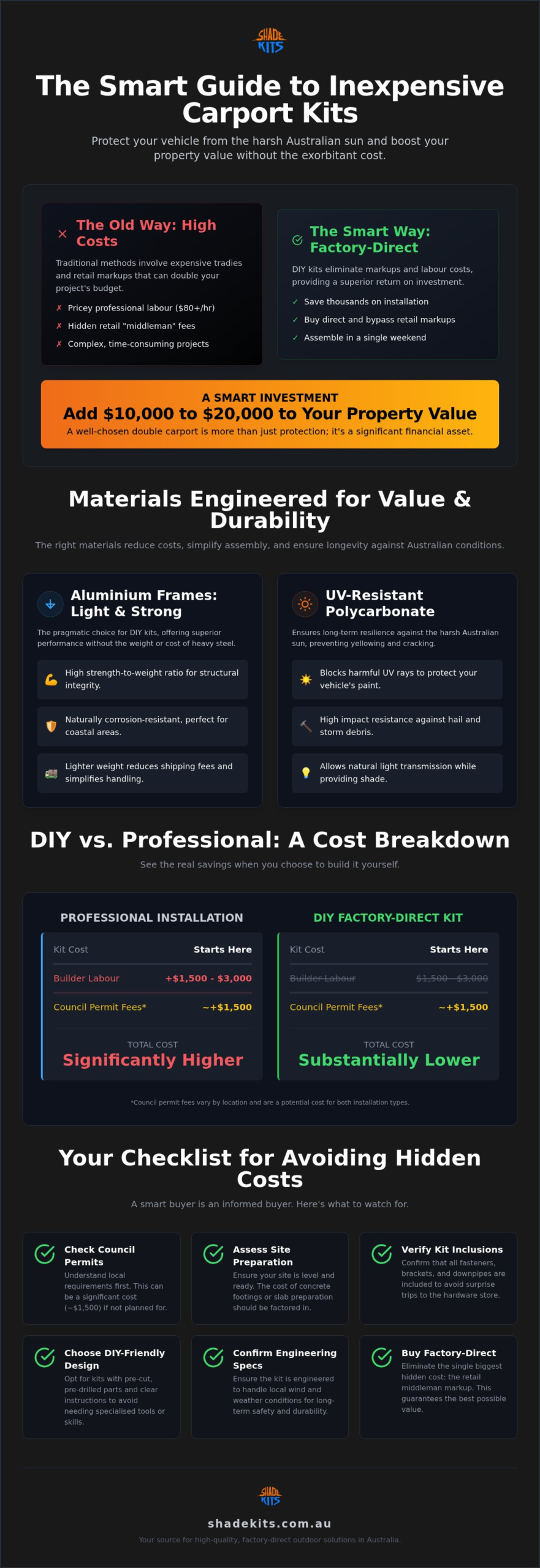
Success with inexpensive carport kits depends on your ability to look beyond the initial checkout price. While the kit itself is the main component, several logistical factors can inflate your final spend if they aren’t managed early. Understanding these “invisible” costs allows you to maintain a realistic budget and avoid mid-project delays. We’ve identified the four areas where costs typically creep up so you can plan with confidence.
Council regulations are the most common source of budget surprises. In many Australian jurisdictions, a building permit and council fees can cost up to $1,500, depending on the project’s complexity. For a standard double carport, you might expect a $500 council fee and an additional $500 for the building permit itself. A lodgement fee of approximately $120 to $140 may also apply. While some smaller structures fall under “exempt development” rules, you should always verify this with your local authority before starting.
Having pre-prepared engineering drawings is essential for a smooth application process. If you are looking for specific local guidance in high-density areas, check the requirements for Sydney or Melbourne. Remember that choosing a non-permanent solution like the CarCave, which we discussed previously, can often bypass these permit costs entirely because it doesn’t require permanent footings.
Your foundation is the next major consideration. A new concrete slab typically costs between $1,000 and $3,500. If you already have a structurally sound concrete driveway, you may be able to bolt the kit directly to the surface using specialised masonry anchors. However, if you’re building on soil, you’ll need to dig and pour concrete footings. While DIY concrete is an option for the confident handyman, hiring a contractor for the base ensures a perfectly level surface. The foundation is the one place you should never skimp on quality because the structural safety of your vehicle depends entirely on the ground-level anchor points.
Don’t forget to audit your tool shed before the kit arrives. A successful build requires a high-quality hammer drill, a spirit level, a socket set, and at least two sturdy ladders. If you need to hire these, factor in a daily rental rate of approximately $50 to $100. Finally, clarify your delivery options. Depot delivery is almost always the most budget-friendly choice. Home delivery often requires a “tail-lift” truck or even a forklift, which can add significant surcharges to your shipping bill. Choosing a depot pick-up allows you to manage the final leg of transport yourself and keep costs down. Before finalising your kit selection, it’s also worth reviewing a comprehensive carport kits with guttering Australia planning checklist to ensure your drainage system meets local standards and your build avoids costly mid-project surprises.
Ready to start your project with a transparent price? Browse our fully engineered carport kits and get a clear delivery quote today.
Choosing a supplier for your vehicle protection is a decision that impacts your property for years. While the market for inexpensive carport kits is crowded with generic imports, Shade Kits focuses specifically on the logistical and environmental realities of the Australian landscape. We understand that a kit sitting in a warehouse in Sydney needs to be just as resilient as one destined for the tropical humidity of the north or the dry heat of the west.
Our approach prioritises transparency and dependability. We don’t just sell you a box of parts; we provide a structural solution backed by local expertise. This means every component is selected for its ability to perform under pressure, ensuring your investment remains secure long after the initial assembly is finished. By cutting out the middleman and shipping factory-direct, we ensure you get the highest quality materials without the retail markup.
The Australian sun is famously unforgiving. In 40-degree heat, inferior plastics and coatings can become brittle and fail within a few seasons. Shade Kits uses UV-stabilised materials and powder-coated aluminium frames to ensure that your carport retains its structural integrity and aesthetic appeal. Our kits are engineered with specific wind ratings in mind, providing confidence for homeowners in regional areas prone to heavy gusts. For a deeper dive into the technical requirements of building in local conditions, refer to our Ultimate Guide to DIY Carport Kits Australia.
Our national delivery network ensures that whether you are looking for kits in Perth or need a solution delivered to Brisbane, you receive the same high standard of service and protection. We’ve optimised our logistics to handle the vast distances of the continent, ensuring your flat-pack arrives safely and on schedule. This reach allows us to support DIYers in every corner of the country with consistent, reliable vehicle protection.
The true value of a DIY project is often found in the quality of the instructions. We provide comprehensive, easy-to-follow assembly manuals that demystify the construction process. You won’t find impenetrable jargon or confusing diagrams here. Instead, you’ll find a logical, step-by-step guide designed for a two-person team to complete over a single weekend using basic tools.
If you hit a snag during the build, our customer support team is ready to help. You’ll speak with people who actually understand the product and the assembly process, not a generic call centre. This commitment to after-sales care is why so many Australian homeowners trust us to protect their most valuable assets. Explore our range of inexpensive carport kits today and discover how simple it is to add professional-grade protection to your home.
Finding inexpensive carport kits that don’t compromise on structural integrity is entirely possible when you focus on smart engineering over cheap materials. By choosing factory-direct savings, you effectively remove the retail markups that often push these projects out of reach. The combination of rust-proof aluminium and UV-resistant polycarbonate provides the specific durability required to withstand the Australian sun for years to come.
The most significant saving comes from your own effort. Completing the assembly as a weekend project allows you to bypass expensive trade rates and keep thousands of dollars in your pocket. With Australia-wide shipping and clear, step-by-step instructions, the process of upgrading your home’s vehicle protection is now more accessible than ever. You’ve done the research and identified the hidden costs; you’re ready to make a pragmatic investment in your property’s future.
Browse our range of durable, factory-direct Carport Kits and start your DIY project today. It’s a satisfying way to achieve professional results on your own terms.
Yes, most carports in Australia require a building permit from your local council. The requirement is typically triggered by size, such as structures over 10 square metres, or height, often those over 2.4 metres. Since regulations vary significantly between local authorities, you should always check your specific council’s rules before purchasing inexpensive carport kits. A planning permit might also be necessary if you intend to build forward of your home’s front wall.
Delivery costs are determined by your specific location and whether you select depot or home delivery. Choosing a depot pick-up is usually the most cost-effective method because it avoids the surcharges associated with tail-lift trucks required for residential drops. Because our kits are engineered as flat-packs, the compact packaging helps keep national shipping rates as low as possible while ensuring safe transit across our Australia-wide network.
We strongly recommend having at least two people for the assembly process to ensure safety and structural accuracy. While aluminium components are much lighter and easier to lift than steel, you’ll need a second person to support the frame and beams while they’re being secured. A two-person team can typically finish a standard kit over a single weekend, which is the most efficient way to achieve a professional result without hiring a tradie.
Polycarbonate roofing is often the superior choice for temperature regulation and natural lighting. It blocks 99% of harmful UV rays while allowing light to filter through, preventing the area from feeling like a dark tunnel. Unlike dark metal sheets that absorb and radiate heat, polycarbonate keeps the space under the canopy significantly cooler during a January heatwave. It is also designed to resist impact from Australian hail, which can dent traditional metal roofs.
Yes, a well-installed carport is a practical addition that can significantly boost your home’s market appeal. A double carport that matches your home’s aesthetic can add between $10,000 and $20,000 to the property’s resale value. Because inexpensive carport kits allow you to avoid high labour costs, you’ll often see a return on investment that exceeds 100% once the structure is complete.
You’ll need a standard set of household trade tools to complete the build successfully. This includes a high-quality hammer drill for securing masonry anchors, a socket set, a spirit level, and a tape measure. Since you’ll be working at height to install the roofing sheets, two sturdy ladders are also essential. Most kits come pre-drilled and pre-cut, so you won’t need specialized metal-cutting saws or heavy-duty machinery.
The CarCave is a foldable, non-permanent solution that provides rapid hail protection without the need for a concrete slab or footings. It’s an ideal alternative for renters or homeowners who want to avoid the $1,500 cost often associated with council permits and building fees. While a permanent carport is a fixed asset, the CarCave offers the same level of vehicle canopy protection with the added benefit of being portable and exempt from most council regulations.
Aluminium is exceptionally resilient in coastal environments because it doesn’t rust or corrode like traditional steel. It naturally develops a protective oxide layer that resists salt-air degradation, giving the structure a lifespan of several decades. This makes it a pragmatic, low-maintenance investment for Australian homes near the ocean, as it won’t require the constant painting or rust-treatment that timber or steel structures often demand.