
Is it really worth waiting months for a custom-built garage while the Australian sun slowly bakes the life out of your car’s paintwork? Most homeowners feel caught between the high cost of traditional trades and the genuine anxiety of watching a sudden hail storm roll in. You want a durable car port that adds value to your home, but the complexity of council permits and the expense of custom construction often make the project feel like a distant dream.
This guide shows you how to select and install the perfect shelter to shield your vehicle from our harsh climate without the custom-build price tag. We’ll walk through the latest 2026 regulatory updates, such as the new building permit thresholds in Western Australia and upcoming streetscape rules in Brisbane. You will discover why factory-direct aluminium kits have become the smartest financial alternative to timber builds, offering a professional, long-term result through a straightforward weekend assembly project.
A what is a carport search usually describes it as an open-sided roofed structure designed to offer primary protection for vehicles against the elements. While the definition is simple, the necessity of having one in the Australian landscape has never been greater. In 2026, vehicle owners are facing record UV levels and increasingly volatile weather patterns that make leaving a car out in the open a significant financial risk. By providing a dedicated shelter, you aren’t just shielding your car from rain; you’re preserving the integrity of your second most expensive asset.
Many homeowners find that a car port is actually superior to a traditional garage for everyday use. The open-sided design allows for constant natural ventilation, which prevents the stifling heat build-up often found in enclosed spaces. This airflow helps regulate the temperature of the vehicle’s mechanical components and interior cabin, reducing the strain on your air conditioning when you jump in for the morning commute. Furthermore, the long-term impact on your vehicle’s resale value is substantial. Pristine paintwork and a dashboard free from sun-induced cracks are the first things buyers look for, and a well-maintained exterior can add thousands to a trade-in price.
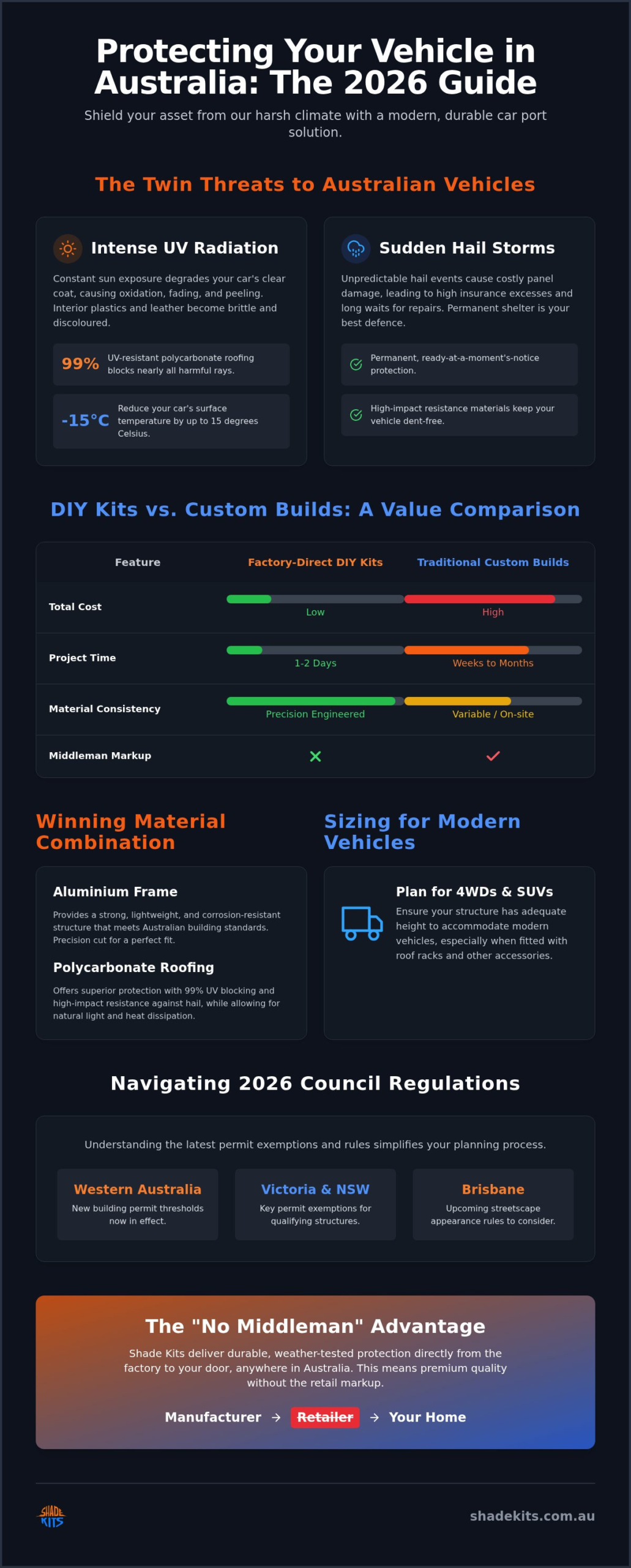
The intensity of the sun in our part of the world is notorious for its ability to degrade automotive finishes. Over time, constant UV radiation breaks down the chemical bonds in a vehicle’s clear coat, leading to oxidation, fading, and eventually peeling. It isn’t just the outside that suffers; interior plastics and leather trims often become brittle and discoloured when exposed to direct light through the windscreen. Parking under a quality shelter can reduce the surface temperature of your car by up to 15 degrees compared to being parked in the full sun. UV-resistant polycarbonate roofing is a durable, high-impact material engineered to block 99% of harmful rays while facilitating heat dissipation to keep the area underneath significantly cooler.
The 2026 storm season has already demonstrated that hail events are becoming more frequent and less predictable across the country. For many Australians, the cost of insurance excesses and the frustration of waiting weeks for panel beaters after a storm can be avoided with the right infrastructure. While temporary car covers offer some level of defence, they are often difficult to fit quickly when a storm is approaching. A structural car port provides the ultimate peace of mind because the protection is permanent and ready at a moment’s notice. For those who need specialized or foldable options, solutions like the CarCave offer high-impact resistance that bridges the gap between a standard kit and a heavy-duty shelter, ensuring your vehicle remains dent-free during the most severe weather events.
Choosing a car port usually involves a choice between hiring a local tradie for a custom build or opting for a factory-engineered kit. While custom construction used to be the default, the 2026 market has seen a massive shift towards DIY solutions. The primary reason is the total cost of ownership. When you hire a builder, you aren’t just paying for materials; you’re paying for their travel, their overheads, and their hourly labour rates, which can significantly inflate the final invoice.
Factory-direct kits disrupt this model by removing the middleman. By purchasing directly from the manufacturer, you secure high-grade materials that meet Australian building standards without the retail markup. Consistency is another major advantage. Every component in a kit is cut and drilled using precision machinery in a controlled environment. This eliminates the “on-site adjustments” that can lead to misaligned roofs or structural weaknesses in traditional timber builds.
Time is often the deciding factor for busy Australian families. A custom project can drag on for weeks as you wait for quotes, council approvals, and builder availability. In contrast, a well-organised DIY project can be completed over a single weekend. Once your kit arrives, the process is logical and methodical, allowing you to go from an empty driveway to a fully protected vehicle in a matter of hours.
Removing labour costs is the most effective way to lower your project’s price point. In 2026, many homeowners are using these savings to upgrade to premium features, such as high-impact polycarbonate roofing or larger double-car designs. Investing in a permanent structure also offers a high return on investment by boosting your property’s street appeal and functional footprint. For a detailed breakdown of current market rates, you can explore our Aluminium Carport Prices Australia Guide.
The modern DIY car port is designed for the average home handyman. You won’t need a shed full of specialised equipment. What tools are actually required? Most projects require only a few common household items:
Because the components are pre-drilled and pre-cut to exact specifications, the assembly feels more like a large-scale furniture project than a complex construction job. To ensure a seamless build, it’s vital to organise your site before the delivery truck arrives. Ensure your concrete slab or footings are level and clear of debris. Taking the time to prepare your foundation properly is the secret to a professional finish that lasts for decades. If you’re ready to start, you can browse our range of car port kits to find the right fit for your home.
Selecting the right materials for a car port is the difference between a structure that lasts decades and one that becomes a maintenance headache after just a few seasons. While timber has a traditional look, it’s prone to warping, rotting, and termite damage in the unpredictable Australian climate. Galvanised steel is another common option, but even with protective coatings, it can eventually succumb to rust, particularly if the surface is scratched during assembly or exposed to harsh coastal conditions. In 2026, aluminium and polycarbonate have become the industry standard for those seeking long-term resilience without constant upkeep.
Modern homeowners are moving away from high-maintenance materials in favour of “set and forget” solutions. This shift is driven by a desire for structural integrity that doesn’t require annual painting or chemical treatments. By choosing factory-engineered car port kits, you ensure that every component is designed to work together, providing a level of consistency that’s difficult to achieve with on-site timber construction. These materials don’t just look better for longer; they provide superior protection for your vehicle in environments that would quickly degrade traditional building products.
Aluminium is the superior choice for Australian car ports because of its natural resistance to corrosion. Unlike steel, aluminium doesn’t rust. When exposed to the atmosphere, it forms a microscopic oxide layer that acts as a self-protecting shield. This makes it the only logical choice for properties in coastal or high-humidity regions where salt air quickly destroys other metals. It’s a durable material that stays structurally sound for a lifetime.
The strength-to-weight ratio also makes aluminium perfect for the DIY market. The frames are light enough to be handled easily by two people during a weekend project, yet they’re strong enough to meet strict wind-load requirements. When finished with a high-quality powder coating, these frames offer a sleek, contemporary aesthetic that complements modern Australian architecture. You won’t have to worry about peeling paint or rust streaks ruining your home’s street appeal.
The roof of your shelter handles the most punishment from the elements. Modern polycarbonate is a high-performance polymer that’s virtually unbreakable, offering incredible impact resistance against the heavy hail stones that frequently strike our eastern states. Unlike metal sheeting, which can be incredibly noisy during rain and creates a dark, cave-like environment, polycarbonate allows natural light to pass through. It keeps the area underneath bright and usable for other tasks while still filtering out 99% of harmful UV radiation.
This balance of light transmission and heat block is essential for vehicle longevity. It ensures the cabin stays cool without needing a completely opaque roof that might darken your driveway or adjacent windows. These panels are also designed to handle heavy downpours and debris. Their smooth surface encourages rain to wash away dust and leaves, ensuring the structure remains clean with very little effort from the owner. Whether you’re in the tropical north or the temperate south, this combination of aluminium and polycarbonate provides a reliable, low-maintenance shield for your vehicle.
Determining the correct dimensions for your new structure is a pragmatic process that goes beyond simply measuring the length of your current vehicle. Many homeowners make the mistake of sizing for the car they drive today, only to find their space inadequate when they upgrade to a larger 4WD or a family SUV three years later. A well-planned car port should provide enough clearance for comfortable movement, future vehicle changes, and the various accessories that define the Australian lifestyle.
Aesthetic integration is equally vital for long-term property value. Your choice should feel like a natural extension of your home’s architecture rather than an afterthought. In 2026, streetscape regulations are becoming stricter, particularly in cities like Brisbane where double carports on narrow blocks are facing new approval hurdles. Selecting a design that complements your roofline and colour palette ensures your project meets both functional needs and local council expectations.
The most critical measurement is often overlooked: the “Door Opening Rule.” To exit your vehicle comfortably without dings or awkward gymnastics, you should allow at least 600mm to 800mm of clearance on both sides of the vehicle. For a single car port, this typically means a minimum width of 3 metres. If you’re planning a double car port, a width of 6 metres is the standard, though you should check your block width against local 2026 zoning laws before committing to a kit.
Height is the next frontier, especially for the modern adventurer. With many Australian 4WDs now featuring suspension lifts, roof racks, and even roof-mounted solar panels, a standard 2.1-metre clearance is often insufficient. Aiming for a 2.4-metre or even 2.7-metre entry height provides the peace of mind that your gear will clear the frame every time. For a deeper dive into sizing and site preparation, read The Ultimate Guide to DIY Carport Kits in Australia.
The roof style dictates both the look of the structure and how it handles the elements. Flat roof designs are the most popular choice for contemporary Australian homes because of their minimalist profile and cost-effective assembly. They provide a clean, modern finish that doesn’t distract from the main dwelling’s features. If you live in a high-rainfall area or own a more traditional home, a gable roof might be the better option. The pitched design offers superior water drainage and can be matched to the existing gables of your house for a seamless look.
For those dealing with tight driveways or limited footprint, cantilever designs are a game-changer. By using support posts on only one side, these structures maximise the usable space for manoeuvring vehicles. This “floating” aesthetic is highly sought after in 2026 for its premium, architectural feel. Regardless of the footprint you have available, you can find a car port kit that balances structural integrity with the specific dimensions of your property.
Shade Kits has become a preferred name for Australians looking to balance professional-grade protection with a manageable DIY experience. By cutting out the middleman, we provide factory-direct pricing that makes high-end materials accessible to everyone. Our focus is on long-term value, ensuring that every car port we deliver is capable of withstanding the extreme conditions of 2026. We don’t just supply kits; we provide a streamlined path to vehicle security that respects both your budget and your time.
We understand that getting these materials to your door is just as important as the quality of the kit itself. That’s why we offer reliable, Australia-wide delivery, ensuring your project stays on track regardless of your location. Whether you’re in a metropolitan hub or a regional area, our factory-direct model ensures you receive a premium product without the logistics-related markups often found at big-box retailers. By choosing a partner that understands the local climate and regulatory environment, you’re investing in protection that truly lasts.
Our range is designed around the principles of structural integrity and user-friendly assembly. We use high-grade aluminium because it offers the resilience needed for our climate while remaining light enough for a straightforward weekend project. Each kit features UV-resistant polycarbonate panels that filter out harmful rays while allowing natural light to illuminate your driveway. These aren’t just generic structures; they are precision-engineered kits tailored for the Australian landscape. You can browse our full Carport Kits collection to see how these designs can be customised to suit your specific property layout.
For many Australians, a permanent structure isn’t always an option. If you’re renting your home or live in a region where council approvals for Class 10a buildings are particularly restrictive, you need a flexible alternative. The CarCave is our revolutionary foldable solution that provides heavy-duty hail protection without the need for permanent footings. It’s an ideal secondary shield for households with multiple vehicles or for those who want the ultimate peace of mind during storm season.
One of the biggest advantages is the speed of setup. You can go from unboxing the unit to having your vehicle fully protected in just a few minutes. This makes it a practical choice for those who need immediate defence against sudden weather shifts without the commitment of a construction project. Explore the CarCave Foldable Protection to see why it’s become an essential tool for vehicle owners across the country who value both mobility and high-impact resistance.
Choosing the right car port in 2026 is a practical decision that pays dividends in both vehicle longevity and property value. Skip the expensive custom trades. Opting for a factory-engineered kit gives you access to premium materials designed specifically for Australian weather conditions. Durable aluminium frames and UV-resistant polycarbonate panels offer a “set and forget” solution that withstands record UV levels and unpredictable hail storms without the need for constant maintenance.
Success starts with accurate sizing for your current and future vehicles; particularly if you’re planning on a larger SUV or 4WD upgrade. Because we offer factory-direct pricing with no middleman, you can invest in high-quality structural integrity without the typical retail markup. Whether you need a permanent structure or the flexible protection of a foldable unit, the path to a professional result is simpler than you might think.
Browse Our Range of Factory-Direct Car Port Kits
Take the next step toward a more secure driveway today; your car’s paintwork and interior will thank you for it.
In most cases, you will need some form of council approval or certification, though specific exemptions apply across different states in 2026. For instance, in Victoria, a freestanding car port under 10 square metres generally doesn’t require a permit, while New South Wales often allows open-sided structures up to 25 square metres without approval if they sit behind the main building line. In Western Australia, recent 2026 changes mean a registered builder isn’t required for these projects if the value is under $50,000, but local council permits remain mandatory. Always check with your local council first as regulations vary significantly between local government areas.
A car port is often a better choice for daily drivers because the open-sided design provides constant natural ventilation, preventing the stifling heat build-up common in enclosed garages. While garages offer total security, they are significantly more expensive and time-consuming to build. A high-quality shelter provides the essential UV and hail protection your vehicle needs at a fraction of the cost and construction time of a permanent garage. It’s a pragmatic solution that shields your car’s paintwork while keeping the interior cabin much cooler on a hot summer day.
Most homeowners can complete the assembly of a DIY car port kit over a single weekend. Because the components are factory-engineered, pre-drilled, and pre-cut, the process is a logical sequence of steps rather than a complex construction project. If you have your site prepared and your footings or concrete slab ready before the kit arrives, you can go from an empty driveway to a fully protected vehicle in roughly 12 to 16 hours of active work. It’s a manageable project that delivers a professional result without the need for specialised trades.
Yes, a structural car port with high-impact polycarbonate roofing is designed to withstand heavy hail stones that would otherwise cause thousands of dollars in panel damage. This material is virtually unbreakable and serves as a permanent shield, giving you peace of mind during the unpredictable storm seasons we’ve seen throughout 2026. For those who can’t build a permanent structure, specialised foldable options like the CarCave also offer significant hail defence for temporary or secondary use. Investing in this protection is a smart way to avoid costly insurance excesses and the frustration of long repair wait times.
Aluminium is the superior material for coastal regions because it naturally resists corrosion and won’t rust when exposed to salt air. Unlike galvanised steel, which can eventually succumb to the elements if the coating is compromised, aluminium forms a protective oxide layer that keeps the structure sound for decades. This makes it a “set and forget” choice for properties near the ocean where high humidity and salt spray would quickly degrade timber or inferior metals. When finished with a high-quality powder coating, an aluminium frame stays looking new with almost zero effort.
While the assembly process is straightforward, we strongly recommend having at least one partner to help with the installation. Handling long aluminium beams and securing roof panels is much safer and more efficient with two people, especially when using ladders. Having a second set of hands ensures that components stay level and aligned during the fastening process, which is critical for the long-term structural integrity and professional finish of your kit. Most of the work is manageable, but that extra help makes the weekend project run much more smoothly.
Maintaining an aluminium structure is remarkably simple and requires very little effort throughout the year. You don’t need to worry about painting, staining, or termite treatments like you would with a timber build. A quick wash with a garden hose every few months is usually enough to remove dust, salt spray, or debris from the frame and polycarbonate roofing. This ensures the gutters stay clear and the powder-coated finish remains vibrant for the life of the structure. It’s the ultimate low-maintenance solution for busy Australian homeowners.
Adding a well-designed car port can significantly increase your property value by improving both street appeal and functional land use. In the 2026 real estate market, buyers prioritise homes with dedicated, weather-protected vehicle storage. A stylish, permanent structure that complements your home’s architecture demonstrates that the property has been well-maintained and offers a practical solution that many modern families consider a “must-have” feature when searching for a new home. It’s a cost-effective upgrade that delivers a high return on investment when it’s time to sell.