
Why should you pay a premium for a custom builder when the same structural integrity is available in a box? It is a common dilemma for Australian homeowners who want to protect their vehicles from punishing UV rays and sudden hail but find themselves staring at quotes often exceeding A$15,000. We understand the frustration of navigating confusing council permits and the fear that a cheaper structure might buckle or rust during a coastal storm. You want a reliable solution that adds genuine value to your property without the professional price tag.
This 2026 guide is designed to help you identify the best freestanding carport kits australia has to offer. We will show you how to select a durable, rust-proof aluminium structure that transforms a complex construction job into a manageable weekend project. We will cover the essential technical details, including wind ratings and material longevity, to ensure your new carport stands up to local conditions. From understanding permit exemptions to mastering the assembly process, you are about to learn how to achieve professional results on your own terms while securing your car against the elements.
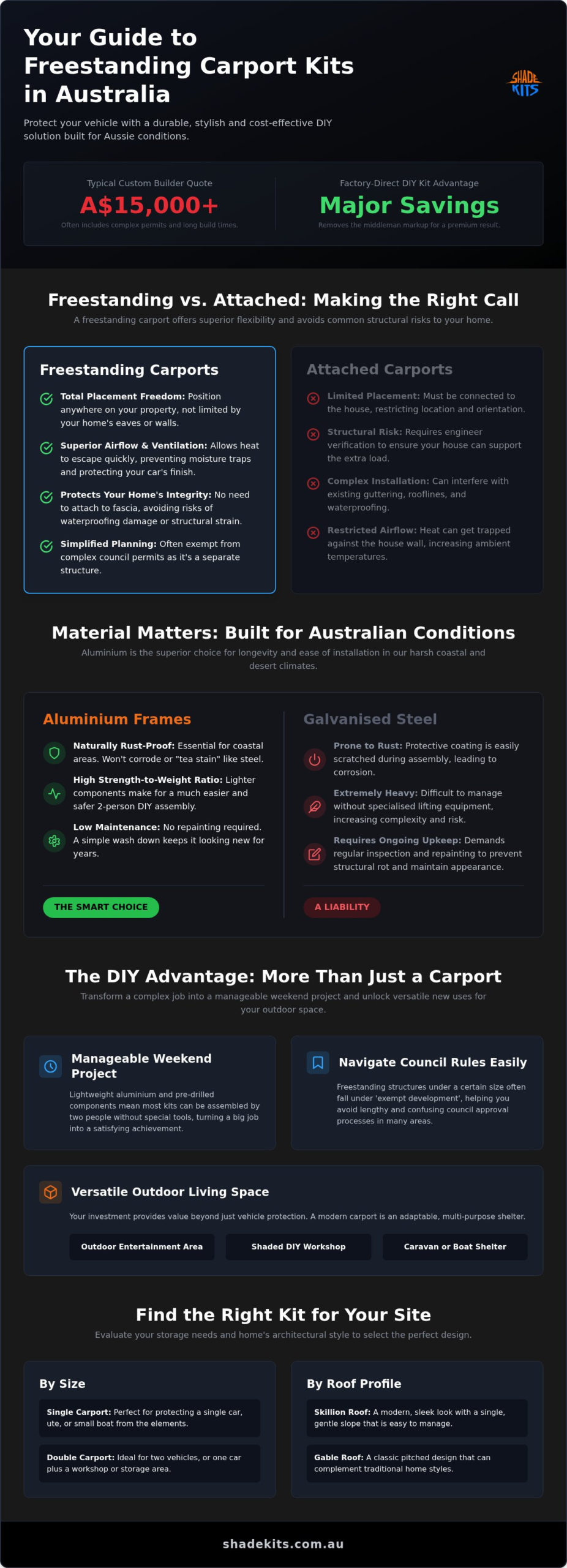
Choosing a standalone structure is often a strategic decision rather than just a budget one. Homeowners often find that the flexibility of placement is the biggest drawcard. You aren’t limited by the height of your existing eaves or the structural capacity of your house walls. When browsing the range of freestanding carport kits australia has available, you’ll notice that the lack of attachment points actually opens up more design possibilities. You can position the shelter exactly where your driveway naturally ends or in a corner of the block that otherwise goes unused.
This independence from the main building also promotes superior airflow. A well-ventilated carport allows heat to escape quickly, which is vital during an Australian summer when internal vehicle temperatures can soar. Constant natural ventilation prevents the moisture traps often found in enclosed garages. This helps protect your vehicle’s paintwork and mechanical components from the humidity-driven corrosion common in our coastal regions.
Deciding between an attached or freestanding model usually comes down to the existing architecture of your home. Freestanding kits simplify the planning process significantly because they don’t require a structural engineer to verify if your house fascia can support the extra weight. This avoids the risk of damaging your home’s waterproofing or structural integrity during installation. These kits are particularly effective for properties with long driveways or where the ideal storage spot is at the rear of the block. They offer a cleaner aesthetic, as you don’t have to worry about clashing with complex roof pitches or existing gutter systems.
Modern designs have moved far beyond simple vehicle shelter. Because these structures are standalone, they double as excellent outdoor entertainment areas for weekend barbecues. When the car is out, you have a ready-made patio or a shaded workshop for DIY projects. The modular nature of high-quality carport kits means they can be adapted for taller vehicles like caravans or boats by choosing specific leg heights. If your needs change in the future, a freestanding structure is far easier to relocate or expand than a permanent extension attached to your home. This adaptability ensures your investment provides long-term value regardless of how your lifestyle evolves.
While galvanised steel has traditionally been the default for heavy outdoor structures, the shift toward aluminium in freestanding carport kits australia wide represents a significant win for the home handyman. The primary challenge in our climate isn’t just the heat; it’s the salt air and humidity that can turn a steel structure into a rusted liability within a decade. Aluminium is naturally resistant to corrosion. This makes it an essential choice for the millions of Australians living within 50 kilometres of the coast. You won’t need to worry about the “tea staining” or structural rot that often plagues steel when the protective coating is scratched during assembly.
Maintaining your structure shouldn’t become a second job. Aluminium frames require almost zero upkeep compared to timber or steel. There is no need for regular repainting or toxic termite treatments. A simple wash down with a hose once or twice a year is usually enough to keep the frame looking new. This long-term durability ensures that your investment continues to add value to your property without demanding ongoing maintenance costs. You can explore how these materials come together by browsing our aluminium carport kits to find a style that suits your home.
The strength-to-weight ratio of aluminium is its greatest asset during a weekend build. Because the beams are significantly lighter than their steel counterparts, you can often manage the assembly with just two people. This reduces the risk of injury and eliminates the need for specialized lifting equipment. Precision engineering in factory-direct kits ensures a “perfect fit” during assembly. Every component is pre-cut and drilled, which removes the guesswork and the frustration of misaligned bolt holes. Choosing a kit that aligns with exempt development standards is much simpler when you are working with a lightweight, modular system designed for predictability.
Selecting the right roof is about balancing protection with comfort. While metal sheeting provides total shade, it also traps heat and can turn the area beneath it into an oven. High-quality polycarbonate roofing is a superior alternative for our conditions. It blocks 99% of harmful UV rays, protecting your car’s paintwork and interior from sun damage, while still allowing natural light to filter through. This creates a bright, airy space rather than a dark tunnel. Modern polycarbonate is also engineered for high impact resistance. It is designed to withstand the heavy hailstorms that frequently sweep across the eastern seaboard, providing a reliable shield for your vehicle when the weather turns volatile.
Finding the right fit for your property involves more than just measuring the width of your vehicle. You need to consider the functional footprint of the entire structure. When evaluating freestanding carport kits australia wide, many owners forget to account for the turning circle required to enter the space comfortably. A standard single carport is typically 3m x 6m, while a double measures 6m x 6m. However, if your driveway has a sharp approach, you may need a wider span to avoid clipping the posts during entry. Always leave at least 500mm of clearance on either side of your vehicle’s mirrors. This ensures you can open doors fully without hitting the frame or feeling cramped.
Height is another critical factor that is often overlooked until the kit arrives. If you drive a modern 4WD equipped with a lift kit or a permanent roof rack, a standard clearance might not suffice. Similarly, if you plan to store a caravan or a boat, you’ll need to select a kit with extended leg heights. Most high-quality kits offer adjustable options, but it’s vital to confirm these measurements before ordering. A structure that is too low for your largest asset is a costly mistake. Check your vehicle’s peak height, including any accessories, and add a safety margin of 100mm to 200mm for total peace of mind.
The skillion or flat-roof design has become the go-to choice for contemporary Australian homes. Its minimalist profile doesn’t compete with your home’s existing roofline, making it an unobtrusive addition to the yard. Selecting from the best freestanding carport kits australia has available means matching the roof pitch to your environment. Skillion designs are incredibly pragmatic; they are generally simpler to assemble than pitched roofs and feature integrated guttering systems that manage water runoff efficiently.
If your block allows for the extra width, investing in a double carport is a strategic move for long-term property value. It offers better cost-efficiency per square metre and provides the flexibility to park vehicles side-by-side comfortably. These wider spans require robust structural engineering. Ensure your chosen kit is rated for the specific wind conditions of your region to maintain long-term stability and safety during storm season.
Building your own vehicle shelter is a rewarding way to save on labour costs, which can range from A$800 to A$2,500 for professional installation. Most high-quality freestanding carport kits australia wide are designed for two people to complete over a single weekend. Success depends on preparation. Before the delivery truck arrives, ensure you have a clear workspace and the basic tools required; a cordless drill, level, ladder, and socket set are usually sufficient. Having your tools organised prevents mid-build frustration and keeps the project on track. It’s about working smarter, not harder.
Council requirements vary significantly across the country. In New South Wales, for example, a carport under 20 square metres might be considered an “exempt development” if it meets specific height and setback criteria. In contrast, Victorian regulations often require a building permit regardless of the structure’s size. Choosing factory-engineered kits simplifies this administrative hurdle because they arrive with certified plans that local councils recognise. These documents prove the structure’s integrity and wind rating, which is much faster than getting a custom timber build approved. Always check your local council’s website first to confirm whether you need a formal permit or a simple notification before purchasing one of the many freestanding carport kits australia offers today.
A stable carport starts with a level foundation. You have two primary choices: a full concrete slab or concrete piers. A slab is ideal if you want a clean, finished floor for your vehicle, though it requires more intensive ground preparation and curing time. Concrete piers are often faster and more cost-effective for freestanding structures, especially if you’re working on slightly sloped ground. Regardless of the footing type, you must mark out the site with string lines to check for squareness. Proper drainage is also vital. The ground should fall away from the structure to prevent water pooling around the base of the posts, which ensures the longevity of your foundation.
Ready to start your home improvement project? You can view our range of DIY carport kits to find a model that fits your specific site requirements and council guidelines.
Shade Kits operates on a factory-direct model. This approach ensures you receive high-grade materials without the middleman markup that typically inflates retail prices. We focus on providing professional-grade freestanding carport kits australia wide, designed specifically for our unique environmental challenges. Whether you are facing the tropical deluges of the north or the intense, dry heat of the inland, our aluminium frames and UV-resistant polycarbonate roofing are engineered to remain stable and rust-free. We remove the complexity of traditional construction by delivering a complete solution directly to your door.
We understand that the transition from a flat-pack kit to a completed structure can seem daunting. That’s why we prioritise comprehensive instructions and accessible support for the confident DIYer. Our kits are precision-cut to ensure that everything lines up correctly the first time. You get the benefit of a structure that meets high engineering standards without the need for specialised tools or years of building experience. It is about empowering you to achieve a professional result on your own weekend schedule.
Not every property is suitable for a permanent installation. If you are currently renting or your local council has particularly restrictive regulations, a traditional build might be out of reach. The CarCave offers a flexible alternative that fills this gap perfectly. It is a foldable, non-permanent solution that provides essential hail protection and UV shielding without the need for council permits or concrete footings. The DIY setup is fast and intuitive, making it ideal for those who need immediate protection that can be moved or stored away if necessary. It effectively guards your vehicle against sun damage, heavy rain, and bird droppings with minimal fuss.
Adding a high-quality aluminium carport kit to your home is a proven way to increase property value. Buyers in Australia prioritise vehicle protection, and a stylish, durable structure can significantly boost your home’s resale appeal. Choosing between the various freestanding carport kits australia has on the market comes down to balancing durability with ease of use. When you evaluate the cost of DIY aluminium kits against the price of custom-built steel alternatives, the financial benefits are obvious. You save thousands on installation labour while securing a structure that won’t rust, warp, or require constant repainting. Factory-direct quality control means every component is inspected to meet our rigorous standards, giving you long-term peace of mind.
Protecting your car from unpredictable Australian elements doesn’t have to be a complex or overpriced ordeal. By choosing high-quality freestanding carport kits australia, homeowners can secure a durable, rust-proof aluminium structure that stands up to coastal salt and intense UV rays for years. We’ve explored how factory-direct models remove unnecessary costs while providing the engineering precision needed for a straightforward weekend assembly. Whether you need a permanent double carport to future-proof your property or a flexible CarCave for immediate hail protection, the right kit provides a functional asset that adds genuine value to your home.
It’s time to move from planning to action. You can browse our range of premium carport kits to find the perfect fit for your site. With factory-direct pricing, rust-proof aluminium construction, and Australia-wide shipping, you get a premium result without the middleman markup. You have the knowledge to navigate council permits and site preparation with confidence. Now, you can look forward to a cooler vehicle and a more functional backyard. Start your project today and enjoy the peace of mind that comes with professional-grade protection.
Council approval is generally required for most permanent structures, though specific standards for exempt development apply in some states. For example, in New South Wales, a carport under 20 square metres may not need a permit if it meets height and setback criteria. Queensland and Victoria typically require building permits for any permanent structure. You should always contact your local council to verify the specific regulations for freestanding carport kits australia in your local area before starting.
Most homeowners can successfully install these kits with the help of one other person. The components are factory-engineered and pre-drilled for precision, which removes much of the difficulty found in traditional construction. You will need basic tools like a drill, level, and ladder. If you aren’t comfortable with structural work or working at heights, hiring a local qualified builder to assemble the kit for you is a practical and safe alternative.
You should expect the assembly of a standard kit to take approximately one to two days. This timeframe assumes that your site preparation, such as a concrete slab or piers, is already completed and cured. Most DIY builders find they can finish a single or double carport over a single weekend. Having a second person to assist with lifting the beams into place is essential for safety and to keep the project moving efficiently.
The main difference lies in weight and corrosion resistance. Aluminium is significantly lighter than steel, making it easier to handle during DIY assembly; it also won’t rust in coastal environments. While steel provides high strength for very large industrial spans, it requires regular maintenance to protect against corrosion. Aluminium offers a low-maintenance, long-term solution that is perfectly suited to the majority of residential freestanding carport kits australia applications.
High-quality kits are specifically engineered to meet Australian wind ratings and impact standards. The polycarbonate roofing used in many modern kits is designed with high impact resistance to withstand heavy hailstorms that would dent traditional metal sheeting. It’s vital to ensure the kit you choose is rated for the specific wind zone of your property, especially if you live in a northern or cyclone-prone region of the country.
Aluminium requires very little upkeep compared to timber or steel. You won’t need to worry about repainting, staining, or termite treatments. To keep the structure looking its best, we recommend a simple wash down with a garden hose once or twice a year. This removes salt spray, dust, and organic debris that can accumulate over time. This minimal maintenance is a major reason why aluminium is a preferred material for long-term outdoor use.
You can install a kit on an existing driveway if the concrete is structurally sound and thick enough to support the load. Most kits can be secured using heavy-duty base plates and masonry anchors directly into the concrete. If your driveway is thin or cracked, you might need to cut out sections and pour deeper concrete footings for the posts. A quick check of your slab’s depth will help you decide the best mounting method.
We offer delivery to most residential and commercial addresses across the country. Our logistics network is set up to handle large, heavy flat-pack kits efficiently. Whether you’re in a metropolitan centre or a regional area, your kit will be shipped with all components secured for transport. We recommend having a clear space ready for the delivery truck to unload the components safely so you can begin your project without delay.