
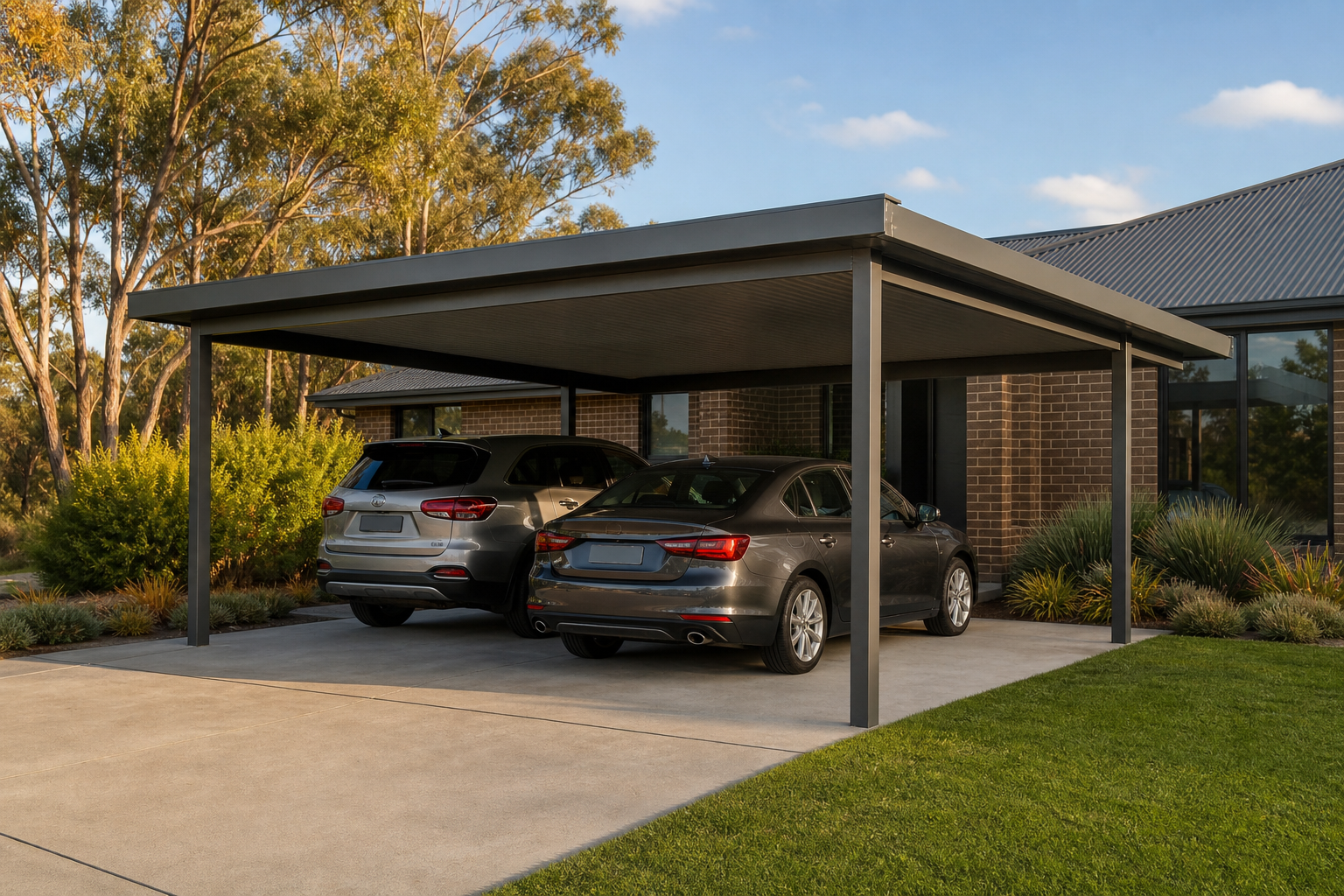

Building your first carport can feel overwhelming – not because the physical work is complicated, but because the compliance side seems like a maze of wind ratings, council forms and engineering certificates. If you have been staring at browser tabs full of conflicting advice, take a breath. This guide is written specifically for first-time buyers who want to get it right the first time, without overpaying or ending up on the wrong side of their local council.
Below, we compare aluminium versus steel kits head to head, unpack exactly what compliance involves in each Australian state, and walk you through everything that ships inside a Shade Kits aluminium carport kit – so there are no surprises on build day.
If you are comparing aluminium and steel kits side by side, the decision often comes down to four factors: weight, corrosion resistance, maintenance and long-term value. Steel kits can be cheaper upfront, but that gap narrows quickly once you factor in the cost of anti-rust treatments, repainting every few years, and the extra labour needed to lift heavier sections into place without a crane or bobcat.
Aluminium is naturally resistant to corrosion. It forms a protective oxide layer the moment it is exposed to air, which means salt spray, humidity and coastal fog will not eat through your frame the way they attack untreated or poorly galvanised steel. For homes within five kilometres of the ocean – or anywhere in tropical and subtropical Queensland, the Top End, or coastal WA – this is not a nice-to-have; it is essential.
| Feature | Aluminium Kit | Steel Kit |
|---|---|---|
| Weight (approx. per lineal metre of beam) | Roughly 40-50% lighter | Heavier – often needs extra hands or equipment |
| Corrosion resistance | Naturally oxide-protected; ideal for coastal and humid zones | Requires galvanising or ongoing paint maintenance |
| Maintenance | Occasional hose-down | Inspect for rust; repaint every 3-5 years in harsh climates |
| DIY friendliness | Two people can comfortably handle beams | May need three or more people for longer spans |
| Colour options | Powder-coated to match Colorbond range | Colorbond roofing available; frame colour may be limited |
The lighter weight of aluminium is a genuine game-changer for DIY builds. You can manoeuvre a 6-metre beam with one helper instead of hiring extra labour, which saves money and makes the entire weekend build far less stressful.
CTA: Compare our full aluminium carport range and see why first-time builders choose corrosion-proof over cut-price.
Before you look at sizes or prices, the first real decision is how your carport connects (or does not connect) to your house. Each option has different structural, aesthetic and compliance implications – and understanding them now will save you headaches at the council stage.
A freestanding carport sits independently on its own posts, with no attachment to your home. This is the simplest option from a structural standpoint because you are not modifying an existing building. Many councils view freestanding structures more favourably when it comes to exempt development thresholds (more on that below). They are also ideal for properties where the house wall is not suitable for attachment – for example, weatherboard homes or walls without adequate structural framing behind the cladding.
An attached carport ties into your existing fascia or wall via a ledger beam. This creates a seamless look and often uses fewer posts, but it does require the host wall to be structurally sound. Your engineering certificate will specify the connection method and load transfer, which is a critical detail for council approval.
A flyover design raises the roofline above your existing gutterline, creating a gap that allows hot air to escape and improves airflow. It is particularly popular in Queensland and northern NSW where heat buildup under a flat attached roof can be intense. Flyover kits use taller posts on the house side to achieve the height difference.
Not sure which suits your block? Book a free 5-minute check-measure call and our team will walk you through layout options based on your property photos.
One of the most common frustrations for first-time carport buyers is the lack of transparent pricing. You request a quote, wait days, and then receive a number with no context. At Shade Kits, we believe you should be able to compare sizes and ballpark costs before you even pick up the phone.
| Configuration | Common Size | Typical Use |
|---|---|---|
| Single carport | 3m x 6m | One car, ute or trailer |
| Double carport | 6m x 6m | Two vehicles side by side |
| Caravan / boat | 4m x 9m (custom height 3.5m+) | Tall vehicles, boats on trailers |
| Custom | Any dimension to suit | Odd-shaped blocks, multi-vehicle setups |
Pricing depends on your wind region, chosen colour, roof type (single-skin or insulated) and whether you need a freestanding or attached configuration. Use the online configurator to generate an instant quote tailored to your postcode and preferences.
CTA: Build my aluminium carport kit now – enter your dimensions, colour and postcode for an instant price.
The phrase DIY kit means different things to different suppliers. Some ship you a box of raw extrusions and wish you luck. Others include everything down to the last tek screw. Here is what a Shade Kits aluminium carport kit includes:
What is not included: concrete for footings, electrical wiring (if adding lights), stormwater plumbing, and any site-specific items like retaining walls or ground preparation. These are standard exclusions across the industry, but we mention them upfront so you can budget accordingly.
CTA: Email me a full bill of materials for your chosen size and configuration.
This is the section that makes most newcomers nervous, so let us break it down plainly. Australian Standard AS/NZS 1170.2 divides the country into wind regions labelled A, B, C and D. Regions A and B cover most inland and metropolitan areas. Regions C and D are cyclonic zones found primarily in northern Queensland, the Top End, and parts of the WA coastline.
Your wind region determines the engineering loads your carport must withstand. A kit engineered for Region A will not be compliant in a Region C location – the posts, beams, footings and connections all need to be rated higher. This is not optional; it is a structural safety requirement and councils will reject applications that do not match.
Every Shade Kits aluminium carport is supplied with engineering documentation specific to your postcode and wind region. When you enter your postcode in our configurator, the system automatically selects the correct engineering tier. You do not need to interpret wind maps or guess – we handle it. Check your wind region here.
If you are in a cyclonic area (Regions C or D), our kits are available with upgraded connections, thicker-walled posts and cyclone-rated fixings. We recommend discussing your specific site with our team to ensure every detail is covered.
CTA: Request engineering documentation for my postcode – free with every quote.
One underrated advantage of aluminium kits is how well powder-coated aluminium holds its colour over time. Unlike painted steel, powder coating on aluminium does not bubble, flake or chalk as rapidly in UV-heavy Australian conditions.
Shade Kits offers a range of colours designed to match popular Colorbond shades including Monument, Surfmist, Woodland Grey, Basalt, Pale Eucalypt, Dune, Paperbark, Manor Red and Classic Cream. If you are matching an existing roof, fence or garage door, simply tell us the Colorbond colour name when you order.
Consistent colour across your property is not just an aesthetic win – it can also influence resale value. Real estate agents consistently note that cohesive exterior finishes make a strong first impression with buyers.
CTA: Browse colour swatches and order samples before you commit.
Here is the truth about council approval: it is not as scary as forums and Facebook groups make it seem. In many cases, a carport under a certain size qualifies as exempt or complying development, meaning you either do not need a full DA or you can use a fast-track private certifier. The rules vary by state, so here is a high-level overview:
We strongly recommend confirming requirements with your specific local council before you build. Rules can change, and overlay zones (heritage, bushfire, flood) can alter what is otherwise exempt. Download our state-by-state council approval cheat sheets for a detailed starting point.
Every Shade Kits order includes engineering documentation formatted for council or certifier submission – plans, elevations, member schedules and wind load computations. This is the paperwork that typically costs $500-$1,500 if you commission it separately from a structural engineer.
CTA: Download my state’s council approval guide (free PDF).
A common question from first-time builders is: can I actually do this myself? The answer is yes, provided you are comfortable using basic power tools and can recruit one helper for beam lifting. Here is a realistic breakdown:
A single 3m x 6m carport typically takes a confident DIYer and one helper around 8-12 hours across a weekend – roughly half a day for footings (plus curing time) and one day for frame and roofing. A double 6m x 6m structure adds approximately 4-6 hours. These estimates assume footings are poured and cured before frame assembly begins.
If your slab already exists, you can use post anchors bolted into the concrete using chemical anchor bolts. Your engineering documentation will specify minimum slab thickness and anchor requirements. Watch our step-by-step install videos to see the full process before you start.
CTA: Download the full installation guide (PDF) and watch the video walkthrough.
Shade Kits delivers aluminium carport kits Australia-wide. Standard lead times are approximately 7-10 business days for popular configurations. Custom sizes or non-standard colours may take slightly longer – your order confirmation will include a specific dispatch date.
Kits are palletised and shipped via trusted freight partners. Metro deliveries across Sydney, Melbourne, Brisbane, Perth, Adelaide, Hobart, Canberra and Darwin typically arrive within 3-5 business days of dispatch. Regional and remote postcodes may attract a surcharge – enter your postcode in our delivery calculator for a transparent freight quote before you commit.
Depot pickup is available in selected locations if you prefer to collect and save on freight costs.
CTA: Check delivery cost and ETA to my postcode.
Once your base carport is up, you can extend its functionality with add-ons that bolt directly onto the aluminium frame:
Planning for upgrades now is far cheaper than retrofitting later. Even if you do not add solar panels today, ordering solar-ready beams at the kit stage costs a fraction of replacing standard beams down the track.
CTA: Ask about upgrade options when you request your quote.
Nothing builds confidence like seeing finished projects from people who were in your shoes a few weeks ago. Our customer gallery features before-and-after photos from first-time builders across every state – suburban driveways in Melbourne, coastal properties in the Sunshine Coast, rural acreage in the Hunter Valley and everything in between.
Many of these customers had the same concerns you might have right now: will I get the permits sorted, can I really build this myself, will it look professional? Browse their results and judge for yourself.
CTA: See customer photos and reviews.
If you have read this far, you are clearly serious about getting your carport right. The fastest way to move forward is to jump into our online configurator, enter your dimensions, colour preference and postcode, and receive an instant price with engineering included. No waiting, no pushy sales calls.
Prefer to talk it through first? Book a free 5-minute check-measure call and our team will review your site photos, confirm your wind region and walk you through the permit process for your council area.
You can also apply for a trade account if you are a builder, installer or property developer looking for volume pricing.