
Why would you commit to an A$40,000 permanent garage build when the next severe storm cell is already forming off the coast? If you’ve ever spent a summer afternoon frantically throwing old blankets over your bonnet, you know that basic fabric covers simply don’t cut it against heavy hail. Finding a high-quality foldable car shelter Australia can rely on used to be a significant challenge, often leaving vehicle owners stuck between expensive renovations or risking their paintwork to the harsh elements.
We understand that you want to protect your investment without the stress of council approvals or the high cost of a custom builder. This guide introduces you to the Car Cave, a professional-grade solution designed to shield your vehicle from intense UV exposure and impact damage. You’ll discover how these foldable kits provide a secure, all-weather environment that’s easy to operate and completely relocatable. We will break down the structural integrity of these units and show you how to achieve total peace of mind before the next storm season hits your suburb.
A Car Cave is a specialised, semi-permanent solution designed for vehicle owners who need more than a simple fabric cover but don’t want the commitment of a permanent build. While the traditional definition of what a carport is usually involves a fixed structure with a roof and open sides, the Car Cave reimagines this concept for the modern driveway. It utilises an accordion-style frame that completely encloses the vehicle, providing 360-degree protection from hail, bird droppings, and intense UV radiation. This foldable car shelter Australia residents are increasingly adopting is engineered for rapid deployment, making it ideal for those who need high-level protection without the administrative headache of council approvals.
Standard car covers often fall short when a heavy hailstorm hits. They are difficult to fit, can scratch your paintwork if dust is trapped underneath, and offer almost zero impact resistance against large hail stones. The Car Cave solves these issues with a “drive-in, fold-over” system that removes the struggle of wrestling with heavy fabric. It is a practical choice for homes with limited driveway space or for renters who aren’t permitted to make permanent changes to a property. Because it isn’t a fixed structure, it provides a flexible shield that can be packed down or moved if your circumstances change. It’s about having garage-level security without the garage-level price tag.
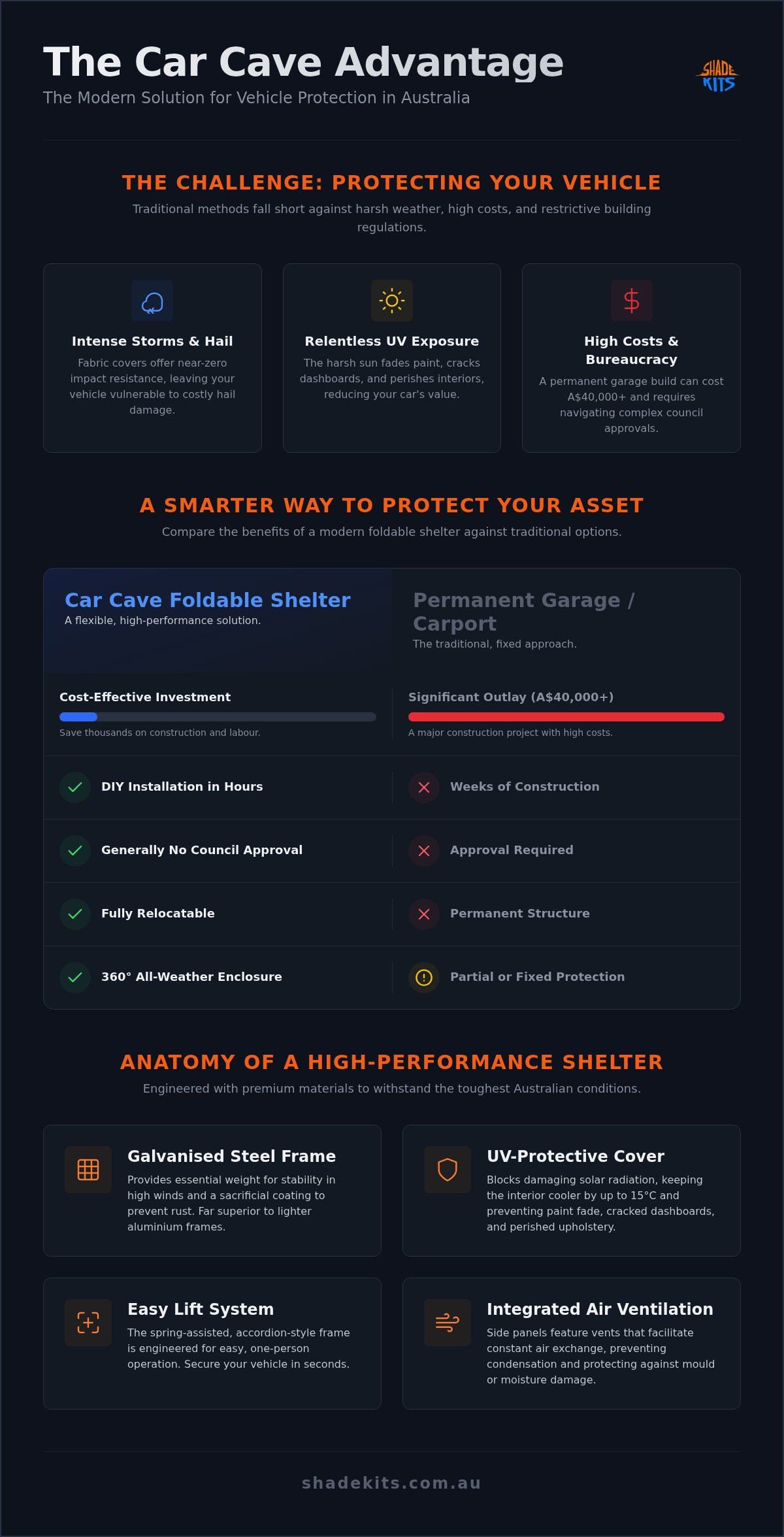
The structural integrity of a Car Cave depends entirely on the quality of its materials. A professional-grade kit features a heavy-duty galvanised steel frame. This is vital for resisting rust, especially in coastal areas where salt air can quickly degrade inferior metals. The cover itself is typically made from high-denier, UV-treated fabric or polycarbonate options to withstand the relentless Australian sun. To make daily use manageable, these kits include a spring-assisted lift system. This allows for easy, one-person operation, so you can secure your vehicle in seconds without needing a second set of hands. Every component is selected to ensure the unit remains stable during wind gusts while remaining light enough to operate manually. This balance of strength and simplicity is what defines a high-performance foldable car shelter Australia can rely on year-round.
To understand why a high-quality foldable car shelter Australia performs so well, we need to look closely at its construction. Unlike flimsy temporary tents, a professional Car Cave is built to endure the extreme shifts of the Australian climate. Every component, from the base plates to the peak of the roof, serves a specific protective purpose. Because these units are classified as non-permanent, they offer a unique loophole for homeowners. When considering the legalities of your setup, it’s always wise to check with your local council or state/territory planning authority regarding temporary structures. These solutions are often designed to bypass the need for traditional building permits, offering homeowners a flexible option.
The frame is the backbone of your shelter. While aluminium is light, it often lacks the sheer mass required to remain stable during sudden, gusty winds or intense weather conditions. We use heavy-duty galvanised steel because it provides superior structural integrity and essential weight. This weight ensures the unit stays grounded while the galvanised coating acts as a sacrificial layer against corrosion. This is particularly vital in coastal regions where salt air can destroy untreated metal in a single season. Balancing this strength with DIY ease is achieved through precision engineering, allowing you to assemble a rigid, rust-resistant skeleton without needing specialised trade tools.
The relentless sun is often more damaging than the rain. A high-performance kit acts as a thermal barrier, capable of reducing interior cabin temperatures by up to 15 degrees during a typical Australian heatwave. This prevents the “sun-baking” effect that causes dashboards to crack and leather seats to perish. Under 2026 standards, UV-stabilisation involves the molecular bonding of light-absorbing inhibitors into the fabric coating to prevent long-term polymer degradation and brittleness. By blocking out high percentages of solar radiation, the Car Cave ensures your vehicle’s clear coat remains intact for years longer than a car left in the open.
Airflow is the final piece of the puzzle. Integrated ventilation systems are built into the side panels to facilitate constant air exchange. This is a critical feature because it prevents the build-up of condensation, which can lead to mould growth on your car’s paintwork or interior. To ensure a perfect park every time, these kits also feature vehicle positioning stops and integrated locking points. These small but significant details provide the security and peace of mind you’d expect from a traditional garage. If you are ready to upgrade your driveway, you can view the full range of engineered kits to find the right fit for your vehicle.
Choosing between a permanent structure and a foldable car shelter Australia residents often find themselves weighing up the balance between long-term property value and immediate, flexible protection. A permanent single garage in Australia can cost between A$20,000 and A$40,000, which is a significant investment that requires council approval and weeks of construction. In contrast, a Car Cave kit provides professional-level security at a fraction of that cost. Because these kits are classified as temporary or non-permanent structures, they typically bypass the need for building permits, allowing you to secure your vehicle on the same day your kit arrives.
A permanent carport kit is often the ideal choice for long-term homeowners who want to add tangible resale value to their property. If you plan to stay in your home for the next decade or more, a fixed structure provides a sleek, integrated look that matches your house’s architecture. These kits are particularly effective for multi-car households that need to cover several large utes or SUVs under a single, wide-span roof. For those looking for a permanent addition, we recommend reading The Ultimate Guide to DIY Carport Kits in Australia (2026) to understand the structural requirements for fixed builds.
The Car Cave excels in scenarios where a traditional build is either impossible or impractical. If you are currently renting, you can’t exactly pour a concrete slab and bolt down a permanent structure. A foldable car shelter Australia-wide delivery makes it possible to protect your high-value assets, such as a classic car or a brand-new ute, and then simply pack the unit up and take it with you when you move. It is also the smartest option for homes with narrow driveways where the support posts of a traditional carport would block access to the side of the house.
Beyond the logistical advantages, the Car Cave offers a unique “trampoline effect” for hail defence. While large hail stones can dent rigid metal roof sheets on a permanent carport, the tensioned fabric of a foldable shelter absorbs the impact energy and bounces the stones away. This reduces the risk of noise and structural damage during a severe storm. Installation is another major factor. While a permanent kit might take a full weekend and a team of helpers, a Car Cave can be fully operational in just a few hours. This makes it the most pragmatic solution for those who need reliable vehicle protection without the long-term commitment of a construction project.
Successful installation begins with a clear, level site. You need enough space not just for the vehicle, but for the full folding arc of the frame as it opens and closes. Before you start unboxing your foldable car shelter Australia kit, ensure the ground is stable and free of debris. A concrete driveway is the gold standard for stability, but the system can work on other surfaces if they are properly prepared. Once you’ve cleared the area, lay out all frame components in an organised fashion. This prevents the frustration of searching for a specific bolt or bracket while you are in the middle of the build.
The “First Fold” test is the most critical part of the assembly process. Before you fully tighten every anchor point, cycle the frame through its full range of movement. This allows you to check for any binding in the pivot points and ensures the fabric has the correct tension across the entire structure. If the alignment is off by even a few centimetres, the frame can twist, which puts unnecessary strain on the spring-assisted lift system. Taking ten minutes to verify alignment now will save hours of adjustments later.
Australia’s storm seasons often bring sudden, high-intensity wind gusts that test the limits of any non-permanent structure. To prevent uplift, we recommend securing the base plates to a concrete driveway using heavy-duty dyna-bolts. These provide the mechanical grip necessary to keep the unit grounded when wind pressure builds under the canopy. If you are installing on pavers or bitumen, you might need to consider longer ground anchors or specialised fixings to ensure stability without causing permanent damage to the surface. In high-wind areas, additional ground-fixing points are a sensible precaution to ensure your vehicle remains shielded during the worst of the weather.
A regular maintenance routine ensures your investment remains in peak condition for years. Salt spray, fine red dust, and acidic bird droppings can degrade even the highest quality UV-treated fabrics if left to sit. A simple wash with mild soap and water every few months is usually enough to keep the canopy looking new. You should also inspect the pivot points annually; a quick application of a silicone-based lubricant keeps the folding mechanism smooth and silent. For more detailed tips on keeping your structure in peak condition, check out our Quick Guide to Carport Maintenance and Care.
If you’re ready to start your project, you can order your factory-direct Car Cave kit today and have your vehicle protected before the next storm cell arrives.
Shade Kits has built a reputation by removing the unnecessary costs associated with traditional retail showrooms. By operating on a factory-direct model, we ensure that every dollar you spend goes directly into the quality of the materials rather than middleman markups. This approach allows us to provide a high-performance foldable car shelter Australia residents can rely on at a price point that remains accessible for the average family. Our kits are not generic imports. They are specifically engineered for the Outback. We test our components against the harshest Australian UV levels and extreme storm conditions to ensure that the galvanised steel and high-denier fabrics perform when the sky turns dark.
Logistics shouldn’t be a barrier to protecting your vehicle. We offer nationwide delivery, moving your kit from our warehouse straight to your driveway, whether you are in a metro centre or a regional town. We also understand that the DIY aspect of a kit can feel daunting for some. That is why we provide comprehensive guides and expert advice to support you through every step of the process. Our goal is to act as a steady hand, ensuring your project succeeds without the need for expensive professional installation labour. Transparency and dependability are at the core of everything we do.
The Car Cave is designed with the modern Australian driveway in mind. At 5.7m x 2.5m, the dimensions are specifically tailored to house the large utes and SUVs that dominate our roads today. This ensures full coverage from bumper to bumper, leaving no part of your clear coat exposed to the sun or hail. When you choose this system, you are investing in a dedicated, heavy-duty hail-defence system that offers 360-degree protection. For more technical specifications or to view the different material options, you can visit The CarCave Product Page.
Our community of users includes thousands of drivers who have successfully shielded their cars through intense storm seasons. From the humid tropics of the north to the frosty mornings in the south, the feedback is consistent. These kits are easy to use and remarkably resilient. We remain committed to using only high-quality materials, such as our rust-resistant frames and UV-stabilised covers. By maintaining our “no middleman” policy, we continue to provide exceptional value to Australian families who refuse to compromise on vehicle safety. Explore the CarCave range and secure your vehicle today.
Choosing the right protection for your vehicle doesn’t have to involve the high costs and red tape of permanent construction. By opting for a high-performance foldable car shelter Australia residents can achieve garage-level security with the flexibility that modern life requires. These kits use heavy-duty galvanised steel frames to resist corrosion, while the innovative design provides a superior defence against hail compared to traditional rigid structures.
Whether you are a renter needing a portable solution or a homeowner looking for a cost-effective alternative to a custom build, the Car Cave offers a pragmatic path forward. With factory-direct pricing and Australia-wide shipping, getting professional-grade vehicle protection to your driveway has never been more straightforward. You can take the next step in securing your car’s resale value by browsing our engineered solutions today.
Protecting your investment is a smart move that pays off every time the clouds turn grey. It’s about having total confidence in your vehicle’s safety. We are here to help you find the perfect fit for your driveway.
Most foldable car shelter Australia installations do not require council approval because they are classified as temporary or non-permanent structures. Unlike a fixed carport or garage, these kits can be relocated or packed away, which often exempts them from the building permits required for permanent construction. We always recommend checking with your local council to confirm their specific regulations regarding temporary structures to ensure full compliance with your local planning requirements.
The Car Cave is specifically engineered to defend against hail damage. Its tensioned fabric creates a trampoline effect that absorbs the energy of falling hail stones and bounces them away from your vehicle. This flexible surface is often superior to rigid metal sheets, which can suffer from unsightly denting during severe storms. It provides a reliable shield that protects your clear coat and glass from the impact of typical Australian summer storm cells.
You can typically assemble a DIY Car Cave kit in approximately two to three hours with two people. The system is designed for straightforward installation using standard tools, and the pre-engineered components fit together without the need for specialised trade skills. Because the kits are factory-direct and come with comprehensive guides, the process is streamlined to ensure you can have your vehicle protected on the same day the package arrives at your driveway.
When properly anchored, the Car Cave is designed to withstand the wind gusts common during Australian summer storms. The heavy-duty galvanised steel frame provides the necessary mass to stay grounded, while the anchoring system is engineered to comply with Australian Standard AS/NZS 1170.2 for wind actions. We recommend using dyna-bolts for concrete installations to prevent uplift and ensure the structure remains stable during sudden weather changes that are frequent in many regions.
Our standard Car Cave kits measure 5.7 metres in length and 2.5 metres in width, which is specifically sized to accommodate modern Australian utes and large SUVs. This footprint ensures that even long-wheelbase vehicles are completely enclosed and protected from bumper to bumper. The internal height is also generous, allowing for easy access while the vehicle is parked inside. This approach simplifies the selection process while covering the majority of passenger vehicles currently on the road.
You can install a Car Cave on a sloped driveway, provided the specific areas where the base plates and pivot points sit are relatively level. If the incline is too steep, the folding arc of the frame may become misaligned, which can put unnecessary strain on the lift system. It is best to select a site where the vehicle can sit flat, ensuring the frame operates smoothly and the fabric maintains even tension across the entire structure.
The foldable mechanism is designed for reliable operation in all weather conditions, including wet winters. We use heavy-duty galvanised steel for the frame to prevent rust and corrosion when exposed to rain or high humidity. The spring-assisted lift system is built to ensure it remains functional even after repeated exposure to the elements. Regular maintenance, such as applying a silicone-based lubricant to the pivot points once a year, will keep the movement smooth and silent year-round.
The high-denier fabric used in our kits is treated with UV-stabilisers to block out the vast majority of harmful solar radiation. While no fabric can claim absolute 100% protection indefinitely, our covers are engineered to prevent the sun-baking that causes paint to fade and interiors to crack. By creating a consistent thermal barrier, the kit significantly reduces the UV loading on your car’s clear coat, preserving its showroom finish far longer than a vehicle left in the open.