
Why hand over your hard-earned savings to a contractor when you can achieve a professional-grade finish yourself for a fraction of the price? It’s a common frustration for Australian homeowners who want to upgrade their outdoor living area but feel stuck between flimsy, off-the-shelf shades and the eye-watering quotes of custom builders. You want a space that looks integrated with your home and stands up to the harsh sun, but the fear of choosing the wrong materials or getting tangled in council red tape often stalls the project before it begins.
We believe that building your dream backyard shouldn’t be an expensive gamble or a logistical nightmare. This 2026 guide will show you exactly how to select, plan, and install high-quality DIY patio cover kits that add genuine value to your property. We’ll explore the latest trends in insulated roofing and durable aluminium frames, explain the current council requirements for permanent structures, and provide a clear, step-by-step roadmap to ensure your installation is both straightforward and structurally sound. By the end of this article, you’ll have the confidence to create a low-maintenance, stylish outdoor area while keeping your budget firmly under control.
The Australian backyard has always been a central part of our lifestyle, but the way we build these spaces is undergoing a significant shift. By 2026, the demand for DIY patio cover kits has surged as homeowners look for smarter ways to enhance their properties without the complexity or expense of traditional construction. This trend isn’t just about saving money. It’s about accessibility and the availability of high-performance materials that were once only found on commercial sites or high-end custom builds.
Modern homeowners are moving away from high-maintenance timber structures that require constant oiling, sanding, and painting. Instead, there is a clear preference for powder-coated aluminium and UV-resistant polycarbonate roofing. These modern pergola design materials offer a “set and forget” solution that handles the intense Australian sun and coastal salt air far better than traditional wood. By choosing a permanent, engineered structure, you’re making a long-term investment that boosts your home’s resale value and creates a seamless transition between indoor and outdoor living. These versatile systems are often used for more than just entertaining; many homeowners adapt similar engineering for carports or protected walkways to create a cohesive look across the entire property.
Hiring a builder or a specialist patio company often comes with what many call the ‘tradie tax’. This is the significant markup on materials and labour that covers their business overheads and profit margins. In 2026, wait times for quality contractors can still stretch into months, leaving your backyard project in limbo. Taking the DIY route allows you to bypass these delays entirely. You gain total control over the project timeline, ensuring the work is done to your exact standards. There’s also a distinct sense of pride in completing a high-impact home improvement project yourself, knowing every bolt is secure and every beam is perfectly aligned.
The financial logic behind DIY patio cover kits is hard to ignore, especially when dealing with a factory-direct model. By removing the middleman and retail showrooms, you’re paying for the quality of the structural components rather than someone else’s marketing budget. Flat-pack delivery has also revolutionised the industry, lowering logistics costs and making it possible to ship professional-grade structures to almost any location in Australia. However, it’s vital to distinguish between factory-direct quality and cheap imports. Investing in a kit designed specifically for local conditions ensures you won’t be paying for expensive repairs or replacements after the first major storm season. A well-engineered kit provides the structural integrity you need without the custom-built price tag.
Choosing the right structural material is the most critical decision you’ll make when browsing DIY patio cover kits. While the aesthetic appeal of a structure matters, the Australian environment is notoriously brutal on outdoor building materials. Between the scorching UV levels in summer and the salt-heavy air of our coastal suburbs, your choice of frame and roofing will determine whether your patio lasts three years or thirty. It’s essential to look past the initial price tag and consider how these materials perform under pressure.
Timber has long been a traditional choice, but it’s increasingly seen as a liability in the modern Australian backyard. It requires regular sanding, oiling, or painting to prevent warping and rot. Even with diligent care, termites remain a constant threat in many regions. Steel offers significant strength and is often used for larger spans, but it’s incredibly heavy. This weight makes it a difficult material for a two-person DIY team to handle safely without specialised lifting equipment. Aluminium has emerged as the pragmatic middle ground for homeowners who value longevity and ease of assembly.
Aluminium is naturally resistant to rust and corrosion, making it the superior choice for homes within five kilometres of the ocean. Unlike steel, which can begin to oxidise if the protective coating is scratched, aluminium remains structurally sound even in high-moisture environments. Its lightweight profile is a game-changer for DIYers. You can often lift and position beams without needing a crane or a large crew. When finished with a high-quality powder coating, these frames won’t peel or fade, maintaining their sleek appearance through decades of direct sun exposure.
The roof is your primary line of defence against the elements. While traditional metal roofing provides total shade, it can also trap heat underneath, creating an uncomfortably warm “oven effect” during a February heatwave. High-grade polycarbonate roofing solves this by blocking up to 99% of harmful UV rays while still allowing natural light to filter through. This keeps your outdoor area bright without the sunburn. Modern polycarbonate is also engineered for extreme impact resistance. It’s designed to withstand the heavy hail common in Australian summer storms, ensuring your investment doesn’t end up with cracks or leaks after a single season.
If you look at the maintenance requirements over a 10-year period, the differences become even more stark. A timber patio will likely require five separate rounds of intensive maintenance to stay safe and attractive. A steel structure will need regular inspections for rust spots, particularly at the joints. In contrast, an aluminium kit generally only needs an occasional wash with a hose to remove dust and salt spray. If you’re looking for durable aluminium structures that prioritise long-term value over constant upkeep, the choice becomes very clear. Investing in high-performance materials from the start ensures your weekend project remains a source of relaxation rather than a never-ending chore.
Selecting the right structure for your backyard involves more than just picking a style that looks good on a screen. When you are comparing DIY patio cover kits, you need to look closely at the engineering that keeps the structure standing during a summer storm. A common mistake is assuming all kits are created equal. In reality, the difference between a high-quality kit and a budget import lies in the thickness of the aluminium extrusions and the grade of the fasteners provided. High-quality kits feature pre-cut and pre-drilled components, which ensures that the structural integrity isn’t compromised by guesswork during assembly.
Before you commit to a purchase, take precise measurements of your intended site. Don’t just measure the ground area. Look up. You need to account for the height of your house eaves, the location of existing gutters, and any potential obstructions like outdoor lights or power lines. A perfect fit depends on understanding how the new roof will interface with your existing home. If you’re planning a large-scale project across multiple areas of your property, looking at the standards for engineered carports can often provide a good benchmark for the level of structural integrity you should expect from a premium patio supplier.
Australia is split into distinct wind regions, and your kit must be rated for your specific zone. Most of inland Australia falls under Region A, but coastal areas often require Region B certification to handle higher wind loads. A reputable supplier will provide engineered certification proving the kit meets these standards. Look for heavy-duty brackets and high-tensile fasteners. These components are the unsung heroes of your patio; they ensure that wind uplift doesn’t turn your new roof into a giant sail during a gale. Checking for these certifications before you buy will save you significant stress when it comes to council approvals.
A patio shouldn’t look like an afterthought. Modern kits offer a range of powder-coated colours designed to complement standard Australian building palettes, from classic creams to contemporary charcoals. You also need to decide between a flat skillion roof or a pitched design. While flat roofs offer a sleek, minimalist profile, pitched roofs can provide better airflow and more effective water runoff in high-rainfall areas. Consider how the structure will integrate with your existing deck or pavers. Ensuring the posts are positioned to avoid foot traffic paths will make the space feel much more natural and functional for everyday use.
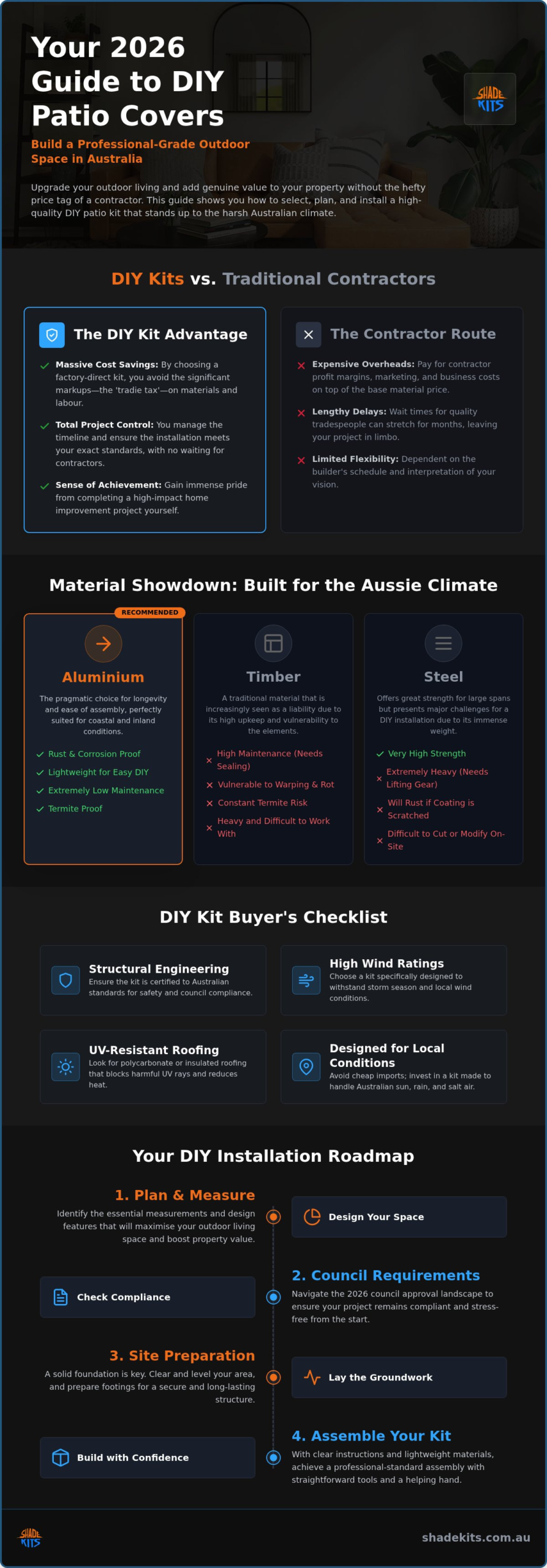
Moving from the planning phase to the actual build is where your project truly comes to life. While the idea of assembly might feel daunting, most DIY patio cover kits are designed for logical, sequential construction. A realistic timeline for a standard 3x4m or 6x4m structure is usually one to two weekends. This assumes you’ve already handled the preliminary groundwork and council checks. Setting a clear schedule prevents the project from dragging on and ensures you have enough daylight to work safely and methodically.
Before the delivery truck arrives, you should organise a basic toolkit. You don’t need a workshop full of specialised machinery; most aluminium kits require only a high-quality cordless drill with driver bits, a spirit level, a tape measure, and a socket set. Because you’ll be working at heights to secure the roofing panels, two sturdy ladders are essential. Safety isn’t just a box to tick. It’s the foundation of a successful build. Aluminium is lightweight, but long beams can catch the wind easily. Always have a second person on hand to help steady the frame during the initial stand-up phase.
As of July 2026, building permits and council approvals remain a standard requirement for permanent, roofed patio structures across most of Australia. While some very small structures under 10 or 20 square metres might fall under “exempt development” in specific states, these exemptions rarely apply to waterproof, permanent roofs. The good news is that the approval process is much simpler when you have the right documentation. A high-quality kit supplier provides engineered drawings and structural certifications out of the box. These documents are vital for your local council or private certifier to verify that the structure meets the National Construction Code standards, which were updated in May 2026.
A professional finish starts at ground level. Whether you are mounting your posts to an existing concrete pad or installing them into new footings, the base must be perfectly level. If you’re building over an existing paved area, check that the substrate is thick enough to support the structural loads. It’s also a critical safety step to contact “Dial Before You Dig” to identify any underground services like power, water, or gas lines. Clearing a three-metre perimeter around your work zone will give you the space needed to layout components and move ladders without tripping over garden debris or old building materials.
Taking the time to get your site and paperwork in order ensures the assembly of your DIY patio cover kits goes exactly according to the manual. If you’re looking for structures that come with comprehensive documentation to streamline your approval process, explore our range of engineered carport and patio solutions designed specifically for Australian conditions.
Choosing the right supplier is the final piece of the backyard puzzle. While we have discussed the importance of materials and planning, the actual success of your project depends on the quality of the kit and the support behind it. Shade Kits has built a reputation by bridging the gap between flimsy retail imports and the high costs of custom trades. By dealing directly with the manufacturer, you aren’t just saving on retail markups. You are gaining access to professional-grade engineering that is usually reserved for large-scale commercial projects. This factory-direct model ensures that every dollar you spend goes into the structural integrity of your home improvement.
Our DIY patio cover kits are designed specifically for the unique demands of the Australian environment. We don’t believe in “one size fits all” solutions that fail after the first major storm. Instead, our frames are constructed from high-tensile, powder-coated aluminium that won’t rust, rot, or attract termites. This durability is matched by our UV-resistant polycarbonate roofing. It’s engineered to withstand the intense 2026 sun while maintaining its clarity and strength over time. Because our kits are standardised and pre-engineered, the assembly process is straightforward. We have removed the guesswork by ensuring every bracket, beam, and fastener fits perfectly, allowing you to achieve a professional finish without needing years of construction experience.
We understand that regional homeowners often struggle with high shipping costs or limited delivery options. That is why we’ve optimised our logistics to offer Australia-wide delivery, reaching both metro hubs and regional centres. Every kit is meticulously flat-packed to ensure it arrives in perfect condition, no matter how far it has to travel. But our job doesn’t end when the truck leaves the warehouse. We view ourselves as your project mentors. You’ll have access to comprehensive installation resources and expert guidance to help you through every stage of the build. Whether you are looking for a new entertaining area or want to see our full range of carports and patio solutions, we provide the tools and transparency you need to succeed. Dealing direct means you get better materials, better support, and a better outcome for your property.
Upgrading your home with DIY patio cover kits is one of the most effective ways to increase property value while creating a space you’ll actually use year-round. By choosing durable aluminium frames and UV-resistant polycarbonate roofing, you ensure your investment stands up to the Australian climate without the constant maintenance required by traditional timber. Success lies in the details; having the right engineered documentation makes the council approval process straightforward and keeps your project on track from the first weekend of assembly.
You don’t need a team of expensive contractors to achieve a professional-grade result. With our factory-direct model and Australia-wide delivery, you can access the same high-performance materials used by the pros at a fraction of the cost. Whether you’re looking for extra shade for entertaining or a permanent cover for your vehicle, the right kit provides a structured, manageable path to a better outdoor lifestyle. It’s about taking control of your home improvement and building something that lasts.
Browse our factory-direct DIY patio and carport kits today and start planning your installation. Your ideal outdoor living area is well within reach, and we’re here to help you build it with confidence.
Yes, you will generally need council approval for any permanent, roofed structure. While specific rules vary between local government areas, most DIY patio cover kits require a building permit to ensure they meet safety and wind-rating standards. It’s always best to contact your local council or a private certifier before you begin. Having the engineered drawings and structural certifications from your supplier will make this application process much smoother.
Most homeowners can complete the installation within one to two weekends. This timeframe depends on having a level site ready to go and a second person to assist with the heavier lifting. Because the components in high-quality kits are pre-cut and pre-drilled, you won’t waste time on complex carpentry. A methodical approach and following the sequential instructions will ensure the project moves along without unnecessary delays.
Aluminium is the superior choice for the Australian climate due to its resilience and low maintenance. Unlike timber, aluminium won’t warp, rot, or succumb to termite damage, which are common issues in many regions. It also doesn’t require the regular sanding and oiling that timber structures demand to stay looking their best. For coastal homes, the corrosion resistance of powder-coated aluminium is an essential factor for long-term structural integrity.
We strongly recommend having at least two people for the installation process. While the aluminium components are lightweight, manoeuvring long beams and large roofing panels into place while trying to secure fasteners is difficult and potentially dangerous for one person alone. A second set of hands is vital for holding the frame steady during the initial stand-up phase and for safely managing ladders when working at heights.
You only need a basic set of tools that most DIY enthusiasts already have in their garage. The essential list includes a high-quality cordless drill with driver bits, a spirit level, a tape measure, and a socket set. You will also need two sturdy ladders to safely reach the roof height. Since the kit is pre-engineered and factory-cut, you won’t need specialised cutting tools or heavy machinery to achieve a professional result.
Yes, premium kits are engineered to withstand significant weather events. When you select DIY patio cover kits rated for your specific wind region, you’re getting a structure designed to handle high-velocity gusts. The polycarbonate roofing used in these kits is also highly impact-resistant. It’s specifically manufactured to endure the heavy hail common in Australian summer storms without cracking or leaking, ensuring your outdoor space remains protected.
Maintaining an aluminium structure is incredibly simple and requires very little effort. You don’t need to worry about the painting or staining required for timber structures. An occasional wash with a garden hose and a mild detergent is usually enough to remove dust, cobwebs, or salt spray if you live near the coast. This “set and forget” nature makes it a pragmatic choice for homeowners who want to enjoy their backyard rather than work on it.
Modern polycarbonate roofing is designed to keep your area comfortable by blocking 99% of harmful UV rays. Unlike single-skin metal roofing which can radiate heat downwards, high-quality polycarbonate filters natural light while reflecting a significant portion of the sun’s infrared energy. This prevents the “oven effect” and keeps the space bright and airy. Choosing a tinted or heat-reflective finish for your panels can further improve the thermal comfort of your patio.