
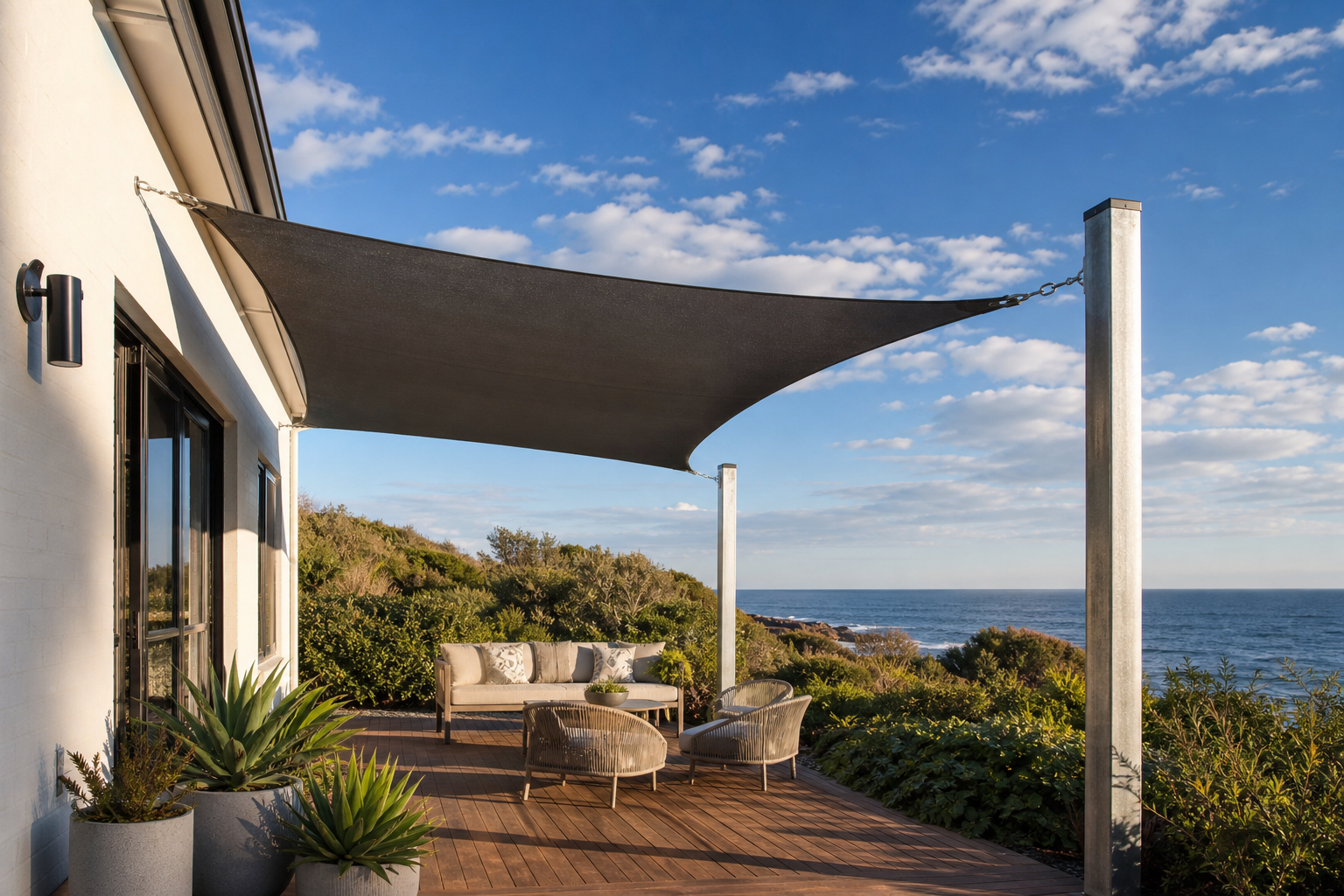

Salt air does not care about your warranty card. If you live within five kilometres of the Australian coastline – or in an exposed regional corridor where wind funnels across open paddocks – a standard shade sail kit designed for suburban backyards can fail within a single storm season. Corroded turnbuckles, undersized posts and shallow footings are the three most common failure points we see from coastal customers who purchased generic kits elsewhere.
That is exactly why we built the DIY Shade Sail Readiness Test. Instead of guessing at specifications, you answer a short series of guided prompts – postcode, span, anchor types, height and site exposure – and receive a tailored recommendation that accounts for your wind region, corrosion environment and UV requirements. The entire process takes around two minutes, and the output maps directly to purchasable kits and hardware bundles right here on ShadeKits.com.au.
CTA: Start the Readiness Test and Get Your Kit Recommendation
The first input is your postcode, and it is the most important one. Your postcode determines your Australian wind region under AS/NZS 1170.2, the standard that governs structural wind actions across the country. Regions range from A (low) through B, C and D, with C and D classified as cyclonic. Coastal towns from Geraldton through to Cairns and across the Top End frequently fall into Region B, C1 or higher. Even southern coastal areas like the Bellarine Peninsula or Kangaroo Island can sit in Region B due to open-terrain exposure multipliers.
After postcode, the test asks for your proposed sail shape (triangle, rectangle or custom polygon), the span between fixing points, the type of anchor you plan to use (steel posts, brick wall, fascia board, existing pergola) and the mounting height at each corner. These six data points are enough to calculate wind load, reaction forces at each fixing, required post diameter and footing depth – all before you spend a dollar.
For coastal and regional properties, the test also flags corrosion category. AS 4312 classifies atmospheric corrosivity from C1 (very low) through to CX (extreme). Beachfront homes within 100 metres of breaking surf can sit in C5 or CX, meaning standard galvanised hardware will pit and weaken far sooner than its rated lifespan. The test flags this automatically and recommends 316-grade stainless steel hardware where required.
CTA: Browse Stainless Steel Hardware and Fittings
Once you complete the prompts, the results panel displays a clear metrics summary modelled on the speed-test interfaces most Australians already recognise. Instead of download and upload speeds, you see:
Below the panel, the test auto-populates two to three matching kits from our catalogue with current prices and an Add to Cart button. You can also choose to email your results as a free PDF – handy if you need to discuss the project with a partner, builder or council officer before committing.
CTA: See Matching Kits and Add to Cart
This is where coastal and regional installs diverge most sharply from suburban ones. A shade sail is essentially an engineered membrane structure. Wind does not just push against the fabric – it creates both positive pressure on the windward face and significant suction (negative pressure) on the leeward side and around edges. The total load on each fixing point can be several times higher than most DIY buyers expect.
Our Post and Footing Calculator uses the terrain category, shielding factor and topographic multiplier from AS/NZS 1170.2 to derive ultimate limit state wind pressures for your specific site. In practical terms, here is what that looks like for a common 5m x 5m square sail at 2.5m average height:
| Wind Region | Post Size (SHS) | Min. Footing Depth | Footing Diameter |
|---|---|---|---|
| A (suburban shielded) | 90x90x3mm | 800mm | 450mm |
| B (coastal/open regional) | 100x100x4mm | 1000mm | 500mm |
| C1 (cyclonic) | 125x125x5mm | 1200mm | 600mm |
These are indicative figures. Your actual test results may vary depending on terrain category, height above ground, sail shape and the number of fixing points. For cyclonic Regions C and D, we strongly recommend obtaining site-specific engineering certification – and we can arrange that for you.
CTA: Request Engineered Design for Cyclonic Regions C and D
Transparency builds trust, so here is exactly how the Readiness Test derives its recommendations. The wind load calculation follows Clause 2 of AS/NZS 1170.2:2021, using regional wind speed (VR), terrain and height multiplier (Mz,cat), shielding multiplier (Ms) and topographic multiplier (Mt) to arrive at the site wind speed (Vsit). From that, we derive design wind pressure using the standard dynamic pressure formula (0.5 x air density x Vsit squared), then apply net pressure coefficients specific to membrane canopy structures.
Post and footing design references AS 4100 (Steel Structures) for the post bending capacity and AS 2159 principles for in-ground embedment. Soil bearing capacity is assumed at a conservative 100kPa for general residential clay soils – if you know your soil type is sandy or reactive, the test lets you adjust this input for a more accurate footing recommendation.
UV ratings reference AS/NZS 4399, which measures ultraviolet protection factor (UPF) of fabric by laboratory spectrophotometry. A shade cloth marketed as 95% shade does not automatically deliver 95% UV block. The correlation depends on weave density, colour and fabric composition. Our recommended commercial-grade HDPE knitted fabrics are independently tested to UPF 50+, which blocks over 98% of UV radiation regardless of colour.
You can read more about fabric specifications and test methodology in our UV and Shade Cloth Ratings Guide.
CTA: Read the Full UV Ratings Guide
One of the biggest anxieties for DIY buyers is not knowing whether they have the skills or tools to complete the job. The Readiness Test outputs a complete bill of materials and tool list tailored to your specific result. For a typical two-post, two-wall-plate installation of a triangular sail, here is what to expect:
Every ShadeKits.com.au kit includes the sail, turnbuckles, D-shackles, snap hooks and wall plates (where applicable). Posts and concrete are ordered separately or as an add-on bundle. For coastal installs, the test defaults to 316-grade stainless steel fittings which resist chloride-induced pitting far better than standard galvanised or 304-grade alternatives.
Most two-person teams complete a single-sail install in four to six hours, excluding concrete curing time (allow 48 to 72 hours before tensioning). Larger multi-sail configurations or installs requiring four new posts can stretch to a full weekend. The test assigns a difficulty rating from 1 (straightforward wall-mount triangle) to 5 (multi-sail, all new posts, cyclonic region) so you can gauge effort before ordering.
CTA: Download the Full DIY Installation Guide
Council requirements for shade sails vary significantly across Australian states, territories and even between neighbouring local government areas. In many jurisdictions, a shade sail under a certain area (commonly 20 square metres) attached to a dwelling as an awning is considered exempt development, meaning no development application is required. However, freestanding shade structures with posts, sails in heritage overlay zones, or sails in cyclonic regions almost always require some form of approval or certification.
The Readiness Test flags likely approval requirements based on your postcode and sail area, but we always recommend confirming with your local council before pouring concrete. If your council requires engineered drawings and a certificate of structural adequacy, ShadeKits.com.au can connect you with qualified structural engineers who understand membrane structures. This is particularly important for Regions C and D, where non-compliant shade structures can void home insurance and attract compliance notices.
CTA: Talk to a Shade Pro About Council Requirements
After supplying thousands of kits across Australia, we have catalogued the most frequent errors DIY installers make – especially in coastal and high-wind areas. The Readiness Test is specifically designed to prevent these:
CTA: Start the Readiness Test and Avoid Costly Mistakes
We are not a marketplace reselling imported sails with unknown provenance. Every shade sail fabric we supply is commercial-grade HDPE knitted cloth with independent UPF 50+ certification, backed by a 10-year manufacturer UV degradation warranty. Our stainless steel hardware is sourced from audited suppliers and load-tested to published breaking strains – not the vague “heavy duty” claims you see on marketplace listings.
For coastal and regional buyers specifically, we carry a full range of 316-grade stainless turnbuckles, D-shackles, snap hooks, wall plates and pad eyes in sizes from M6 through to M16. We also offer custom-cut sails for non-standard shapes, with reinforced webbing borders, pressed stainless corner plates and UV-stabilised stitching rated to 20kg/cm tear strength.
CTA: Design a Custom Shade Sail for Your Space
We ship to every Australian postcode, including regional and remote areas across WA, NT, QLD and Tasmania. Standard kits dispatch within three to five business days from our warehouse. Delivery timeframes vary by destination:
Posts and steel components ship separately via freight and may have slightly longer lead times. The Readiness Test includes an estimated delivery window based on your postcode so you can plan your install weekend accordingly. Full details are available on our Shipping and Delivery page.
CTA: Check Delivery ETA for Your Postcode
Nothing validates a product like seeing it perform in the real world. We regularly feature installs from customers in some of Australia’s most demanding environments – from the Sunshine Coast hinterland to the exposed cliffs of the Great Ocean Road and the cyclonic communities of North Queensland.
Recent highlights include a four-point rectangle sail over a pool deck in Airlie Beach (Region C1, 316 stainless throughout, engineered certification supplied for council), a twin-triangle setup at a beachfront cafe in Byron Bay (Region B, custom charcoal fabric, wall-mounted to structural steel columns), and a large five-point sail over a school playground in Geraldton (Region D, fully engineered with independent certification).
If you have completed an install using a ShadeKits.com.au kit, we would love to feature your project. Send your photos and location details through our contact page for a chance to be featured.
CTA: Share Your Install or Ask a Question
The test uses AS/NZS 1170.2 wind region data and conservative engineering assumptions to generate its recommendations. It is designed to get you to the right kit and specification range for your location. For standard residential installs in Regions A and B, the output is typically sufficient for a safe, compliant DIY installation. For cyclonic regions or unusual site conditions, we recommend confirming results with a qualified structural engineer.
The test identifies cyclonic postcodes and provides indicative post and footing sizes for Regions C1 through D. However, cyclonic installations almost always require site-specific engineered drawings and council approval. We can arrange engineered certification through our network of structural engineers – just select the engineering add-on in your test results.
Fascia boards are not structural and should not be used as primary fixing points without reinforcement. If you select fascia as an anchor type, the test will recommend a backing plate bolted through to a rafter, lintel or structural beam. Similarly, pergola posts must be verified for lateral load capacity before attaching a tensioned sail. Our DIY Installation Guide covers reinforcement methods in detail.
Requirements vary by local government area. Many councils treat small domestic shade sails as exempt development, but freestanding structures with permanent posts, sails over a certain area, or installations in heritage or bushfire overlay zones may require a development application. We recommend checking with your local council before starting construction.
Not necessarily. Shade percentage refers to the amount of visible light blocked, while UV block is measured separately under AS/NZS 4399 using spectrophotometry across UVA and UVB wavelengths. A 90% shade cloth may block 95% or more of UV depending on fabric composition and colour. All ShadeKits.com.au fabrics are independently rated to UPF 50+, blocking over 98% of UV radiation. Read our UV and Shade Cloth Ratings Guide for the full breakdown.
Post size and footing depth depend on your wind region, sail area, mounting height and soil conditions. As a rough guide, a 5m span in Region A typically needs 90x90x3mm SHS posts at 800mm depth, while the same span in Region B coastal exposure steps up to 100x100x4mm at 1000mm depth. The Readiness Test calculates this precisely for your inputs using our Post and Footing Calculator.