
A garage isn’t automatically the better investment. How much value a carport adds to a home depends on whether covered, off-street parking appeals to likely buyers and how well the structure suits the property. A well-designed carport can improve parking appeal and shelter vehicles, while a garage may better suit buyers who want enclosed storage.
Weigh the possible resale appeal against the benefit you’ll get while living in the home. Covered parking helps keep a vehicle out of direct sun and rain, and makes a property more practical where street parking is limited.
This article explains how carports compare with garages for resale appeal, what affects their value in Australia, and how location, design and buyer priorities shape the decision. You’ll also learn what a carport can offer beyond parking, so you can assess whether it’s a useful improvement for your home.
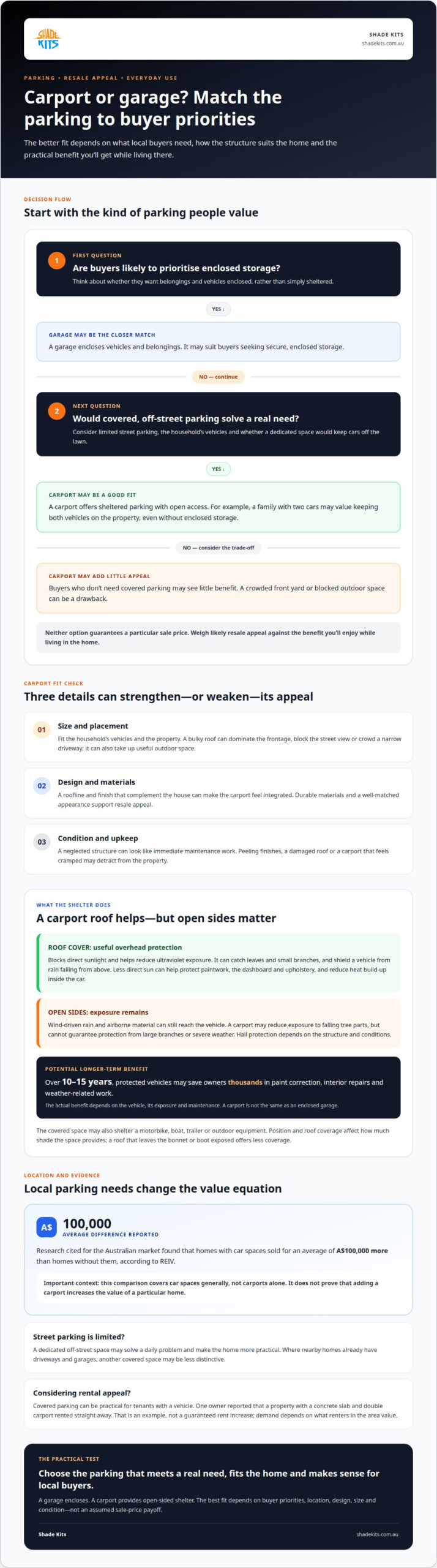
A garage and a carport solve different parking needs. A garage encloses vehicles and belongings, while a carport provides sheltered parking with open access. Buyers who need secure, enclosed storage may favour a garage; those who want a covered parking space may value a carport. Neither option guarantees a particular sale price.
Covered parking can make a home more appealing than one offering only street parking. It gives residents a dedicated space and keeps vehicles off the lawn. For example, a family with two cars may value a carport that keeps both on the property, even without enclosed storage.
Kerb appeal depends on how the structure fits the front yard. A well-designed carport can make parking look organised and keep tyre marks off the lawn. Match its size and appearance to the house, rather than letting a bulky roof dominate the frontage or block the street view.
Prospective buyers also notice whether a carport looks like part of the home. A roofline and finish that complement the exterior can create a more integrated appearance. Visible wear or a structure that crowds a narrow driveway can detract from the property during an inspection.
Size, materials, design and condition all affect resale appeal. A carport that fits the household’s vehicles, uses durable materials, suits the home and is well maintained presents better than one that feels cramped or neglected. Peeling finishes or a damaged roof, for instance, can look like immediate maintenance work.
A carport can detract from a property if it blocks useful outdoor space, clashes with the house or looks poorly maintained. Buyers who don’t need covered parking may see little benefit, and a crowded front yard can be a drawback. A garage may suit buyers who prioritise enclosed storage.
Rental appeal is another consideration. Covered parking can make a rental more practical for tenants with a vehicle. One owner reported that a property with a concrete slab and double carport rented straight away. This is an example of potential appeal, not a guaranteed rent increase: demand depends on what renters in the area value.
For landlords, compare the carport’s everyday usefulness with the property’s existing parking. A covered space may help distinguish a home with no off-street parking, but add little to one that already has ample secure spaces. Consider whether it also keeps the driveway and entry clear for tenants.
Compare the options by the need they meet: a garage encloses vehicles and belongings, while a carport provides open-sided shelter and parking. If you want a tidier frontage and a protected place for vehicles, a carport may fit; if buyers are likely to prioritise enclosed storage, a garage may be a better match.
Australian weather can expose a parked vehicle to strong sun, rain and falling debris. A carport roof blocks direct sunlight and helps reduce exposure to ultraviolet rays. It can also catch leaves and small branches before they land on the car. The sides remain open, so wind-driven rain and airborne material can still reach the vehicle.
Less direct sun can help protect a car’s paintwork, dashboard and upholstery from premature ageing. A covered space can also reduce heat build-up inside the vehicle, making it more comfortable to enter after parking. That everyday benefit matters when a car sits outside for long periods.
A carport offers some shelter from harsh weather, but it isn’t the same as an enclosed garage. Its roof helps shield a vehicle from rain falling from above, while open sides leave it more exposed to wind and sideways rain. It may reduce exposure to falling tree parts, but can’t guarantee protection from large branches or severe weather. Hail protection depends on the structure and conditions, so an open-sided roof shouldn’t be treated as complete protection.
Vehicle protection may reduce wear that leads to repair work. Over 10-15 years, protected vehicles may save owners thousands in paint correction, interior repairs and weather-related work. The actual benefit depends on the vehicle, exposure and maintenance. A car that spends most days beneath cover faces different conditions from one parked in full sun or under trees.
Covered parking can shelter more than a daily car. The same space may protect a motorbike, boat, trailer or outdoor equipment from sun and rain. For example, parking a trailer beneath a carport can limit weather exposure while keeping it accessible, rather than storing it in an enclosed room.
Consider how the roof will work with the property. The carport’s position, coverage and appearance affect how well it shelters a vehicle and fits the home. A roof extending over the parking area provides more shade than one that leaves the bonnet or boot exposed. Good coverage can also make the space more useful for outdoor items.
For homeowners considering carport options, the key is matching the structure to the vehicle and its exposure. A carport offers useful overhead shelter, while a garage provides more complete enclosure. Weigh that difference against the local weather, nearby trees and how you use the vehicle each day.
Location affects how useful off-street parking is to buyers. On a street with limited parking, a dedicated space can solve a daily problem. Where homes commonly have driveways and garages, another covered space may be less distinctive. The same carport can attract different interest depending on nearby homes and parking options.
Research cited for the Australian market found that homes with car spaces sold for an average of A$100,000 more than homes without them, according to REIV. That comparison covers car spaces generally, not carports alone. It also doesn’t prove that adding a carport increases a particular home’s value by A$100,000.
The surrounding parking situation helps explain why. A home near shops, workplaces or public transport may still benefit from vehicle shelter if residents rely on cars. Where on-street parking is scarce, an off-street space can be useful for residents and visitors. Where parking is readily available, buyers may focus more on other features.
Consider a compact inner-city property with no driveway. A covered parking structure could address a practical gap, especially where buyers currently compete for street spaces. In some markets, installing a garage at an inner-city property with little available parking could return over A$100,000. That figure relates to a garage, not a carport, and isn’t a general valuation for either structure.
For a carport, location affects how much buyers may value the convenience. A household with several vehicles may appreciate a covered space that keeps one car off the street. A buyer without a car may see less benefit. Appeal depends on the property’s existing parking, nearby options and the needs of people looking in the area.
Street presentation matters too. A structure that fits the block can make parking feel organised without taking up valuable garden or outdoor living space. On a narrow frontage, supports or a roof across the main approach may make access feel less practical. The layout should work with the home’s entry, driveway and outdoor areas.
Before adding a carport to improve resale appeal, identify the local parking problem it solves. Compare nearby homes with and without off-street spaces, then consider whether buyers would gain shelter, easier access or space for another vehicle. These practical benefits are a better basis for judging the project than applying a broad property-price average to one home.
Resale return on investment compares a carport’s contribution at sale with its installation cost. A return of 50% means the resale contribution equals half the original outlay, rather than the full amount. It’s a useful way to frame potential recovery, but it doesn’t describe every benefit enjoyed while living in the home.
A standard one-car metal carport is estimated to return 50-65% of its cost at resale. A custom-fit carport may contribute to resale appeal, though the outcome depends on the property and buyer preferences. These ranges show how capacity and fit can shape buyer appeal, but they aren’t a promise that every property will achieve the same result.
Design can also influence resale estimates. A premium attached carport that matches the home is estimated to return 70-85% of its cost. An enclosed or garage-style structure may appeal to buyers seeking more protected storage. The broader typical resale-return estimate for a carport is 50-75% of installation cost.
Treat comparisons as examples of different structure types, not as a ranking that applies to every home. An attached design may suit an exterior where it looks integrated, while an enclosed structure serves a different purpose. Buyer preferences, parking needs and the quality of the finished space all affect how useful it seems.
Condition matters because visible damage can make a carport look like a repair job instead of an asset. Before selling, address worn finishes or roof damage and clear the parking area. A tidy structure helps buyers see its size, access and relationship to the house.
Consider what the structure takes away as well as what it adds. A carport occupying useful outdoor space may leave less room for a garden or other living areas. For example, a design that leaves a clear path to the backyard may work better than one that blocks access or crowds an entertaining area.
To assess likely resale appeal, compare the carport’s type, condition and fit with nearby homes. Then weigh its potential return against practical benefits such as vehicle shelter and outdoor storage. Buyers who prefer enclosed storage may value a garage differently from an open carport.
Base your decision on the home’s use and presentation, not a percentage alone. A well-maintained structure that suits the exterior can support buyer interest, while one in the wrong place may detract from the block. Treat return estimates as a planning guide, alongside the value of using the space before selling.
A carport’s value comes from the parking problem it solves, not simply from adding a roof. For Australian homeowners, the key question is whether covered, off-street parking improves the property for likely buyers. A carport can add practical appeal, but that doesn’t automatically translate into an equivalent increase in sale price.
A carport may matter most where a home lacks dedicated parking. A buyer comparing similar properties could favour one with a place to park off the street, especially where nearby parking is limited. That preference reflects convenience and vehicle shelter, not a guaranteed dollar amount for the structure.
Australian sales comparisons have found higher average prices for homes with car spaces, but that difference doesn’t isolate the value of a carport. A car space might be a garage, driveway or another parking arrangement. Location, land, interior condition and other renovations also affect a sale price, so parking is only one part of the picture.
To judge the likely contribution, start with the property’s current parking. If the existing driveway already serves the household, a carport may mainly add weather cover. If cars currently occupy the street or lawn, it can create a more practical layout and free the front yard. These examples show why the same structure can appeal differently from one home to another.
Next, consider how the carport affects the rest of the block. A design that preserves access to the garden and front door can improve everyday use. One that crowds a narrow frontage or takes up valuable outdoor space may make the property feel less balanced. Buyers assess the whole home, including how the structure looks from the street.
Condition and how well the structure fits the home shape buyers’ impressions. A well-maintained carport that complements the house presents as a useful feature. A damaged roof, worn finish or awkward position can instead suggest work for the next owner. Fix visible wear and clear the parking area to show how the structure works during inspections.
Finally, compare the improvement with other priorities in the home. For example, a household choosing between parking cover and an interior renovation should consider which better addresses the property’s most obvious shortcoming. The right choice depends on buyer needs in that area, not a universal rule that outdoor work always beats interior improvements.
The practical takeaway is to treat a carport as a way to improve parking and presentation, not as a fixed-value addition. It is most useful when off-street shelter is needed, the layout remains functional and the structure suits the home. If you’re adding one before selling, these factors offer a more grounded measure than assuming a specific price increase.
Shade Kits offers Carport Kits for homeowners who want covered parking and everyday vehicle shelter. A carport kit can suit a property where off-street parking is useful but a fully enclosed garage isn’t necessary. Choose based on the available space, the vehicles to shelter and how the structure will sit beside the home.
Consider those practical needs alongside potential resale appeal: a well-positioned carport can create a tidier frontage without promising a particular increase in value. Shade Kits also offers Pergola Kits, Awning Kits and Patio Covers for other outdoor shading needs.
Contact Shade Kits to discuss Carport Kits for your home and parking needs.
Before choosing a structure, picture how you’ll use the property over the coming years. Will you need room for another vehicle, clearer access to the yard or a more convenient place to park? Those everyday needs can guide a design that works for your household now and remains useful if you sell later.
How much value a carport adds to a home depends on how well it meets buyer needs and suits the property. No single design fits every home, so weigh the parking benefit against the space it uses and the appearance you want to maintain.
Shade Kits offers Carport Kits for covered parking, alongside Pergola Kits and Awning Kits for other outdoor shading needs. If you’re ready to explore a carport for your property, contact Shade Kits about your carport. A considered choice can make your home more practical for the years ahead.
A garage may suit buyers who need enclosed storage, while a carport may work better for households prioritising covered parking and easy access. For example, someone storing tools or sporting equipment may prefer a garage, while a driver seeking shelter for a daily vehicle may find an open-sided structure more practical. The better fit depends on the property’s layout and what buyers need, not just the structure type.
A carport is a roofed parking space, usually with open sides rather than the enclosed walls of a garage. A freestanding carport may sit beside a driveway, while an attached structure can extend from the house. Its open design allows easier access but offers less enclosure for belongings than a garage. The size and position should suit the vehicles and available space.
There isn’t one property-tax outcome for every Australian home. A carport may be considered in a property valuation, but any effect on council rates or land-tax assessments depends on the valuation process and rules for that property. For instance, a new structure may be treated differently across jurisdictions. Check the relevant council and state revenue guidance to understand how an addition is assessed at your address.
Some Australian councils may regulate carport design and require a development application because a carport is a permanent structure. Requirements can depend on the proposed design and the property’s location. Before work begins, review the rules that apply to your address, including requirements for placement or appearance. This helps you understand the approval process before settling on a layout or starting construction.
A carport generally involves less construction than an enclosed garage, which adds walls and a door. The total outlay depends on the structure’s size, materials, site preparation and design. For example, a simple open-sided shelter and a fully enclosed building involve different scopes of work. Compare what each option provides, rather than choosing on initial expense alone, and include any required site preparation in your plans.
There is no fixed figure for how much value a carport adds to a home in Australia. Its contribution depends on local demand for covered parking, existing spaces and how well the structure suits the property. A carport may address a clear parking need, but add less appeal where buyers already have convenient off-street parking. Consider its usefulness and presentation together when weighing likely value.
There isn’t one average cost for every Australian carport project. The amount depends on the structure’s dimensions, materials, site conditions and whether groundwork is needed. For example, preparing a sloping or uneven area can change the project scope compared with building on a suitable existing surface. Compare the full requirements of your preferred design, including site preparation, rather than relying on a broad price estimate.
A carport can add resale appeal through covered parking, while a garage may appeal to buyers seeking enclosed storage. Which matters more depends on the home and its likely buyers. For example, a property with limited parking may benefit from a dedicated covered space, while buyers needing secure storage may place greater value on a garage. A well-maintained structure that suits the property is easier to present as a useful feature.