
Want a carport roof that provides cover without making the space underneath feel dark? That balance is one reason polycarbonate carport kits are worth considering. The right option depends on more than the roof, though: your vehicle, available space, site conditions and assembly plans all matter.
When comparing kits, look at the panel construction, frame material, dimensions and what comes with the kit. Shade Kits’ Single Carport pairs twin-wall polycarbonate roof panels with an aluminium-alloy frame, giving you specific product details to compare against your project.
This guide explains what to look for in polycarbonate roofing and how to plan for vehicle clearance, delivery, assembly and local approval requirements. Use the practical checks below to narrow down your options before choosing a kit.
A carport kit brings together a supporting structure, roof panels and the components needed for assembly. Once built, it provides a covered parking area without enclosing it like a garage. The open sides make it easier to access the vehicle, but also mean that rain and sun can reach it from the sides.
Polycarbonate is a thermoplastic used in sheet form for roofing. Its appearance and construction can vary, so the material name alone doesn’t tell you how a particular roof will look or perform. Panel design and specifications matter, as do the frame, fixings and assembly. Polycarbonate is a strong, tough, and optically transparent thermoplastic polymer. That broad description is useful background, not a performance rating for any individual carport roof.
Think of the roof as one part of a system. The panels provide the overhead covering, the frame supports them and the fixings connect the components. The panel construction and the design of the complete structure affect what the roof is suited to. Don’t assume that every polycarbonate panel offers the same protection from hail, heat or storms.
An open carport has a roof but no walls around the parking space. The roof provides overhead cover, while the open sides leave the vehicle exposed to conditions that reach it from the sides. A garage, by contrast, is enclosed. A carport can be a practical middle ground, but it doesn’t provide the same coverage as a fully enclosed building.
Twin-wall describes a panel with two outer faces joined by internal webs, creating channels between them. It identifies the panel’s construction, not a guaranteed level of strength, insulation or weather protection. Shade Kits’ Single Carport uses twin-wall polycarbonate roof panels, a specific example of this panel type in a carport kit.
When comparing options, look beyond the word “polycarbonate”. Find the stated panel construction and consider it alongside the supporting frame and assembly components. This gives you a more useful basis for deciding whether the complete kit suits your parking space and site, without relying on broad material claims alone.
Roof panels cover the parking space, the frame supports them and the supplied hardware connects the parts in the kit’s intended layout. These elements work as a system: a panel’s properties matter, but so do its fit with the frame and the way it is secured. A material label alone can’t tell you how a complete roof will perform.
Light transmission is one detail to consider. How much light passes through depends on the panel specification, including its construction and finish. Don’t assume a clear panel and a coloured or opaque panel will behave alike. If the amount of light under the roof matters for your parking area or nearby windows, compare the actual panel details rather than relying on the word “polycarbonate”.
Start with the information provided for the specific kit. Compare panel construction, thickness and finish where those details are stated. Read UV-related claims as applying to the named panel specification, not to every polycarbonate roof. Also consider how the panels, frame and fixings are supplied together. A panel viewed on its own won’t tell you whether the complete roof system suits your intended layout.
Installation instructions are part of the system, too. Follow the manufacturer’s directions for handling, orienting and fitting the panels, and use the supplied components as instructed. Don’t improvise a fixing method or assume a panel can be trimmed or positioned in any direction. The instructions explain how the parts are intended to come together, so read them before assembly.
The frame supports the panels and holds them in the kit’s designed position. Its material and configuration are product-specific details, not qualities to infer from the roof material. Shade Kits’ Single Carport has an aluminium-alloy frame paired with twin-wall polycarbonate roof panels. That describes the product’s components without implying a particular wind rating or lifespan.
When comparing polycarbonate carport kits, assess the roof and frame together, then read the product specifications and assembly instructions as a set. Check which panel details are stated, how the components fit and whether the instructions are clear for your project. You can review the available carport kit details as a practical reference.
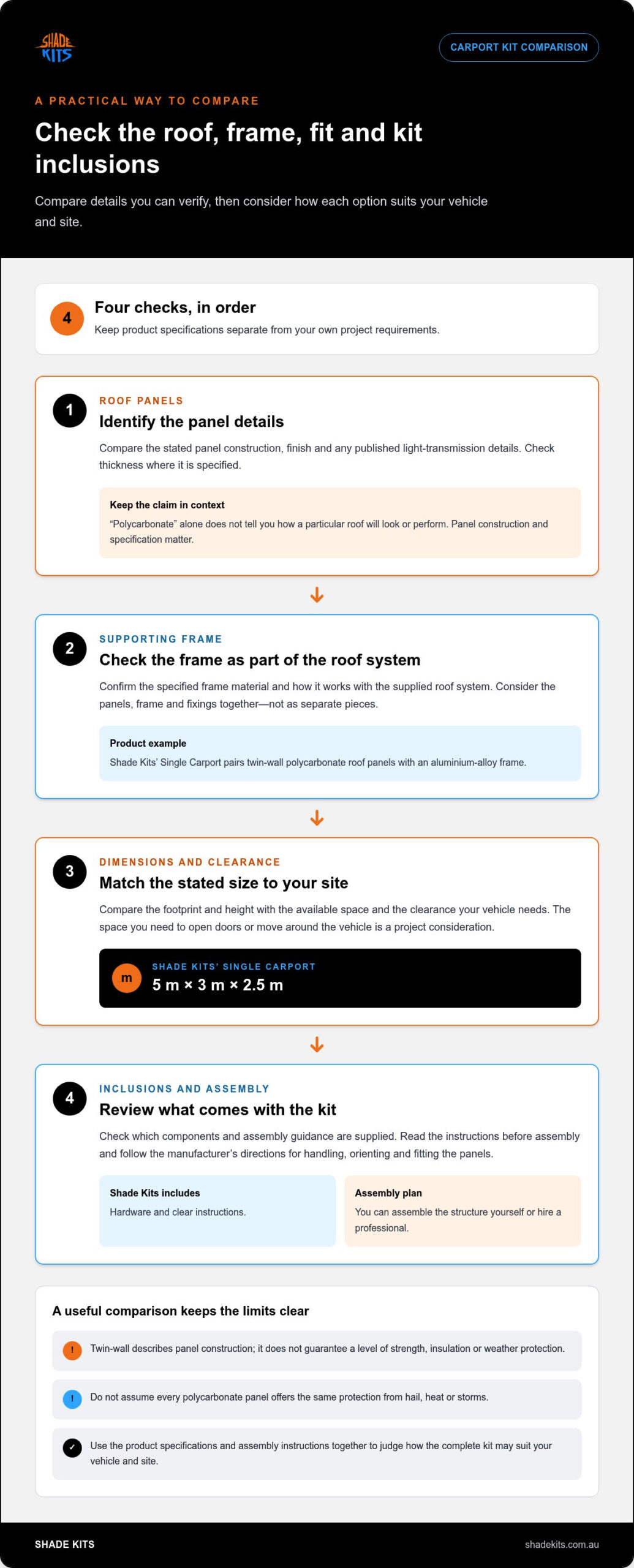
A useful comparison starts with details you can verify, then considers how each option fits your vehicle and site. Keep product specifications separate from your own priorities: a stated panel type or footprint is a product fact, while the space you need to open doors or move around the vehicle is a project consideration.
| Detail | Shade Kits Single Carport | What to weigh up |
|---|---|---|
| Roof panels | Twin-wall polycarbonate | Compare the stated panel construction, finish and any published light-transmission details. |
| Frame | Aluminium-alloy | Check the specified frame material and how it works with the supplied roof system. |
| Dimensions | 5 m × 3 m × 2.5 m | Compare the stated footprint and height with your site and vehicle clearance needs. |
| Inclusions | Hardware and clear instructions | Review which components and assembly guidance come with the kit. |
Don’t assume one roofing material is always stronger, cooler, safer or longer-lasting. Compare information that’s actually provided: appearance, panel construction, stated light characteristics and product specifications. Make sure you’re comparing like with like, since the name of a material alone doesn’t describe a complete roof system. For a broader discussion of roof materials, see the related article Durable Polycarbonate vs Glass: Roofing Showdown.
For a polycarbonate option, focus on the panel details and how they work with the frame and fixings. For metal or glass alternatives, use the documented specifications for those products rather than general assumptions. If information such as panel thickness or light transmission isn’t stated, don’t treat it as a known performance feature. Compare documented characteristics against your preferences instead of trying to declare a universal winner.
Start with your vehicle’s footprint, then allow for everyday use. Check whether the doors can open comfortably, whether you can walk around the parked vehicle and whether you need access at the front or rear. Measure the proposed site as well, including nearby boundaries and obstacles that could reduce usable space.
The Shade Kits Single Carport measures 5 m × 3 m × 2.5 m. Compare those stated dimensions with your vehicle and available space rather than assuming a nominal single-car size will suit every car or site. If you plan to cover more than one vehicle, assess the total parking area and access needs before comparing larger configurations. Accurate site measurements give you a practical starting point for choosing a kit that fits your property and routine.
Plan before choosing a kit. Check the site, vehicle and delivery access, then compare those details with the product specifications and assembly instructions. This helps you identify practical constraints early, rather than discovering that the footprint or access route doesn’t work once the kit arrives.
Measure the available footprint and note anything that could restrict the structure or vehicle access. Compare those site measurements with the selected kit’s stated dimensions. Check vehicle clearance separately: a footprint that fits on paper may still feel tight if the doors can’t open comfortably or there’s little room to move around the parked car.
Approval requirements can vary depending on your location and project. Check the applicable rules with your local council before selecting a kit or starting work, as requirements for one site may differ from another. For broader project-planning prompts, use The Essential Australian Carport Checklist alongside your measurements and product specifications.
Shade Kits’ DIY carport kits include hardware and clear instructions. Set aside time to review the guidance and organise your assembly space before beginning. You can assemble the kit yourself or hire a professional. Choose the approach that suits your skills, available help and project plan.
Careful preparation is part of choosing well. Explore Shade Kits carport kits as you compare your site measurements and assembly plans.
Once you’ve measured your site and considered how you’ll use the space, compare your needs with the kit specifications. Shade Kits’ Single Carport has an aluminium-alloy frame, twin-wall polycarbonate roof panels and dimensions of 5 m × 3 m × 2.5 m. Use those stated dimensions to assess fit against your vehicle, access needs and proposed location.
To buy, choose a style, size and colour that suit your project, arrange delivery to your door, then assemble the kit yourself or hire a professional. Shade Kits pricing is one price, with no hidden freight fees or surprise add-ons at checkout. You can factor the kit and delivery into one clear purchase decision.
Shade Kits DIY carport kits include hardware and clear instructions to guide assembly. They are supplied factory-direct, with Australia-wide delivery to your door. If standard dimensions don’t suit your site, custom sizes can be made to fit your measurements after engineering confirmation and a quote.
Before settling on a standard or custom size, keep your measured footprint and project requirements together. This makes it easier to compare dimensions with the space available. For custom sizing, engineering confirmation and a quote are part of the planning process.
Use this checklist to keep the decision practical:
For broader preparation, refer to The Essential Australian Carport Checklist alongside your site measurements and kit specifications. Keep approval requirements in mind and check the applicable rules with your local council before starting the project.
Ready to compare the details with your plan? Explore polycarbonate carport kit options and shortlist a style and size that suit your site. With the dimensions, roof description, frame material and assembly approach in view, you’ll have a clearer picture of the project.
Turn your measurements and priorities into a practical shortlist. Compare the roof and frame specifications with your site, then consider which polycarbonate carport kits suit your intended use and assembly plans. A good match between the kit and your project makes it easier to plan the next steps.
Shade Kits is an Australian-owned family business supplying DIY carport kits factory-direct, with Australia-wide delivery. Kits include hardware and clear instructions, and you can assemble yours or hire a professional. Pricing is one price, with no hidden freight fees or surprise add-ons at checkout, so you can plan your purchase with those details in mind.
Ready to explore the options? Explore Shade Kits carport options and compare the available kits with your project requirements. Start with a measured site and a clear idea of what matters to you.
They can suit an Australian home when the kit specifications and proposed position match your vehicle, property and local conditions. Shade Kits designs its outdoor shade kits for Australian homes and weather conditions, but suitability still depends on the site and project. Consider exposure, available space and access, and check local approval requirements before building. A material description alone doesn’t establish how a roof will perform in every setting.
Some polycarbonate roofing is described as UV-resistant, but don’t assume every panel provides the same UV performance. Shade Kits describes its polycarbonate roofing as UV-resistant. For a particular kit, use the stated panel details rather than general claims about the material. UV resistance also doesn’t mean a car or items beneath the roof are fully protected from sunlight. The complete roof specification matters.
Yes, if you’re comfortable following the kit’s assembly instructions and can organise a suitable work area and help for the task. Shade Kits kits come with hardware and clear instructions, and you can assemble them or hire a professional. Before starting, read the instructions fully and make sure the assembly process suits your skills, available assistance and site. Don’t begin until any required local approvals are in place.
Measure your vehicle and the available space, then compare both with the kit’s stated dimensions. Include features that affect clearance, such as roof racks, and consider whether doors can open without hitting nearby walls or fences. Think about how you’ll approach and park the vehicle, not just whether it fits inside the footprint. If standard dimensions don’t suit, custom sizes can be made after engineering confirmation and a quote.
It may. Requirements vary with your state or territory, local council, site and proposed structure. Planning approval and a building permit are separate considerations, and a building permit may be needed even where planning approval isn’t. Check the rules that apply to your property with your local council before purchasing or starting construction. Don’t rely on an exemption that applies to a different location or carport design.
Follow the care instructions for your specific panels, as cleaning guidance can depend on the product’s finish and specification. As a cautious starting point, use water and a soft cloth to remove surface dirt, and avoid abrasive pads or strong cleaners unless the manufacturer permits them. Don’t use a cleaning method simply because it’s suitable for another roofing material. If the supplied instructions include care advice, follow that guidance.