
Polycarbonate can withstand impact far better than glass or acrylic, but a polycarbonate roofing hail rating depends on the sheet and its product warranty. Polycarbonate is described as having 250 times the impact resistance of glass and 30 times the strength of acrylic. Hail cover varies by product; most polycarbonate roofing products have a limited lifetime warranty that includes hailstones up to 25 mm.
It’s understandable to expect a material name alone to show how a roof will fare in a storm. In practice, sheet profile, thickness, support spacing and warranty terms all affect the protection you can expect. Even a tough sheet must suit the structure and local weather.
This guide explains how polycarbonate compares with glass and acrylic in hail, what warranty wording means, and which sheet features influence impact performance. You’ll also learn how to weigh the options for an Australian carport, pergola or patio cover before planning your roof.
Hail performance depends on documented resistance, sheet construction and warranty terms, not just the material name. For roofing or a greenhouse, compare the evidence before assessing how panels may handle local weather.
Documented hail resistance means a product’s performance is recorded against a stated hail classification or test. For roofing and greenhouses, that evidence lets you compare sheets by tested performance rather than assuming every polycarbonate panel behaves alike. The Swiss Association of Cantonal Fire Insurers’ VKF Hail Register records component classes from HW 1 to HW 5. Look for a documented class linked to the specific component being considered.
The VKF Hail Register’s five classes run from HW 1 to HW 5, with HW 3 recommended as the residential minimum. That class covers hailstones up to 3 centimetres in diameter. The VKF system is Swiss, so its classes alone do not establish an Australian Building Code requirement. They can still provide a documented comparison point, but don’t describe an HW result as an Australian code rating.
Polycarbonate sheets are impact resistant, but the material name alone doesn’t tell you how a particular roof will perform in hail. Sheet design and installation also matter. Compare documented performance for the actual panel, rather than transferring a rating from another product. Hail warranties differ too: covered hail size and duration vary, and most products have a limited lifetime warranty covering hailstones up to 25 mm. Check the product terms for the scope of cover.
A roofing hail test exposes a component to specified impact conditions, then records its response against a stated method or classification. The VKF test standard describes a 3-centimetre hailstone striking at around 86 kilometres per hour. That is a Swiss test reference, not proof of an Australian classification. For a useful Australian comparison, match the test evidence to the exact roofing product and avoid treating different methods as interchangeable.
What hail impact ratings apply to polycarbonate roofing in Australia? The VKF’s HW 1 to HW 5 classes are Swiss classifications. A product’s documented test result should be read alongside its stated method, not assumed to represent a universal Australian rating.
How are hail resistance ratings for roofing tested and classified in Australia? Compare the named test method, impact conditions and recorded product result. The VKF example uses a 3-centimetre hailstone at around 86 kilometres per hour; that result should remain identified as VKF testing.
How much does hail-resistant polycarbonate roofing cost per square metre in Australia? There’s no single figure for every sheet. Cost per square metre depends on the profile, thickness and roofing system, so compare specifications as well as materials.
Does hail damage affect home insurance claims in Australia? Hail damage may be relevant to a home insurance claim. The policy wording, type of damage and available records all affect how a claim is assessed.
What warranty exclusions and limitations apply? Hailstone-size limits and warranty duration vary by product. Read the terms for covered damage, exclusions and the remedy offered; a 25 mm hail limit does not automatically describe every polycarbonate roof.
Polycarbonate has a much higher impact resistance than glass or acrylic in standard comparisons. It is described as having 250 times the impact resistance of glass and 30 times the strength of acrylic. Those comparisons make the material worth considering for a roof exposed to hail, but they don’t mean every polycarbonate sheet performs identically. Product construction and the test used still matter.
In a standardised notched impact test, polycarbonate records 65 to 75 kilojoules per square metre, while acrylic glass (PMMA) reaches around 2 kilojoules per square metre. These results compare how materials handle impact under a defined test, not how a complete polycarbonate roof will perform in every storm. A roofing sheet is part of a larger assembly, so its supports and fixing arrangement also affect how impact loads are handled.
Polycarbonate tends to deform on impact rather than shatter, unlike glass or acrylic. This difference matters where hail strikes a roof: deforming and breaking into fragments are distinct failure responses. Polycarbonate also remains robust in cold temperatures, while acrylic loses impact resistance significantly. Temperature is therefore worth considering when comparing materials for exposed outdoor use.
Charpy and ISO 179 are names associated with notched impact testing. When comparing results, use figures that come from the same test method and material conditions. The reported polycarbonate and PMMA values show a marked difference, but a test result shouldn’t be treated as a direct hail rating. A test specimen and an installed roof panel are different things, and the result needs to be read in its stated context.
Thickness and profile are important when comparing sheets. For SUNGLAZE solid sheet and BEEHIVE profiles, check the exact variant and its impact-test evidence. A profile name alone doesn’t establish hail performance, and greater thickness doesn’t automatically mean a particular hail class. Match the product documentation to the roof design instead of assuming one material label covers every configuration.
Which polycarbonate roofing brands and profiles have the highest hail resistance in Australia? Material type alone can’t establish a brand or profile ranking. Compare the exact sheet’s documented impact result, test method and thickness. These details provide a sounder basis than a brand name or profile label.
A polycarbonate roofing hail rating is most useful when it applies to the exact sheet being installed. Compare the evidence with the roof design and its exposure. Keep the material test result, product claims and finished-roof performance distinct.
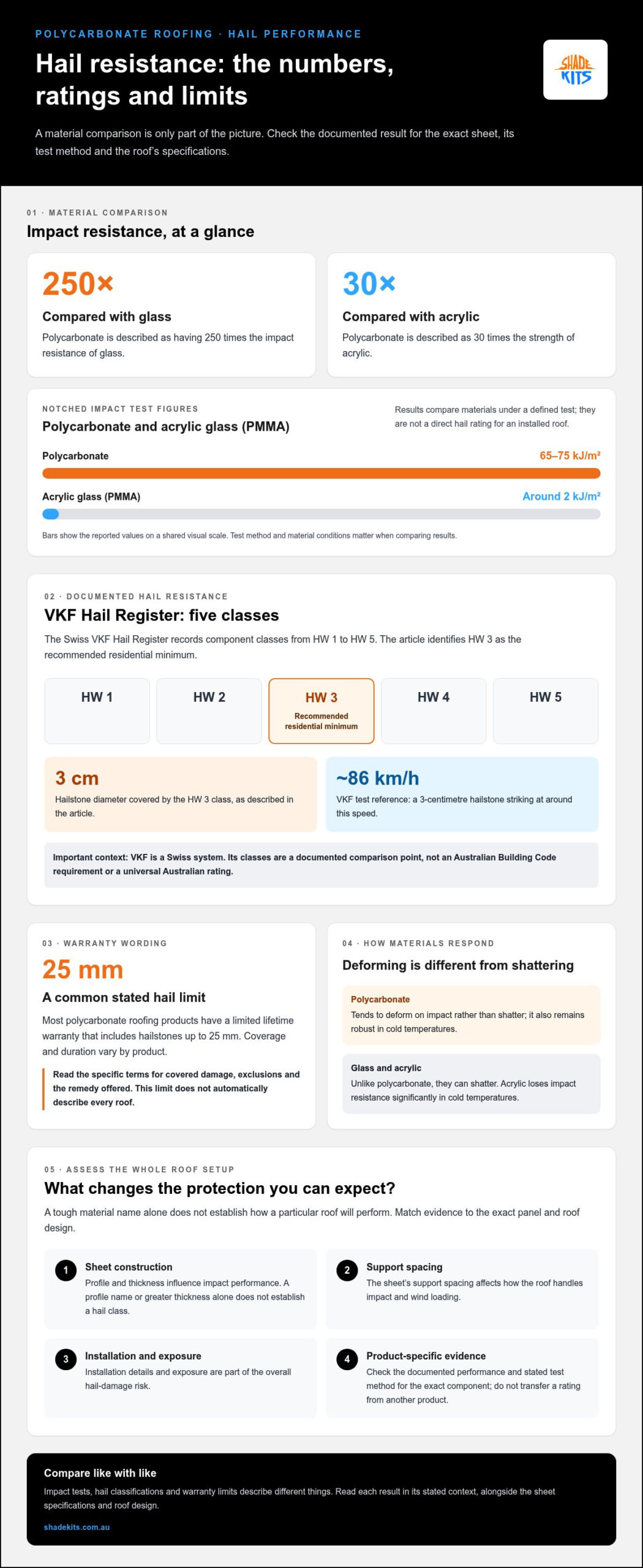
A hail warranty sets out which hail damage a roofing product’s manufacturer will cover, and under what conditions. Polycarbonate roofing warranties differ by product in both covered hailstone size and duration. Most polycarbonate roofing products have a limited lifetime warranty that includes hail damage from hailstones up to 25 mm. That figure is a product-warranty limit, not a universal performance rating for every sheet.
Hailstone size matters because a stated limit defines the impact covered by the warranty. For example, a product warranty covering hailstones up to 25 mm identifies a specific threshold. It doesn’t establish what happens to a sheet hit by larger hail, or guarantee that every impact below the threshold will cause no damage. The exact wording determines what the manufacturer covers.
Read the warranty for the specific product and sheet, rather than applying a general claim to all polycarbonate roofing. Check whether it mentions hail, sets a size limit, states the warranty period and explains the remedy. A limited lifetime warranty still has terms: “lifetime” alone doesn’t explain which damage qualifies or how a claim is handled.
Keep the warranty with the product details. If hail damages the roof, these records help identify the sheet and its applicable terms. Compare any hailstone threshold in the warranty with documented impact results, but don’t treat them as interchangeable. A test result describes performance under specified conditions; warranty wording defines the manufacturer’s coverage.
These details distinguish sheet strength from warranty protection. A product may resist impact, but its warranty sets the conditions for coverage. Similarly, a warranty threshold doesn’t prove every roof assembly will perform identically in hail. For an outdoor structure, assess documented sheet performance and warranty terms separately.
Across Europe, the frequency of particularly severe hailstorms with hailstones larger than 5 centimeters is increasing faster than anywhere else in the world. Northern Germany was struck by tennis ball-sized hailstones on July 13 and 14, 2026.
Profile, thickness and fit all affect how a polycarbonate roof handles weather and impact. Flat and corrugated sheets have different support and joining requirements, so replacement panels must suit the existing roof structure. The sheet specification is a starting point, not a complete measure of hail performance.
Flat polycarbonate roofing is available in thicknesses from 2 mm to 6 mm. The specified rafter distance for flat sheets is 600 mm to 800 mm. Thicker sheeting can span further between supports and cope with higher wind loading, but the roof design still needs to suit the chosen sheet. Standard corrugated sheets are 0.8 mm thick, so don’t assume a flat-sheet thickness or support arrangement applies to corrugated roofing.
Before replacing a corrugated sheet, identify its profile and thickness, then match the replacement to the roof’s corrugations and supports. A mismatch can leave gaps or uneven bearing, affecting how the sheet sits and sheds water. For impact resistance, rely on the replacement product’s documented performance rather than assuming a similar-looking panel has the same specification.
Installation details also matter. Polycarbonate expands with temperature changes, so allow approximately 3 mm of clearance on each side when joining sheets. Leave approximately 50 mm of extra sheet length to overhang into the gutter. These allowances help accommodate movement and direct runoff, while correct support and fastening help the panel remain properly seated.
Keep drilled holes well away from sheet edges. The guidance is to place holes at least twice the hole diameter from the edge; for a 6 mm hole, that means 12 mm. This spacing helps reduce the chance of damage around the fixing point. Follow the sheet system’s fitting details, since fastening through the wrong part of a profile can compromise the fit.
After hail, inspect the sheets, joins and fixings for visible damage. Cracks, loose fixings or displaced panels can affect roof performance, even if the damage seems limited to one area. Replacement may be more suitable than a patch, particularly if a repair would prevent the panel from sitting securely or shedding water properly. Match any replacement to the existing profile and support layout.
What installation details improve polycarbonate roofing resistance to hail damage? Use the correct sheet profile and support spacing, allow approximately 3 mm of joining clearance, and keep holes at least twice their diameter from sheet edges. For a 6 mm hole, maintain 12 mm of edge distance; these details help avoid stress and fitting problems.
For a roof repair, keep sheet specifications and fitting details with the warranty information. These records make it easier to compare a replacement panel with the original, including its profile, thickness and documented impact performance.
Hail damage depends on more than the roofing material. Hailstone size, impact conditions, sheet construction and roof supports all influence how an outdoor roof responds. A polycarbonate sheet may deform on impact, but its performance as part of a roof also depends on secure support and fixings.
Hailstone size and impact energy matter. The VKF test reference discussed earlier uses a 3-centimetre hailstone travelling at around 86 kilometres per hour. That standardised example shows why impact conditions matter when comparing evidence. Real storms can involve hailstones of different sizes and strikes across different parts of a roof, so a single test result doesn’t describe every event.
Sheet thickness and profile affect how a panel handles force. Flat polycarbonate roofing is available from 2 mm to 6 mm, while standard corrugated sheets are 0.8 mm thick. Thicker sheeting can span further between supports and cope with higher wind loading. The material’s thickness alone doesn’t establish a hail class; the profile and supporting structure also shape how impact is transferred.
Support spacing is another key factor. For flat polycarbonate sheets, the stated rafter distance is 600 mm to 800 mm. A roof’s actual support layout should suit its selected sheet and design. If a panel flexes between supports, impact loads are handled differently than when it is closely supported. The right configuration therefore matters alongside the sheet specification.
Fixing details can influence local damage. A hole placed too close to a sheet edge may leave less material around the fastener. For a 6 mm hole, the stated guidance is to keep it 12 mm from the edge. When joining sheets, allow room for expansion rather than forcing the panels tightly together.
The sheet’s condition matters too. Polycarbonate isn’t scratch resistant and may become scratched or dented if precautions aren’t taken. A panel with surface damage or compromised fixings may respond differently from an intact, correctly fitted sheet. After hail, inspect for cracks, dents, displaced panels and loose fixings. Distinguish surface marks from damage that affects the sheet’s fit or function.
Assess documented impact evidence alongside the complete roof design. Compare the exact sheet profile, thickness, support spacing and fixing arrangement instead of relying on a generic material claim. These factors help explain why two polycarbonate roofs may have different outcomes in the same hailstorm.
Shade Kits offers Carport Kits for people planning covered vehicle protection and comparing roofing options for their property. Its factory-direct DIY kits are designed for Australian homes and weather conditions, with durable aluminium frames and UV-resistant polycarbonate roofing.
Choose a carport kit for an outdoor structure that helps shield a vehicle from hail, rain and harsh sun. Pergola Kits, Awning Kits and Patio Covers suit other sheltered outdoor spaces. When comparing options, consider the structure’s purpose, roofing material, documented impact performance and warranty terms. This helps align your weather-protection needs with the project.
For a carport project, explore Shade Kits’ carport kits. Contact Shade Kits to discuss your project.
Use the polycarbonate roofing hail rating as one part of your project brief, alongside the area you want to cover and how you’ll use it. A clear brief helps you compare roof structures and identify relevant documentation. Think beyond the sheet: the finished roof needs to work as a complete system for your home and outdoor space.
Shade Kits offers Carport Kits, Pergola Kits and Awning Kits for vehicle cover and sheltered outdoor areas. Choose a structure that suits your plans, then assess the roofing material and its documented performance together. A clear decision now can make the next stage of your project easier to manage.
Ready to explore roofing options for your project? Contact Shade Kits about roofing options and take the next step with confidence.
Modern polycarbonate roofing can combine daylight transmission, UV protection and impact resistance. For an outdoor area, consider whether you prioritise filtered light, reduced heat or a clear roof, as sheet properties differ. The polycarbonate roofing hail rating is one part of assessing suitability; also consider surface care and condensation conditions. Polycarbonate can block harmful UV rays, and some roofing can reduce summer heat by as much as 69%.
There isn’t one hailstone size that applies to every polycarbonate roof because product specifications and warranty terms vary. The polycarbonate roofing hail rating should be considered alongside the specific sheet and its coverage terms. Many products have limited lifetime warranties covering hailstones up to 25 mm, but that describes a warranty limit, not a universal guarantee against damage. Read the terms to understand what the manufacturer covers.
Polycarbonate is described as having 250 times the impact resistance of glass, and it tends to deform rather than shatter. Metal roofing uses a different material and construction, so compare the specifications for the exact products rather than assuming one broad ranking applies. For glass, consider both impact performance and the consequences of breakage. The roof’s support and fixing design also shape how the complete assembly responds to hail.
Material type alone can’t establish a brand or profile ranking. Compare the exact sheet’s documented impact result, test method and thickness.