
Is that extra three metres of width really just for a second car, or is it the secret to future-proofing your home’s value? Most homeowners start their search simply looking for a bit of shade, but they quickly realise that the choice between a single and a double carport involves much more than just vehicle count. You probably know the frustration of a cluttered driveway where guest parking is a constant headache, or the stress of watching a summer storm roll in while your car sits exposed to potential hail damage.
It’s a common challenge, and you’re right to be cautious about making the wrong structural choice for your block. We promise to clarify the practical differences between these two options so you can choose the perfect protection for your vehicles and lifestyle. We will provide a clear breakdown of dimensions, explain how to handle local council requirements for larger structures, and show you how a weather-resistant DIY kit can add genuine value to your property. By the end, you’ll have the confidence to select a solution that stands up to the Australian climate while keeping your driveway organised and functional through 2026 and beyond.
Choosing a structure for your driveway isn’t just about counting your current cars. It’s about how you use your home every day. While a standard Carport provides essential shelter, the decision between a single or double footprint usually comes down to long-term utility. In 2026, more Australian homeowners are moving away from “just enough” space toward structures that offer genuine versatility. Whether you’re shielding a new EV from intense UV rays or creating a dry spot for the kids to play, the right choice depends on your specific block and your five-year plan.
Australian weather is notoriously tough on vehicle paintwork and interiors. A high-quality carport kit with UV-resistant polycarbonate roofing acts as a shield against the sun and sudden hail. Evaluating your needs means looking at your current lineup and considering if you’ll soon have a teenager’s car, a new boat, or simply a need for extra undercover storage. Thinking ahead prevents the need for a costly upgrade later.
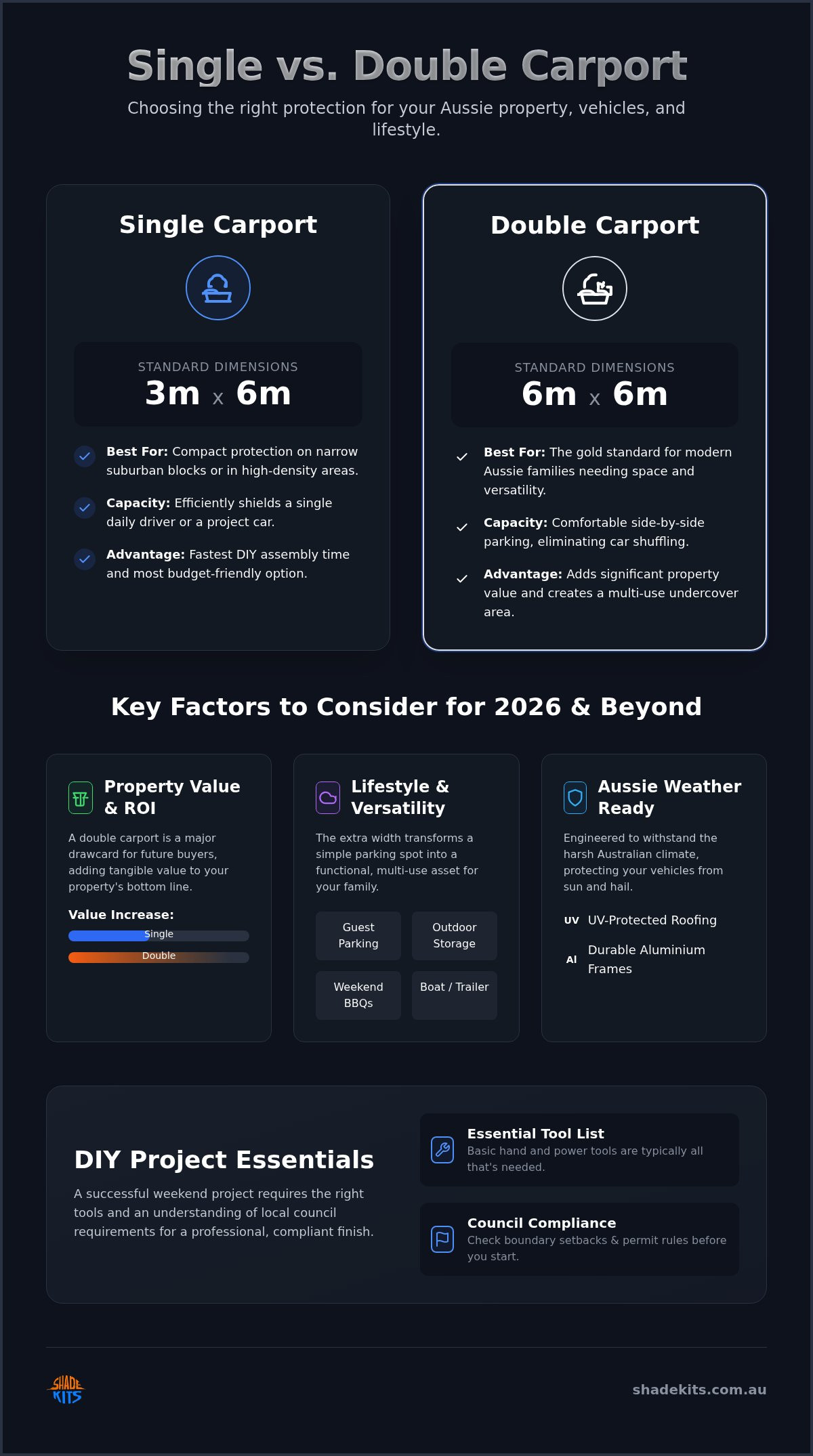
Single carports remain a staple for high-density urban areas or narrow suburban blocks. They are the most efficient way to provide professional-grade protection without a massive footprint. If you’re looking for a secondary shelter or have a tight budget, these kits offer the fastest DIY assembly time. They’re ideal for shielding a single daily driver or a vintage project car while keeping the rest of the driveway clear for movement. For many, it’s the perfect balance of function and space efficiency.
The double carport has become the gold standard for modern Aussie families. It provides side-by-side protection, which means no more car shuffling on Monday mornings. Beyond vehicles, the extra width creates a functional undercover area for weekend BBQs or a sheltered spot for a trailer. From a resale perspective, a double structure is a major drawcard. Most buyers in the current market look for at least two covered parking spots. This makes the larger kit a smart investment that adds tangible value to your property’s bottom line.
Choosing the right size for your structure requires more than a quick glance at your driveway. In Australia, a standard single carport typically measures around 3.0 metres wide by 6.0 metres long. This provides enough room for a standard sedan or a small SUV. However, if you’re looking at a double carport, the footprint expands to approximately 6.0 metres by 6.0 metres. This extra width is what transforms the space from a simple parking spot into a multi-use asset.
| Carport Type | Standard Width | Standard Length | Typical Entry Height |
|---|---|---|---|
| Single Kit | 3.0m | 6.0m | 2.4m |
| Double Kit | 6.0m | 6.0m | 2.4m |
Measuring your block is the first critical step. You must account for “swing room,” which is the space needed to fully open vehicle doors without hitting posts or the car parked next to you. It’s also vital to check your boundary setbacks and local council permit requirements. While specific rules vary significantly between councils and states across Australia, understanding these regulations early on will ensure your carport complies with local planning schemes and property line restrictions.
A width of 5.5 metres might sound sufficient, but it’s the absolute bare minimum for two modern SUVs. If you want to avoid door dings, aiming for a full 6-metre width is much safer. Post placement is equally important. You don’t want a structural post positioned exactly where your driver-side door needs to swing open. If you plan to store wheelie bins or mountain bikes along the side, adding an extra 50 centimetres of width will save you a lot of daily frustration. You can browse our range of sizes to find the exact dimensions that suit your driveway layout.
Don’t forget to look up. A standard kit usually offers a clearance height of around 2.4 metres. This is plenty for most cars, but it’s a tight squeeze for a 4WD with a lift kit and a roof rack. If you have a caravan or a boat with a high cabin, you’ll need a high-clearance kit. The roof style also plays a role. A flat roof provides consistent height across the entire span, while a gable roof offers more internal vertical space in the centre. Planning for a future vehicle upgrade now ensures your kit won’t become obsolete if you switch to a larger car next year.
Many homeowners assume that a double carport will cost twice as much as a single model. In reality, the price jump is much smaller than you might expect. While you’re adding more roofing and wider beams, the base engineering and shipping logistics remain similar. Choosing a factory-direct DIY kit allows you to bypass the significant markups often found with on-site builders and traditional retailers. It’s a pragmatic way to get professional-grade protection without the professional price tag.
By handling the assembly yourself, you can save thousands on labour costs. Professional installers typically charge between $500 and $1,500 for a basic setup, and those costs only rise for larger structures. When you opt for a kit designed for the home handyman, that money stays in your pocket or can be reinvested into other home improvements. The long-term savings continue with your choice of materials. Aluminium frames and polycarbonate roofing are the savvy choice for the Australian climate because they don’t require the constant sanding, painting, or rust-treatment that timber and steel often demand.
When you break down the components of a kit, you aren’t doubling every single part. You might use the same number of posts or perhaps just two extra, but the main increase is in the span of the beams and the number of polycarbonate sheets. Standard kit sizes are significantly cheaper than custom fabrication because the parts are precision-engineered in bulk. Avoiding custom tweaks keeps the project simple and ensures every component fits together perfectly on the first try. It’s the most cost-effective way to achieve a high-end finish on a budget.
For a typical three-bedroom Australian home, undercover parking for two vehicles is almost a requirement for modern buyers. A single carport might leave one car exposed, which can be a deal-breaker during a resale. A well-integrated double structure improves the street appeal of your home, especially when you match the frame colour to your existing gutters or roofline. It’s a structural upgrade that offers a high return on investment because it solves a logistical problem for the next family. For those looking for more budget-friendly options, check out our Inexpensive Carport Kits: A Savvy Australian Buyer’s Guide (2026) for more tips on balancing cost and quality.
Assembling a double carport isn’t necessarily more complex than a single, but it does require more coordination. While the assembly logic remains the same, the wider spans mean the beams are longer and heavier. You’ll definitely need a second set of hands to manage the structural components safely. Choosing a kit with aluminium frames makes this process much easier for the average homeowner. Aluminium is significantly lighter than traditional steel or timber, making it manageable for a two-person weekend project without needing specialised lifting equipment.
Before you start, gather your essential tools. A successful build relies on having a high-quality power drill with a socket set, a long spirit level, a measuring tape, and at least two sturdy ladders. Accuracy is everything when you’re working with a larger footprint. If your frame isn’t perfectly square from the start, the roof sheets won’t align correctly. For a step-by-step breakdown of the process, you can refer to The Ultimate Guide to DIY Carport Kits in Australia (2026) to ensure you have every detail covered before the delivery truck arrives.
Because a double carport covers a larger area, it may be subject to different local regulations than a smaller single structure. Most Australian councils have specific “exempt development” criteria that define how large a structure can be before it requires a formal building permit. These rules often focus on your property’s set-back requirements, which is the minimum distance allowed between the carport and your front or side boundaries. It’s a quick but vital check to make with your local planning office to avoid any compliance issues down the track.
Structural integrity starts at the ground level. You generally have two choices for securing your kit: “in-ground” posts that are set into concrete footings or “on-slab” base plates that bolt directly onto an existing concrete driveway. If you’re using an existing slab, ensure it’s thick enough and in good condition to support the weight and wind load of a larger structure. Leveling the site is non-negotiable. Even a slight slope can cause water to pool in the gutters or lead to a crooked frame. Taking the time to prep the surface properly ensures your carport remains stable through decades of Australian storms.
Ready to start your project? You can view our range of DIY-friendly carport kits and find the perfect fit for your driveway today.
Investing in a double carport is a decision that impacts your property’s daily function and its long-term market value. At Shade Kits, we’ve refined the DIY experience by focusing on materials that solve the specific challenges of the Australian environment. We understand that a structure this size needs to be resilient, easy to maintain, and simple to put together. By choosing our factory-direct model, you’re bypassing the typical retail markups and receiving a precision-engineered kit that has been tested against the harshest local conditions.
Our choice of materials sets us apart from traditional hardware store options. We use high-grade aluminium frames because they offer a superior strength-to-weight ratio compared to timber or steel. Aluminium is naturally resistant to corrosion, meaning it won’t rust, rot, or warp over time. This is particularly important for larger structures where maintenance can be a time-consuming chore. Every kit comes complete with all the necessary hardware, from the posts and beams to the smallest fasteners. This ensures you won’t have to make mid-project trips to the shops for missing components.
The Australian sun is the primary enemy of your vehicle’s paintwork and interior. Our kits feature UV-resistant polycarbonate roofing as standard, which blocks 99% of harmful UV rays while still allowing natural light to filter through. This material is also incredibly impact-resistant, providing a vital layer of defence during the sudden hailstorms that frequently sweep across the country. For those who require even more flexible options for extreme weather, we also offer The CarCave: Foldable Protection for Hail Defence as a non-permanent alternative.
We’re more than just a kit supplier; we’re your partner in the building process. Our team is committed to helping Aussie DIYers achieve professional results without the need for expensive contractors. We provide clear documentation and support to ensure your assembly goes smoothly from the first post to the final roof sheet. No matter where you live, from metropolitan centres to regional towns, we offer reliable nationwide delivery to your door. You can explore our full range of Carport Kits to see the different styles and finishes available for your home.
Choosing a double carport is about more than just finding a spot for the second car. It’s a strategic move to future-proof your home’s resale value while gaining a versatile undercover space for storage or entertainment. The key to a successful project lies in selecting materials like aluminium and UV-resistant polycarbonate that can withstand the intense Australian sun and sudden hail without requiring constant maintenance.
By opting for a factory-direct DIY kit, you can achieve a professional finish while avoiding high retail markups and expensive installation fees. We’ve simplified the process with precision-engineered components and expert support to guide you through every step of the assembly. Whether you’re in a metro centre or a regional town, our reliable Australia-wide delivery ensures your vehicle protection arrives right at your door.
Browse our range of durable Double Carport Kits to find the perfect fit for your lifestyle. You’ve got the plan; now it’s time to build a structure that stands the test of time.
Most councils in Australia require a building permit for permanent structures, though some smaller carports fall under exempt development rules. You should always contact your local planning office to confirm the specific setback and size limits for your block. Failure to obtain the correct approvals can lead to fines or the required removal of the structure later on, so a quick check first is essential.
The standard dimensions for a double carport in Australia are approximately 6.0 metres wide by 6.0 metres long. This footprint provides enough space for two modern vehicles while allowing room for doors to open without hitting structural posts. If you have larger 4WDs or plan to store bikes along the side, you might consider a slightly wider layout to ensure comfortable daily access.
A DIY double carport kit typically takes two people one full weekend to assemble from start to finish. The first day is generally dedicated to site preparation and standing the main frame, while the second day focuses on the roofing and finishing touches. Having a second set of hands is essential for safely lifting the longer beams and roof sheets into place during the build.
You can certainly install a kit on an existing concrete driveway using heavy-duty base plates and masonry anchors. It’s vital to ensure your concrete slab is in good condition and has a minimum thickness of 100mm to support the structural load. If the driveway is cracked or too thin, you may need to cut out sections and pour deeper concrete footings for better stability.
Aluminium is often the better choice for the Australian climate because it is completely resistant to rust, rot, and termite damage. Unlike timber, which requires regular sanding and staining to prevent warping in the sun, aluminium frames only need an occasional wash. The lightweight nature of the material also makes the DIY assembly process much safer and faster for homeowners working on their own.
High-quality polycarbonate roofing is engineered to be virtually unbreakable and can easily withstand standard Australian hailstorms. These sheets are designed with a high impact resistance that prevents cracking or shattering during severe weather. Most kits are also rated for specific wind regions, ensuring the structure remains stable even during the intense gusts often seen in coastal or open rural areas.
Yes, the open design of these structures makes them incredibly versatile for use as a pergola or undercover entertainment area. Many homeowners use the space for weekend BBQs or as a sheltered play area for children when cars are parked elsewhere. This flexibility is one of the main reasons why larger footprints are becoming the preferred choice for modern Australian backyards and driveways.
You’ll need a standard set of household tools including a cordless drill with a socket set, a spirit level, a measuring tape, and at least two ladders. A chalk line and a string line are also helpful for ensuring the posts are perfectly aligned and square. Most kits arrive with all the specialised fasteners included, so you won’t need to purchase any heavy machinery or professional equipment.