
A carport kit’s wind rating may look suitable on paper but still fail to account for conditions at your property. That’s the key question when comparing wind rated carport kits australia: does the documented design basis match your site and the way the structure will be installed?
It’s reasonable to want evidence that a kit’s design suits your wind exposure, rather than relying on a broad marketing claim. Wind suitability can depend on more than your wind region. Terrain, nearby buildings, topography, the carport’s design and dimensions, and the footings can all affect the assessment.
This guide explains what to check before choosing a DIY carport kit, including the wind classification and engineering documents to request, how site conditions affect the design, and which footing and assembly requirements to confirm. It also covers Australian standards and approval considerations, including AS/NZS 1170.2:2021 and the NCC 2022. Use these checks to assess whether the kit’s documented performance applies to your property before ordering or starting installation.
A wind rating is a design reference, not a blanket promise that a carport will suit every property. It describes structural performance under stated assumptions. Those assumptions need to match the proposed kit, its configuration and the conditions at the installation site. When comparing wind rated carport kits australia, ask not only “Is it rated?” but also “What does the rating cover, and does that basis apply here?”
A classification or engineering document describes the conditions a structure has been designed for. It isn’t a universal guarantee, and the terminology or classification should be checked against current Australian references. A wind rating also differs from material durability: a frame’s corrosion resistance or a roof’s weather resistance doesn’t establish how the complete structure performs under wind loads.
Ask for the design basis behind any stated rating. Check whether the documents identify the relevant wind classification, kit dimensions and configuration, along with any limits or assumptions. A broad “wind rated” label without supporting information doesn’t show whether the design accounts for your property or the way the kit will be assembled and anchored.
Wind exposure varies between sites. Open surroundings, nearby buildings, terrain and local landform can affect the wind loads a structure needs to resist. Neighbouring buildings may provide shielding, but don’t assume this makes a site suitable without assessment. The design basis needs to reflect the proposed carport’s actual position and surroundings.
Australian guidance provides a framework, but it still needs to be applied to the individual property. The National Construction Code (NCC) is an overview of the national code framework. Verify current code and wind-design requirements for your project with the relevant authoritative sources. AS/NZS 1170.2:2021 is the wind-actions standard identified in the NCC 2022; check how it applies to the specific design.
Before comparing options, gather accurate site details and ask how they relate to the kit’s documented design assumptions. If a supplier can’t explain which configuration and site conditions its evidence covers, don’t treat the marketing phrase as proof of suitability. Check the documented design basis, not just the label.
National wind-design references provide a framework, but choosing a suitable carport still depends on how those requirements apply to the proposed structure and site. AS/NZS 1170.2:2021 addresses wind actions, while the National Construction Code (NCC) sets out building requirements. Check the edition and provisions that apply to your project rather than relying on an old document or a rating taken out of context.
A wind classification only helps you choose a kit when its design assumptions reflect conditions at the installation site.
Start by recording where the carport will sit and what surrounds it. Note nearby buildings, whether the site is open or sheltered, the terrain and any changes in landform that may affect exposure. Include the planned dimensions and position of the structure. This information helps a qualified professional assess what else is needed and whether the proposed design basis is relevant.
Don’t assume neighbouring buildings remove wind-design requirements. Their location and shielding effect need to be considered as part of the assessment, not treated as a substitute for one. As a DIY buyer, provide accurate site details and request the right documents, rather than attempting to certify the structure yourself.
Confirm which NCC edition and wind-design standards apply to your project, and whether the kit’s supporting documents address them. The Australian Building Codes Board’s National Construction Code Housing Provisions are an official reference. Check current requirements and project relevance before relying on any edition. AS/NZS 1170.2:2021 is a key wind-actions reference; ask how the supplier’s engineering documents apply it to your selected configuration and site assumptions.
Approval steps aren’t necessarily identical across Australia. Ask the relevant local authority what applies to your property and proposed structure, and whether additional documentation or assessment is required. Kit documents can support your checks, but they don’t replace advice from the authority or a qualified professional where needed.
Once you’ve gathered site information and clarified the applicable requirements, compare the documents with the kit you’re considering. You can view DIY carport kit options as part of that process, then confirm the specific design evidence and assembly conditions before ordering.
Start a comparison with documents, not a headline claim. For wind rated carport kits australia, check whether each supplier’s evidence relates to the exact kit you’re considering and the conditions at your property. A rating shown for one size or configuration may not cover another.
Ask for the relevant engineering documentation and the assumptions behind any stated wind classification. Check that it identifies the kit configuration, including dimensions and roof arrangement, and explains any site conditions or installation limits. If documents are missing, unclear or appear out of date, ask for clarification before ordering. Don’t treat a general marketing statement as proof.
| What to compare | What to check |
|---|---|
| Claimed rating | Is the classification stated clearly, with its design basis explained? |
| Engineering documents | Do they identify the kit and configuration you intend to buy? |
| Site assumptions | Are the assumed exposure, terrain or other site conditions relevant to your property? |
| Assembly requirements | Are the specified connections, footings, anchoring and installation conditions clear? |
Review the structure as a complete system. Frame material alone won’t tell you how the connections, roof components and anchoring perform together. Check that the documents and assembly instructions address the components and installation conditions required for the stated design. Ask whether changing dimensions or components affects the evidence.
Shade Kits describes its DIY carport kits as having aluminium frames and UV-resistant polycarbonate roofing. These material features aren’t evidence of a particular wind rating, certification or structural capacity. Check the selected kit’s product-specific engineering information before relying on it for your project.
Before you decide, ask the supplier:
Compare the answers with the kit documents, and seek qualified advice if the site assumptions or design implications aren’t clear. You can review Shade Kits carport kits as one option, then check the relevant product documentation before choosing.
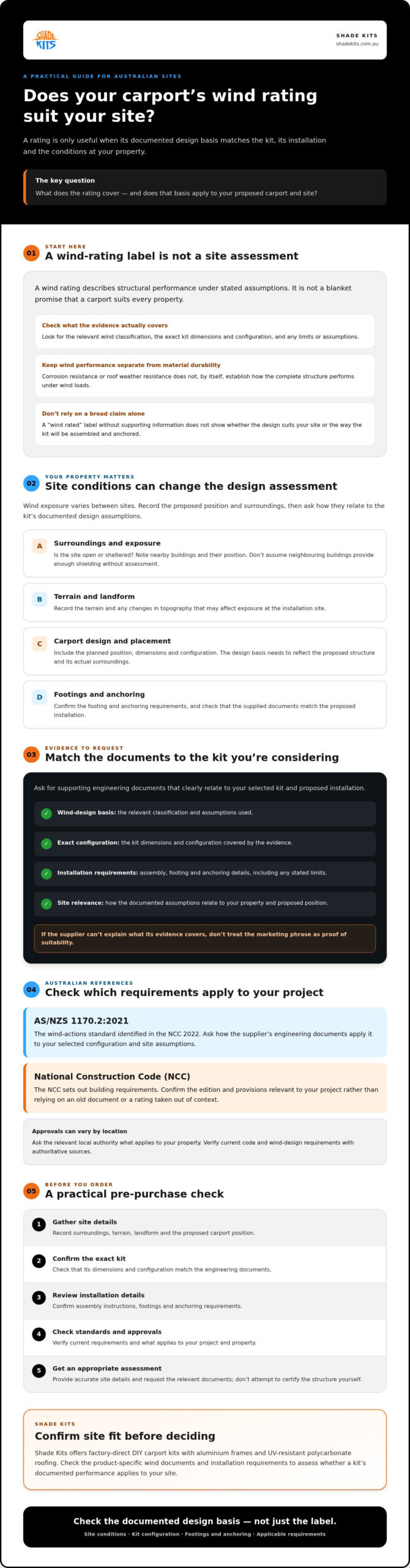
Preparing the key details makes it easier to compare wind rated carport kits australia and identify what still needs checking. Work through these steps before committing to a kit or beginning assembly.
Read the full assembly instructions and check that the supplied components, foundation requirements and anchoring details align with the documents for your chosen kit. Don’t change the configuration or assume a different base will be suitable without confirming the design implications. Follow the supplied instructions and any applicable advice from a qualified professional.
Clarify who is responsible for approvals and arranging any required assessment. Shade Kits supplies factory-direct DIY carport kits and doesn’t provide on-site installation labour, so plan how assembly will be completed.
Before proceeding, use your site measurements and checklist to compare the proposed location, base and anchoring requirements with the kit’s own documentation. You can also browse Shade Kits carport kits while assessing options, then check the specific configuration and supporting information before ordering.
Shade Kits supplies factory-direct DIY carport kits across Australia. They may suit a project where you can check site requirements, arrange any needed professional advice and manage assembly. The business states that its kits feature aluminium frames and UV-resistant polycarbonate roofing, with Australia-wide delivery.
Those material features don’t confirm a kit’s wind rating or prove it’s suitable for a particular property. Before choosing a configuration, check the product-specific engineering documents and confirm which site conditions, dimensions, footings and assembly method they cover. If the evidence for the exact kit isn’t clear, ask for clarification before ordering.
A DIY kit may suit a project where you can follow the supplied assembly requirements and organise site and documentation checks. Start with your intended use, available space and site conditions, then compare those details with the documents for the configuration you’re considering. Don’t infer wind performance from the frame or roofing material alone.
Complete your site checklist and note any unanswered questions about engineering documents, anchoring, assembly or local approval requirements. Use the DIY carport kit range to review available options after defining your requirements. Keep your measurements and checklist handy as you compare the selected configuration with its supporting information.
Before placing an order, ask focused questions: Do the documents match the exact kit configuration? What site assumptions apply? Are the base and anchoring requirements clear? Check the answers against the supplied information and seek qualified advice where needed. If you’re comparing wind rated carport kits australia, confirm site fit and supporting evidence first, then explore the carport range when you’re ready.
A wind rating is useful only when the documented design assumptions fit your site and the exact kit configuration you’re considering. Before choosing wind rated carport kits australia, check the supporting engineering documents, confirm site conditions and verify footing, anchoring and assembly requirements. Also check current approval requirements with the relevant authority for your project.
Shade Kits supplies factory-direct DIY carport kits across Australia, featuring aluminium frames and UV-resistant polycarbonate roofing. These features don’t confirm a particular kit’s wind suitability, so request and review product-specific documentation before ordering. Australia-wide delivery is available, while planning and assembly remain part of the DIY project.
Once you’ve clarified your site needs, explore the Shade Kits carport kits and compare the available options against your checklist. Ask focused questions before committing if any design or installation detail is unclear. Review the range and check the supporting documents for the configuration you’re considering.
A wind rating describes the wind conditions a carport’s design is intended to resist under stated assumptions. For wind rated carport kits australia, the useful evidence is the supporting engineering documentation, not the label alone. Check which kit dimensions and configuration the documents cover, and whether their site assumptions apply to your property. A rating doesn’t automatically guarantee suitability for every location or installation.
You’ll need to consider your property’s wind exposure and the proposed structure, rather than choosing a rating based only on a broad regional label. Terrain, landform, nearby buildings and shielding can affect the design assessment. Record the planned location and dimensions, then ask a qualified professional or relevant authority what site information is needed. Confirm that the supplier’s engineering documents address those conditions and the exact kit configuration.
No. A kit’s documented design assumptions may not match every property, even if the kit carries a wind classification. Exposure, surrounding structures, terrain, topography, dimensions, placement, footings and assembly conditions can all affect whether the design is appropriate. Check the documents against your site and the specific configuration you plan to buy. If the assumptions or their relevance aren’t clear, ask the supplier or seek qualified advice before ordering.
Request the relevant engineering documents and details of the design assumptions behind the stated wind classification. Check that they identify the exact kit configuration, including its dimensions, and set out applicable site, assembly, footing and anchoring requirements. Ask whether component changes or different installation conditions affect the documents. If the evidence is generic, unclear or appears outdated, seek clarification and verify current project requirements before relying on it.
Approval requirements depend on the project and the rules that apply to your property, so check with the relevant local authority before starting work. Ask what approvals, plans or supporting documents are required for your proposed carport, and whether any exemptions apply. Don’t assume a DIY kit is exempt or that requirements are the same across Australia. Confirm the current process for your project before ordering or assembling the structure.
You may be able to assemble a DIY carport kit yourself if you can follow the supplied instructions and meet applicable project requirements. Before starting, check the component list, assembly sequence, base and anchoring details, and any site-specific conditions in the kit documents. Arrange any required approvals or professional assessment first. Shade Kits supplies DIY kits but doesn’t provide on-site installation labour, so plan how assembly will be completed.
Aluminium alone doesn’t establish whether a carport is suitable for a high-wind site. Performance depends on the design of the complete structure, including its frame, connections, roof, footings and anchoring, as well as site conditions and installation. Check product-specific engineering documents for the exact configuration and confirm that their assumptions suit your property. Don’t infer a wind rating or structural capacity from a material description.