
What if the most popular shade solution isn’t actually the one built to survive a true Australian summer? When you’re searching for the ideal awnings, it’s easy to get caught up in aesthetics while overlooking the structural integrity needed to handle high UV levels and sudden storms. You likely already know the frustration of watching your indoor temperatures soar and your outdoor furniture fade under the harsh sun. It feels like a constant battle against the elements that’s reflected in your monthly energy bills.
At Shade Kits, we’re here to help you stop the guesswork. You’ll discover the critical differences between fixed and retractable systems, ensuring you invest in a shade that lasts for years rather than one that requires constant maintenance. We will break down the benefits of aluminium and polycarbonate kits, explore how DIY options help you save on professional labour costs, and provide a clear path to a cooler, more comfortable home.
An awning is a secondary covering attached to the exterior wall of a building, acting as a functional extension of your roofline. While they certainly add character to a facade, their primary job is far more practical. They block harsh UV rays before they ever reach your window glass. This distinction is vital because once sunlight passes through a pane of glass, it creates a greenhouse effect that’s difficult to reverse with air conditioning alone. For a comprehensive overview of awnings, it’s clear they have evolved from simple fabric sheets into high-performance structural assets designed for longevity.
When you’re looking at different awning awnings, you’re essentially choosing between a singular focal point or a cohesive multi-unit shade strategy. By stopping heat gain at the source, these structures can lower indoor temperatures by several degrees. This doesn’t just make your living room more comfortable; it directly impacts your energy bills by reducing the strain on your cooling systems. Additionally, blocking direct sunlight protects your expensive indoor furnishings, such as timber flooring and leather lounges, from the bleaching effects of UV exposure.
External shade is significantly more thermally efficient than internal blinds or curtains. While an internal blind might stop the glare, the heat has already entered the room and is trapped against the glass. In our local climate, where summer temperatures frequently exceed 35 degrees, UV-resistant materials like aluminium and polycarbonate are essential for long-term performance. In 2026, external awnings are formally recognised as key contributors to BASIX and nationwide energy ratings by substantially lowering the cooling load required for residential homes. Choosing durable materials ensures your shade solution won’t crack or fade under the intense Australian sun.
Distinguishing between these two options is a matter of scale and intended use. Window-specific shades are designed for targeted protection, usually covering a single opening to keep a bedroom or study cool. Larger patio covers act as permanent roof extensions, creating a durable outdoor entertaining space that can be used regardless of the weather. Your choice often depends on the orientation of your home. West-facing windows typically require deep-projection shades to block the low, hot afternoon sun, while North-facing areas might benefit from a wider patio cover to provide year-round utility. Common installation sites include decks, poolside areas, and main entrances where weather protection is a daily necessity.
Choosing between a permanent structure and one that folds away is more than a style preference. It’s about how you use your outdoor space daily. While some homeowners prefer the versatility of a retractable arm, others find that a fixed awning awnings strategy provides better long-term reliability. A fixed system is a “set and forget” solution that remains in place regardless of the wind speed or a sudden downpour. It provides a constant barrier against the elements, which is essential for protecting your home’s exterior and maintaining a stable indoor temperature.
Over a ten-year period, fixed aluminium and polycarbonate kits often prove to be the most cost-effective choice for Australian households. They don’t have mechanical arms that can seize or motors that might burn out. Because there are no moving parts, the structural integrity remains constant year after year. According to the Australian Government’s guide to shading, the most effective devices are those that are specifically designed for the sun’s path at your specific latitude. Fixed structures allow you to precisely calculate this angle once and enjoy the benefits permanently without the need for manual adjustment or seasonal maintenance.
If your home is located in a coastal region or a high-wind corridor, a fixed kit is almost always the superior option. These structures are engineered for resilience. They use rigid aluminium frames that won’t rust, warp, or rattle during a storm. For the DIY enthusiast, these kits offer a straightforward assembly process without the complexity of tensioned springs or electrical wiring. You can explore a range of durable awning kits that are designed to withstand local conditions without the need for constant supervision. This makes them ideal for rental properties or second homes where you aren’t always present to retract a fabric shade when the weather turns.
The primary appeal of a retractable system is flexibility. You can retract the cover in winter to let the sun warm your home, then extend it in summer for shade. However, this convenience comes with significant trade-offs. When comparing different awning awnings, consider that fabric covers are susceptible to mould and UV degradation over time, even when using high-quality acrylics. Whether you choose a manual crank or a motorised sensor, you are introducing potential points of failure that fixed frames simply don’t have. Retractable arms are also vulnerable to “sailing” in the wind, which can put immense pressure on your home’s brickwork or cladding if the mechanism isn’t stowed away in time.
When evaluating different awning awnings for your property, the material composition is the single biggest factor in long-term performance. In the harsh Australian environment, materials are pushed to their absolute limits. While traditional canvas or acrylic fabrics have been the standard for years, they often struggle with the sheer intensity of our UV levels and the moisture of coastal air. Choosing between metal, plastic, or fabric isn’t just an aesthetic decision; it’s a choice about how much time and money you want to spend on repairs in five years’ time.
Aluminium frames provide a level of structural integrity that timber and plastic alternatives simply cannot match. Timber requires constant sanding and painting to prevent rot, while many plastics become brittle and crack after just a few seasons in the sun. Aluminium is naturally resistant to rust, making it the ideal choice for homes near the ocean where salt spray destroys lesser metals. When paired with polycarbonate roofing, you get a shade solution that blocks heat while still allowing natural light to filter through, preventing your patio from feeling like a dark cave. For a deeper look at how a durable aluminum awning can reduce solar heat gain by up to 77%, our 2026 guide covers the latest material standards and installation best practices for Australian homes.
The resilience of these materials comes down to their chemical stability. Fabric awnings are prone to fading, tearing in high winds, and developing mould in humid climates. In contrast, high-quality polycarbonate panels feature integrated UV-resistant coatings that prevent the “yellowing” effect common in cheaper plastics. These panels are specifically designed for impact resistance. High-grade polycarbonate panels are engineered to withstand significant impact, meaning they won’t shatter or tear during a typical Australian hailstorm like glass or fabric often do. This makes them a much safer investment for homeowners in storm-prone regions.
Maintenance is where the gap between materials becomes most apparent. Fabric options require regular deep cleaning with specialised detergents to prevent permanent staining and mildew growth. Aluminium and polycarbonate systems are significantly easier to manage. Cleaning is simple; a quick hose-down every few months is usually enough to remove salt, dust, and debris. This “low-touch” approach is perfect for busy households. To ensure the longest possible lifespan under 2026 climate conditions, ensure your aluminium frames are powder-coated. This industrial finish provides an extra layer of protection against the elements, ensuring the colour stays vibrant and the metal stays protected for decades without the need for repainting.
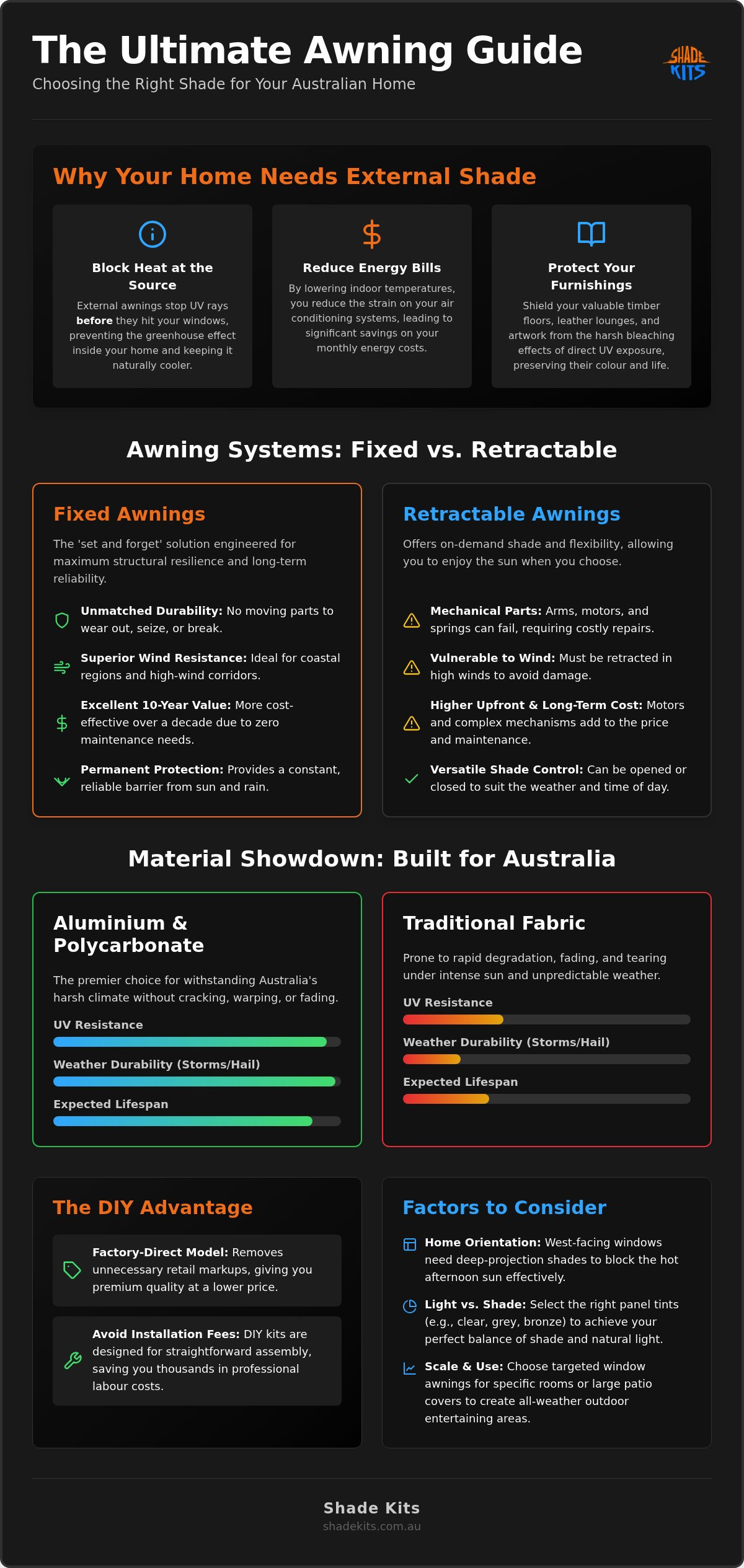
Before you commit to a purchase, a thorough site assessment is your most important step. It isn’t just about what looks good on the facade; it’s about how the structure interacts with the sun’s path and your home’s existing architecture. Choosing between various awning awnings requires a balance of thermal performance and spatial planning. You also need to consider how colour choice impacts your daily comfort. While clear panels maximise natural light, darker tints like grey or bronze are far more effective at reducing glare and heat gain in high-exposure areas.
Local council regulations are another critical factor for permanent external structures. While most small window coverings don’t require formal approval, larger patio covers or structures that extend significantly from the boundary might. In Australia, building permits for larger installations can range from A$150 to A$500 depending on your specific council. It’s always best to have a quick chat with your local planning office to ensure your project meets all site-specific requirements before you begin the assembly process.
The efficiency of your shade depends entirely on the sun’s angle. North-facing windows receive high-angle sun in the middle of the day, meaning you can often achieve great results with a shallower projection. West-facing windows are the real challenge. They face the low, intense afternoon sun that can shine directly under a short awning. You’ll need to calculate the “projection”-the distance the kit extends from the wall-to ensure the glass remains shaded during the hottest parts of the day. Always double-check that your chosen mounting height provides enough clearance for doors and windows to swing open without hitting the frame.
One of the biggest advantages of modern factory-direct kits is the significant cost savings on labour. Professional installation in Australia typically costs between A$75 and A$100 per hour, which can quickly double the total price of your project. Our kits are designed for straightforward assembly using standard household tools like a cordless drill, a spirit level, and a sturdy ladder. If you can follow a logical sequence of instructions, you can achieve a professional-grade result yourself. For those looking to expand their DIY skills even further, you might find our Ultimate Guide to DIY Carport Kits in Australia (2026) a helpful resource for understanding larger structural projects.
If you’re ready to transform your outdoor space with a durable, easy-to-install solution, you can browse our full range of awning kits to find the perfect match for your home’s dimensions and style.
The traditional way of buying home improvements often involves a long chain of retailers and subcontractors, each adding their own margin to the final price. By choosing a factory-direct model, you’re effectively removing the middleman. This allows you to access professional-grade aluminium and polycarbonate at a fraction of the cost you’d pay at a boutique showroom. When you’re comparing awning awnings, this price difference often means the difference between a temporary fabric fix and a permanent structural upgrade that adds real value to your property. It’s about getting more for your money while ensuring every dollar goes toward the quality of the materials rather than a salesperson’s commission.
There’s also a significant sense of pride that comes with completing a self-installed project. You aren’t just saving on labour; you’re gaining a deep understanding of how your home is put together. Our awning awnings are engineered to ensure that this process is rewarding rather than frustrating. By the time you’ve tightened the final bolt, you’ll have a durable outdoor entertaining space that you built with your own hands. This hands-on approach ensures the job is done to your personal standards, providing peace of mind that every fastener is secure and every panel is perfectly aligned.
A common concern for many homeowners is whether they have the technical skills to handle an installation. High-quality kits demystify this process by providing pre-drilled components that align perfectly every time. You won’t need to spend hours measuring and cutting raw materials. Everything you need, from the UV-resistant panels to the powder-coated frames and necessary accessories, arrives in a single, well-organised package. We provide comprehensive instruction manuals that offer clear, pragmatic guidance specifically for the Australian context, ensuring you feel supported from the moment you open the box until the job is done.
If you’re feeling overwhelmed by the idea of a whole-house upgrade, we recommend starting small. Installing a single kit over a sun-drenched kitchen window or a main entrance allows you to see the immediate impact on your indoor temperature and glare. Modern aluminium designs are sleek and minimalist, making them a perfect fit for contemporary Australian architecture. They provide a clean, structural look that fabric simply can’t replicate. As we move through 2026, permanent metal-framed solutions remain the smartest investment for those seeking a balance of resilience and ease of use. If you’re ready to get started, you can View our range of DIY Awning Kits to find the right size and style for your next project.
Investing in the right external shade is one of the most effective ways to lower your energy bills and protect your home’s interior. It’s a practical move that pays off. We’ve explored how fixed aluminium frames and UV-resistant polycarbonate panels outperform traditional fabric in our harsh climate. These materials don’t just block heat; they provide a rust-proof, hail-resistant barrier that stays in place for years without the maintenance headaches of retractable mechanisms. When you’re comparing awning awnings for your property, focusing on structural integrity ensures you’re making a choice that lasts.
Our kits feature rust-proof aluminium and UV-resistant polycarbonate, ensuring they stand up to the local weather. They are designed for simple home installation, which means you can handle the assembly yourself without needing specialised trades. With Australia-wide delivery on all DIY kits, your new shade solution is closer than you think. Browse our factory-direct DIY Awning Kits and start saving today. You’ll enjoy a cooler home and a more functional outdoor space for many summers to come.
Permit requirements depend on the size of the structure and your specific local council regulations. While small window shades often don’t require formal approval, larger permanent structures like patio covers might. In Australia, building permits for these types of installations typically range from A$150 to A$500. It’s best to contact your local planning office to confirm the rules for your specific property before you begin assembly.
Fixed aluminium systems are engineered for high-wind resilience and are significantly sturdier than retractable fabric versions. Because these frames are bolted directly into the structural wall, they don’t flap or catch the wind like a sail. This rigid design makes them suitable for most Australian wind zones. Ensuring you use the correct fasteners for your specific wall type, such as brick or timber studs, is key to this stability.
You’ll likely need a mate to help with the final mounting stage of the project. While the actual assembly of the components is a straightforward solo task, lifting and securing a large frame against a wall requires two people for safety. Having a second set of hands ensures the unit stays perfectly level while you drive in the primary fasteners, preventing any accidental damage to your home’s exterior cladding.
Powder-coated aluminium is the best material for coastal homes because it’s naturally resistant to salt-air corrosion. Unlike timber that can rot or steel that eventually rusts, aluminium maintains its structural integrity even with constant exposure to sea spray. When you’re comparing different awning awnings for a beachside property, choosing aluminium ensures your investment won’t degrade or require constant repainting due to the harsh marine environment.
You will notice a significant drop in indoor temperatures as soon as the installation is complete. By blocking solar radiation before it reaches the window glass, you stop the greenhouse effect from warming your living spaces. This physical barrier is much more effective than internal blinds. Reducing this heat gain lowers the demand on your air conditioning system, which helps to keep your energy bills manageable during summer.
Yes, solid polycarbonate panels provide a completely waterproof barrier that protects your doors and windows from the rain. Unlike fabric covers that can soak through or sag under the weight of water, polycarbonate is a rigid surface that encourages easy runoff. Using this type of awning awnings setup allows you to keep your windows open for ventilation during a summer storm without worrying about water entering your home.
Maintaining a metal-framed shade solution is simple and only requires a quick hose-down every few months. This removes salt, dust, and organic debris that can accumulate over time. If the frame or panels look particularly dirty, a soft cloth and a bucket of mild soapy water will do the trick. You should avoid using abrasive scrubbing pads or harsh chemical cleaners, as these can scratch the protective powder-coated finish.
Most DIY kits are supplied in standard widths that correspond with common Australian door and window dimensions. However, many of these systems are designed to be modular, allowing you to join multiple kits together to cover a wider area. If you have a unique space, it’s important to measure your required projection and width carefully to select the kit combination that provides the most efficient shade coverage for your site.