
Did you know that a dark-coloured car parked in the direct Australian sun can reach surface temperatures exceeding 70°C? This intense heat doesn’t just make the cabin unbearable; it actively accelerates the breakdown of your paint and protective coatings. Most of us have felt that sinking feeling when we notice a new crack in the dashboard or see the clear coat starting to peel. You likely agree that keeping your car in top condition is a priority, yet the high cost of traditional garage construction often makes structural protection feel out of reach.
The good news is that you don’t need a builder’s licence or a massive budget to secure your vehicle’s future. This guide explains how to protect car from sun damage at home using practical, cost-effective methods that actually work. We’ll answer your most pressing questions about paint preservation and interior care while exploring structural DIY options like aluminium carport kits. By the end, you’ll have a clear, manageable plan to keep your car cool and your paintwork pristine all year round.
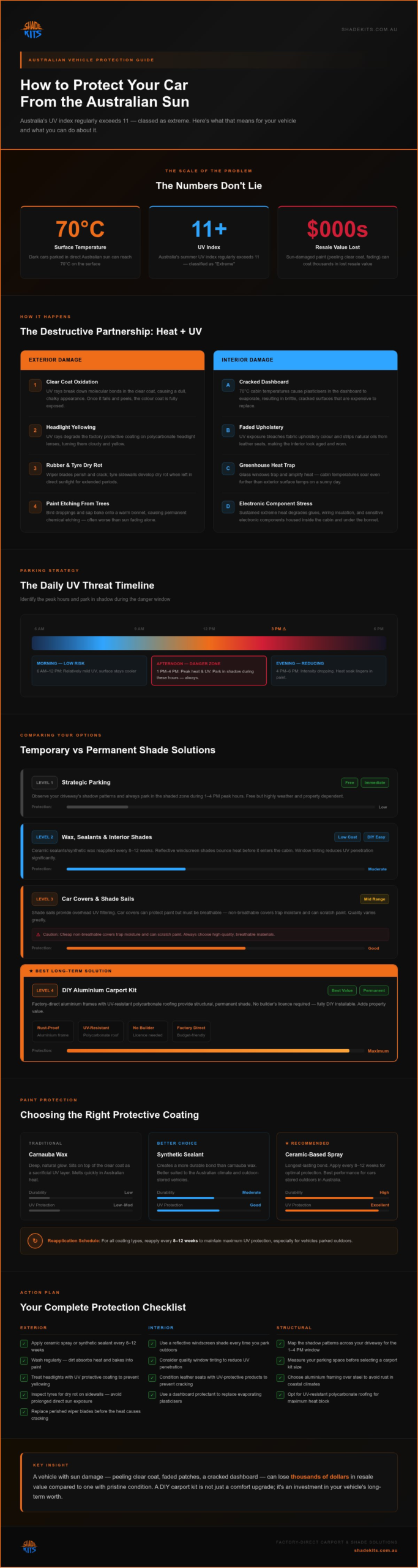
Australia’s sun is famously harsh. Our geographical position and lower ozone levels mean we deal with UV radiation that is far more intense than in the Northern Hemisphere. During an average summer, the UV index regularly exceeds 11, which is considered extreme. This isn’t just about getting a tan; it’s a constant chemical assault on your vehicle. If you’re looking for how to protect car from sun damage at home, you first need to understand that heat and light work in a destructive partnership. While light breaks down the surface, heat accelerates the chemical reactions, leading to rapid deterioration.
Leaving your car exposed has a massive financial downside. A vehicle with “sunburn”, such as a peeling clear coat or faded patches, can lose thousands of dollars in resale value compared to one with pristine paintwork. You might think parking under a tree is a clever fix, but this often backfires. Acidic bird droppings, sticky sap, and falling debris can bake onto your warm bonnet; this causes permanent etching that is even harder to repair than standard sun fading.
The outer layer of your car is designed to be tough, but it isn’t invincible. Most modern vehicles rely on a multi-stage Automotive paint composition that includes a clear coat designed to filter UV rays. Over time, this layer undergoes oxidation, giving the paint a dull, chalky appearance. Once the clear coat fails and begins to peel, the underlying colour is left completely defenceless. UV rays break down molecular bonds in automotive pigments. This process happens silently every day your car sits in the driveway without a structural barrier.
Step inside a car that’s been sitting in the sun and you’ll immediately feel the greenhouse effect in action. Glass windows trap heat, sending cabin temperatures soaring toward 70°C. This extreme environment causes the plasticisers in your dashboard to evaporate; this is why older cars often have brittle, cracked surfaces. It’s not just the dash. UV exposure strips the natural oils from leather seats and bleaches the vibrant colour out of fabric upholstery, making the interior look aged. Learning how to protect car from sun damage at home means addressing these internal threats before they become permanent eyesores.
Protecting your vehicle doesn’t always require a major renovation. Often, the most effective ways to protect your car from sun damage involve simple shifts in your daily routine. Start by observing the sun’s path across your property. The morning sun is relatively mild, but the afternoon glare between 1:00 PM and 4:00 PM is where the real damage occurs. If your driveway has a side that stays in the shadow of the house during these peak hours, always aim to park there. Even partial shade can significantly lower the surface temperature of your bonnet and roof.
Don’t overlook the “forgotten” components that the sun targets first. Headlights are particularly vulnerable; they often turn yellow and cloudy because the UV rays degrade the factory protective coating. Likewise, your windscreen wipers are made of rubber that perishes and cracks under extreme heat; meanwhile, your tyres can develop “dry rot” on the sidewalls if left in direct sunlight for weeks. Keeping your car clean is also a vital defence. Dirt and grime actually absorb more heat and can become baked into the paintwork, making it much harder to maintain that showroom shine.
Think of wax as a sacrificial layer for your car’s exterior. It sits on top of the clear coat and takes the brunt of the UV radiation so your paint doesn’t have to. While traditional Carnauba wax provides a deep, natural glow, it often melts away quickly in the Australian heat. Modern synthetic sealants or ceramic-based sprays are usually a better choice for cars kept outdoors. These products create a more durable bond that can last several months. For the best results, you should aim to apply a fresh layer of protection every eight to twelve weeks. If your vehicle is already showing signs of heavy exposure, a more robust solution like a Car Cave can provide the high-level shade your paintwork needs.
The interior of your car acts like an oven, but you can easily break that thermal cycle. High-quality reflective windscreen shades are essential because they bounce the energy back out through the glass before it can heat up the dashboard. For long-term preservation, a custom-fit dashboard cover provides a physical barrier that prevents plasticisers from evaporating. You should also consider professional window tinting. In most Australian states, you can legally apply film with a 35% Visible Light Transmission (VLT) on front side windows and 20% on the rear. This simple upgrade can block up to 99% of UV rays, keeping the cabin significantly cooler and protecting your upholstery from fading. Learning how to protect car from sun damage at home is a process of layering these small wins to achieve a big result.
When you’re looking at how to protect car from sun damage at home, you’ll likely find yourself weighing the pros and cons of different shade structures. While we’ve established that habits like strategic parking help, a physical roof is the only way to genuinely lower the thermal load on your car. However, not every home has the space or the budget for a full-scale garage. This is where you need to look at the differences between temporary and permanent solutions to find what fits your property and your lifestyle.
It’s tempting to grab a cheap car cover from a local parts retailer, but these often come with a hidden cost. The primary issue is the “sandpaper effect”. Even a slight breeze causes a fabric cover to shift against your car’s surface. If there’s any dust or grit trapped underneath, the cover acts like an abrasive, leaving fine swirl marks in your clear coat. Beyond scratches, non-breathable materials can trap moisture against the metal. This creates a humid micro-climate that accelerates the damaging effects of sun and heat, potentially leading to rust or paint delamination. Generally, traditional covers are only appropriate for indoor storage where wind and humidity aren’t factors.
For many Australian homeowners, the CarCave has become the ideal middle ground. Unlike a standard cover, this foldable solution provides a “no-touch” barrier. It creates a rigid frame that stays completely clear of your paintwork while blocking overhead UV rays and hail. Breathability is the most important factor here. Because these units allow for constant airflow, they prevent the massive heat build-up that usually occurs in enclosed spaces. This is a pragmatic choice for renters or those with small blocks where council rules might prevent the construction of a permanent garage. It gives you the structural benefits of a roof without the long-term commitment of a fixed building project.
Before you commit to a solution, evaluate your driveway constraints. A permanent carport offers the ultimate protection, but it requires enough clearance for posts and potentially a concrete pad. If you’re restricted by narrow side-access or strict local regulations, a portable or foldable unit might be your only viable path to meaningful shade. Understanding these trade-offs is a key part of learning how to protect car from sun damage at home effectively.
While small habits like strategic parking are useful, they can’t match the absolute protection of a permanent structure. If you want to know how to protect car from sun damage at home with total certainty, a physical roof is the only solution that provides a 100% block against overhead UV rays. Unlike temporary shelters, a permanent carport offers a year-round shield that requires very little upkeep. It’s the gold standard for anyone serious about maintaining their vehicle’s condition over the long haul.
We prefer aluminium frames for a very specific reason: they are completely rust-proof. This is essential for the Australian climate, whether you live near the salt air of the coast or in the humid tropics. You won’t have to worry about sanding back rust or repainting every few years. Beyond vehicle protection, adding a carport is a smart financial move. It increases the functional footprint of your property and adds significant resale value, as most Australian buyers view off-street covered parking as a non-negotiable feature.
Many homeowners assume they need to hire a builder and navigate a complex construction process. However, factory-direct kits simplify the entire project. These kits are designed for straightforward assembly, allowing you to achieve professional results independently without the high cost of a traditional contractor. It’s a pragmatic way to get a high-end result on a manageable budget.
The roofing material is where the science of protection really happens. High-quality polycarbonate isn’t just a clear sheet; it features specialised UV-resistant coatings. These layers block the harmful radiation while still allowing soft, natural light to filter through. More importantly, the thermal insulation properties ensure the temperature under the roof stays significantly cooler than the surrounding air. This protects your paint and interior while making the space more comfortable for you. It’s also engineered to withstand the extremes of our climate, including heavy rain and the occasional summer hail storm.
Choosing the right layout is about looking at your current and future needs. A single carport might fit your space now, but a double provides room for a second vehicle or additional storage for a boat or trailer. You should also consider the roof profile. Flat roofs offer a sleek, modern look and are very straightforward to install, while gable designs provide superior drainage and a more traditional aesthetic. When browsing our range of carport kits, think about how the structure will integrate with your home’s existing architecture and how you plan to use the space daily. If you’re ready to upgrade your property and secure your vehicle’s future, explore our range of factory-direct shade solutions to find the perfect match for your driveway.
Choosing the right hardware is the final piece of the puzzle. When you’re deciding how to protect car from sun damage at home, the quality of the materials determines whether your solution lasts two years or twenty. Shade Kits offers a factory-direct model that removes the retail middleman; this ensures you get professional-grade aluminium and polycarbonate without the inflated price tag. This approach allows us to provide high-specification kits that are engineered specifically for the intensity of the Australian environment.
Before ordering, you need to measure your space with precision. Don’t just look at the length and width of your car; consider the swing room for doors and the height clearance for roof racks or aerials. It’s also wise to check your local council’s setback requirements from the property boundary. Once your kit arrives, the self-installation process is designed to be methodical. Every component is pre-cut and pre-drilled, so you aren’t guessing where the bolts go. Most homeowners find that with a basic set of tools and a spare weekend, they can have their structure fully operational.
Maintenance for an aluminium structure is refreshingly simple. Unlike timber, which requires regular staining, or steel, which can succumb to rust, aluminium only needs a quick wash. Every six months, hose down the polycarbonate roofing to remove dust and debris that might block light or trap heat. Checking the gutters and downpipes for leaves ensures that heavy rain is diverted away from your vehicle, keeping the area dry and protected. This simple routine preserves the longevity of your investment for decades.
The primary benefit of a DIY kit is the significant cost saving compared to a custom-built timber structure. Timber requires skilled carpentry and frequent upkeep, whereas our aluminium kits offer industrial precision right out of the box. We provide Australia-wide delivery, meaning you can access the same factory-direct quality whether you’re in a capital city or a regional town. Our team supports home installers throughout the process, ensuring you feel confident from the first measurement to the final bolt. It’s a streamlined way to achieve professional results independently.
Your final decision usually comes down to your property type and long-term goals. If you own your home and have a dedicated driveway, a permanent carport is a fantastic investment in both your car and your real estate value. However, if you’re renting or have limited space, the CarCave offers a flexible alternative that still provides a high-level UV barrier. A comprehensive plan for how to protect car from sun damage at home should combine these structural solutions with the washing and waxing habits we discussed earlier. For those living in regions prone to summer storms, it’s also worth reading our guide on Hail Protection for Cars to ensure you’re prepared for every extreme the Australian sky can throw at you.
The Australian sun doesn’t take breaks, so your protection strategy shouldn’t either. By combining smart daily habits like strategic parking with high-quality sealants, you can significantly slow down the clock on your car’s aging process. However, the only way to achieve total peace of mind is through a dedicated shade structure that blocks radiation before it reaches your paintwork. Mastering how to protect car from sun damage at home is about moving from temporary fixes to a permanent, reliable solution that guards your clear coat and interior from the ground up.
Our factory-direct kits provide a pragmatic path to this level of safety. With durable, rust-free aluminium frames and UV-resistant polycarbonate roofing, you’re investing in a structure specifically engineered for our harsh local climate. We also offer fast Australia-wide delivery to get your home improvement project started as soon as possible.
Browse our range of DIY Carport Kits and protect your car today. Taking control of your driveway’s shade is a rewarding project that preserves your vehicle’s value and keeps your cabin cool for years to come.
You can achieve high-level protection by installing a DIY carport kit or using a foldable shelter like the CarCave. These structures provide a physical roof that blocks overhead UV rays entirely. If structural options aren’t immediately possible, focus on how to protect car from sun damage at home by using reflective windscreen shades and parking in the shadow of your house during the peak afternoon heat between 1:00 PM and 4:00 PM.
While most car covers are designed to block UV radiation, they often introduce other risks like surface scratches and moisture entrapment. In windy conditions, the fabric can move against your paintwork, creating a sandpaper effect that dulls the clear coat. For outdoor use in Australia, a no-touch barrier like a carport or a rigid foldable shelter is generally a safer and more effective way to provide long-term UV protection without damaging the exterior.
Yes, our carport kits are specifically engineered for straightforward self-installation by the average homeowner. Every component is pre-cut and pre-drilled at the factory, which removes the need for specialised trade skills or complex heavy machinery. Most projects can be completed over a weekend with basic tools. This approach allows you to achieve professional, structural results independently while avoiding the significant labour costs associated with hiring a traditional builder or contractor.
Car wax acts as a sacrificial layer that absorbs UV radiation before it can reach your paint’s clear coat. While it is effective, it isn’t a permanent solution and will eventually melt or wear away in the extreme Australian heat. For vehicles kept outdoors, you should apply a high-quality synthetic sealant or ceramic spray every eight to twelve weeks. This routine helps maintain the molecular bonds in your paint and prevents the dull, chalky appearance of oxidation.
UV-resistant polycarbonate is widely considered the best roofing material for Australian carports due to its durability and thermal properties. It features specialised coatings that block harmful rays while allowing natural light to filter through, keeping the area underneath significantly cooler. Unlike metal roofing, which can radiate intense heat downward, polycarbonate helps maintain a lower ambient temperature. It is also engineered to withstand our local environmental extremes, including heavy rain and summer hail storms.
Adding a carport typically adds significant resale value to an Australian property. Most buyers view off-street covered parking as a high-priority feature, particularly in suburbs where street parking is limited or the sun is intense. A well-constructed aluminium carport increases the functional footprint of your home and improves its street appeal. It is a cost-effective way to upgrade your property’s infrastructure while providing essential long-term protection for your own vehicles.
You should aim to wash your car at least once a fortnight if it is frequently parked in the sun. Dirt, bird droppings, and tree sap can become baked into the paintwork under high temperatures, leading to permanent etching and damage. Regular cleaning removes these contaminants before the heat can cause them to bond with the clear coat. Maintaining a clean surface is a simple but vital part of how to protect car from sun damage at home.
The CarCave is designed with a sturdy frame that handles typical Australian weather, but it must be properly anchored in high-wind areas. Because it is a foldable, no-touch shelter, it allows for consistent airflow which prevents the structure from acting like a sail. We recommend securing the base to a solid surface like concrete or using heavy-duty ground pegs. This ensures the unit remains stable during gusts while continuing to provide a reliable shield against UV rays and hail.