
Is your pergola a relaxing outdoor retreat or a magnifying glass that traps you in the scorching midday sun? Most Australian homeowners love the idea of an open, sunlit space, yet they often find themselves retreating indoors because the heat under the roof becomes unbearable. When you are looking at polycarbonate pergola kits australia, it is easy to feel overwhelmed by the different tints and technical specs, especially when you are worried about hail damage or the sheets turning yellow and brittle after just a few seasons.
We understand that you want a comfortable area that stays cool without losing that bright, airy feel. You deserve an outdoor living space that stands up to our harsh climate and remains clear and strong for over a decade. In this guide, we will show you how to choose the perfect balance of light transmission and heat protection for your home. We will explore the best colour tints for Australian conditions, explain how UV-resistant technology prevents fading, and provide the practical steps you need for a successful DIY installation process.
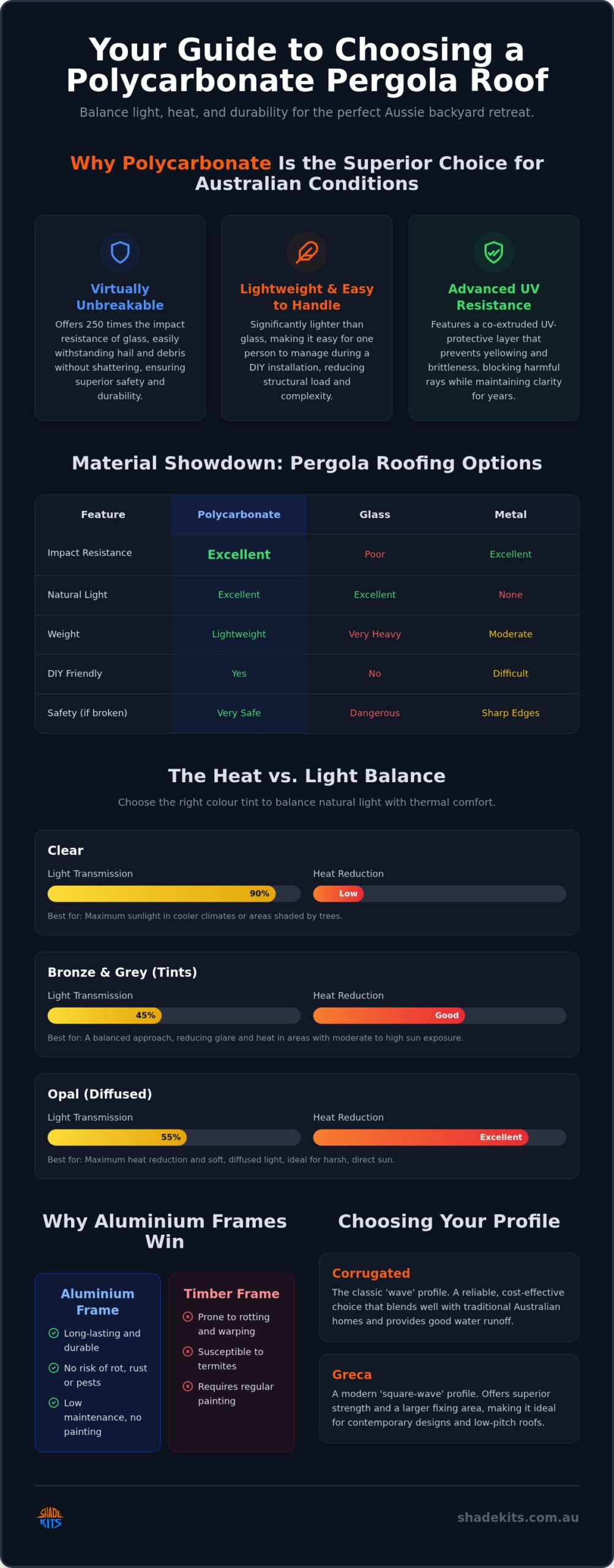
Polycarbonate is a group of thermoplastic polymers that have been specifically engineered for high impact resistance and optical clarity. In the context of home improvement, these panels serve as a high-performance alternative to traditional glass or metal roofing. While a polycarbonate sheet might look similar to acrylic or standard plastic, its structural properties are vastly superior. It is approximately 250 times stronger than glass and significantly lighter, which makes it a standout choice for anyone researching polycarbonate pergola kits australia. This material allows you to create a roof that is virtually unbreakable, yet light enough to be handled by a single person during a DIY project.
In the Australian backyard, roofing has to do far more than just stop the rain. It needs to withstand intense UV radiation, sudden hailstorms, and the constant expansion and contraction caused by our dramatic temperature swings. Polycarbonate has become the gold standard because it strikes a balance that materials like timber or metal simply cannot. It allows natural light to filter through to your living areas while simultaneously blocking the heat. This creates a bright, airy outdoor space that remains comfortable even during a blistering February afternoon. It’s built for this environment.
Standard plastics often become brittle and yellow after just one or two summers under the intense Australian sun. This degradation happens because UV radiation breaks down the chemical bonds within the material. High-quality panels solve this through a specialized manufacturing process. UV co-extrusion is a process where a concentrated layer of UV inhibitors is fused directly into the surface of the sheet during production to ensure the panel remains clear and flexible for the long term. This layer acts as a permanent shield. It protects the structural integrity of the panel and prevents the “yellowing” effect that plagues cheaper alternatives.
When you compare materials for an outdoor entertaining area, the practical benefits of polycarbonate become clear. Glass is aesthetically pleasing but incredibly heavy, expensive, and dangerous if it shatters during a storm. Metal roofing is exceptionally durable, but it blocks all natural light. This often leaves the adjacent indoor rooms feeling dark and gloomy. Polycarbonate offers the best of both worlds. It provides the light transmission of glass with the resilience of metal. Shade Kits focuses on these high-performance materials because they ensure DIY pergola kits remain manageable for the average homeowner while delivering a professional finish that lasts. It is the most pragmatic solution for a modern Australian lifestyle.
When you hear the term “profile” in the context of roofing, it refers to the specific shape and cross-section of the sheet. This isn’t merely an aesthetic choice for your garden. The profile dictates how efficiently water runs off the structure and how much weight the sheet can support between your rafters. Selecting the correct profile for your polycarbonate pergola kits australia ensures your outdoor area remains dry during a summer downpour and structurally sound when facing the pressure of a heavy hailstorm.
The pitch of your pergola is the most important factor in this decision. Most manufacturers recommend a minimum fall of 5 degrees to prevent water from pooling. If your structure has a relatively low pitch, a profile with deeper ribs or waves, such as Greca, can help channel water away more effectively than a shallower alternative. This prevents leaks and reduces the build-up of dirt and debris that can occur when water sits on the surface for too long.
Corrugated polycarbonate is the traditional “wave” design that has been a staple of Australian backyards for decades. It is a reliable, cost-effective option that blends perfectly with the architecture of older homes. Greca, on the other hand, features a trapezoidal or “square-wave” profile. It is often the preferred choice for modern builds because the flat surfaces provide a larger contact area for fixings. This design can offer superior strength and a cleaner, more contemporary look. Matching the profile of your pergola to the existing lines of your house roof is a simple way to ensure the new structure looks like a deliberate part of the original home design.
Multiwall sheets represent a step up in technology. Instead of a single solid layer, these sheets consist of multiple skins joined by vertical ribs to create hollow internal chambers. These chambers trap air, creating a thermal barrier that significantly reduces the amount of heat passing through the roof. As an ultra-lightweight material, multiwall provides the sleek, flat appearance of glass without the immense weight or fragility. It is the ideal choice for high-end architectural pergolas where year-round thermal comfort is a priority. If you’re planning a project and want to ensure the best result, browsing professionally designed pergola kits can help you identify which profile suits your specific climate and lifestyle needs.
The most common question homeowners ask is: “Will my pergola be too hot to use in summer?” It is a valid concern. If you select the wrong tint, your outdoor area can quickly become a “hot house” that traps heat and glare. The secret to a comfortable space lies in understanding the trade-off between light transmission and heat reduction. When browsing polycarbonate pergola kits australia, you aren’t just choosing a colour for its looks; you’re selecting the thermal performance of your new living area. The goal is to find a balance where you don’t need sunglasses to sit outside, but you also don’t feel like you’re sitting in a dark cave.
Every sheet has a “Shade Factor,” which is a technical measurement of how much visible light the material blocks. Generally, as the shade factor increases, the heat reduction also improves. However, your home’s orientation should dictate your choice. For pergolas facing North in Australia’s sunnier, hotter regions, intense, direct sun is common for most of the day, making heat reduction the priority. Conversely, a South-facing area in cooler parts of the country might feel dark and cold during winter, so a tint that allows more light transmission is often the better move. This versatility of polycarbonate in architecture allows you to customise your environment to suit your specific local climate.
Clear sheets offer maximum light transmission, often exceeding 90 percent. They are excellent for keeping adjacent indoor rooms bright, but they provide almost zero heat protection, making them best suited for deep shade or winter-focused spaces. Opal (white) panels are a popular middle ground. They provide soft, diffused light that eliminates harsh glare while offering excellent heat reduction. Grey or bronze tints provide a sleek, modern aesthetic and are highly effective at blocking heat, though they will make the space underneath feel noticeably darker than an opal roof.
For those in the hottest regions of Australia, standard tints might not be enough to keep the space comfortable. Advanced metallic-infused sheets are designed to reflect the sun’s infrared radiation, which is the primary cause of heat build-up under a roof. Solar control tints work to lower the temperature by several degrees by filtering out heat-generating wavelengths while still allowing high levels of natural light to pass through. If you’re unsure which tint is right for your specific backyard, checking professional pergola roofing options can help you find a solution that keeps your outdoor area cool all year round.
Australia’s climate is a testing ground for any outdoor structure. From the salt spray of the coast to the dry heat of the interior, your roofing must endure a relentless gauntlet of environmental stress. While earlier sections focused on light and heat, the long-term value of polycarbonate pergola kits australia depends entirely on their ability to remain structurally sound for a decade or more. Achieving this longevity requires more than just high-quality sheets; it demands a stable foundation and an understanding of how materials behave when the temperature soars.
One of the most critical factors in a successful DIY installation is accounting for thermal expansion and contraction. Polycarbonate is a dynamic material that physically moves as it heats up and cools down. If the sheets are fastened too tightly or without the correct oversized weather-seals, they can buckle, noise-up with loud “popping” sounds, or even crack around the screw holes. Using a stable aluminium frame provides a significant advantage here. Unlike timber, which can warp or twist over time and put additional stress on the roofing, aluminium remains perfectly straight and provides a consistent, rust-proof base that accommodates the natural movement of the panels.
For many homeowners, the fear of a sudden summer hailstorm is the primary reason they hesitate to install a translucent roof. Polycarbonate is the safest choice for hail-prone regions because it is engineered to absorb impact energy rather than shattering. While standard residential sheets are incredibly tough, some high-impact variants are designed specifically to withstand larger hailstones without denting or piercing. If you are concerned about protecting your outdoor assets, you can find similar durability insights in our guide to hail protection for cars. This resilience ensures that your entertaining area remains safe and waterproof even after a severe weather event.
A pergola roof acts like a giant sail during high winds. Proper structural integrity relies on two things: the strength of the frame and the precision of the fastening system. To prevent sheets from “rattling” or lifting, it is essential to follow Australian standards for purlin spacing, typically AS/NZS 1170.2 for wind actions. Shade Kits’ aluminium frames are engineered to handle these specific loads, ensuring that the connection points between the roof and the structure are secure. To keep your roof looking new, avoid using harsh chemicals or abrasive brushes during cleaning. A simple wash with mild soapy water and a soft cloth is all you need to keep the UV-protective layer intact for years to come.
Ready to build a space that stands the test of time? Explore our range of engineered pergola kits designed specifically for the Australian climate.
When you decide to upgrade your backyard, you face a choice between sourcing “bits and pieces” from various hardware stores or investing in a fully integrated system. While buying individual components might seem flexible, it often leads to logistical headaches, such as mismatched profiles or missing specialized fixings. Choosing polycarbonate pergola kits australia ensures that every rafter, screw, and roofing sheet has been engineered to work as a single, cohesive unit. This eliminates the guesswork and ensures the structural integrity of your build from day one.
The combination of aluminium frames and polycarbonate roofing is particularly well-suited for the Australian lifestyle. Timber pergolas require significant long-term commitment; they need to be sanded, stained, or painted every few years to prevent rot and termite damage. Aluminium is a “set and forget” material. It does not warp, rust, or peel, even when exposed to the high humidity or salt air common in our coastal regions. By pairing this low-maintenance frame with high-performance roofing, you create an outdoor space that stays beautiful without demanding your entire weekend for maintenance.
Shade Kits operates on a factory-direct model, which means we remove the retail middleman to provide premium materials at a more accessible price point. Because the components are pre-cut and the kits are designed for straightforward assembly, the “DIY” part of the project becomes much more manageable for the average homeowner. You don’t need a background in carpentry to achieve a professional result. For those who are still in the early stages of project mapping, reviewing the essential Australian carport checklist can provide a helpful framework for planning similar structural projects around your home.
Your backyard should be a place of comfort and relaxation, not a source of constant chores. By selecting a kit that balances light transmission with heat protection, you are making a long-term investment in your home’s value and your family’s quality of life. We provide Australia-wide delivery, ensuring that whether you are in a metro centre or a regional town, you have access to the same high-quality, UV-protected materials. If you are ready to start your project, you can browse our full range of pergola kits online today. Our team is here to provide the expert support you need to ensure your DIY journey is a success from the first bolt to the final sheet.
Creating a comfortable, long-lasting outdoor area comes down to making informed choices about your materials. By selecting the right profile for water runoff and the ideal tint for heat reduction, you’ve already solved the most common frustrations homeowners face. You now know that a successful project relies on the combination of UV-resistant technology and a stable frame that accommodates natural thermal movement. Investing in premium polycarbonate pergola kits australia ensures your new space remains clear, cool, and structurally sound for many years to come.
We are here to help you achieve a professional result with minimal stress. Our kits feature durable, low-maintenance aluminium frames and high-performance roofing designed specifically for our local conditions. With Australia-wide delivery and factory-direct pricing, you can move forward with confidence knowing you have the right support for your DIY journey. Your ideal outdoor retreat is well within reach.
Build your dream outdoor space with a factory-direct Pergola Kit from Shade Kits and enjoy a cooler, more resilient backyard this season.
Opal is generally the best all-rounder for the Australian climate because it provides soft, diffused light while significantly reducing heat. If your priority is maximum heat reduction, a grey or bronze tint is more effective, though it will make the space darker. Clear sheets should only be used in areas where you want maximum sun and zero heat protection, such as South-facing decks in cooler states.
Yes, high-quality polycarbonate roofing blocks approximately 99.9% of harmful UV radiation. This protection is achieved through a co-extruded layer on the surface of the sheet that filters out UV rays while allowing visible light to pass through. This feature is a standard inclusion in our polycarbonate pergola kits australia, ensuring that both your family and your outdoor furniture are protected from sun damage and fading.
Polycarbonate is specifically engineered to survive hail storms and is roughly 250 times stronger than glass. While it is virtually unbreakable under normal conditions, the level of protection depends on the sheet’s impact rating. Most residential-grade panels can withstand significant impact from mid-sized hailstones without cracking or piercing, making it one of the safest roofing materials for regions prone to sudden summer storms.
The main difference lies in the shape of the profile; Corrugated features a traditional round wave, while Greca has a square, trapezoidal wave. Greca is often preferred for modern designs because its flatter surfaces provide a larger contact area for fixings, which can offer better structural stability. Corrugated is a classic choice that is often used to match the existing roof lines of older Australian homes.
You can stop the cracking or popping noise by ensuring the sheets have enough room to expand and contract as the temperature changes. This is usually achieved by pre-drilling holes that are slightly larger than the screw shank, typically 10mm for a standard fixing. Using specialised weather-seals or fasteners allows the sheet to move freely against the frame without binding or creating friction-related noise.
You should never walk directly on polycarbonate roofing panels as they are not designed to support concentrated body weight. Walking on them can cause the sheets to crack, buckle, or even fail entirely, posing a serious safety risk. If you need to access the roof during installation, use crawling boards or ladders supported by the underlying rafters or purlins to distribute your weight safely across the structure.
In Australia, high-quality polycarbonate sheets typically last between 10 and 15 years, though many remain functional for much longer with proper care. Their lifespan is determined by the quality of the UV-protective coating and how well the installation accounts for thermal movement. Choosing a polycarbonate pergola kits australia with a reputable warranty ensures that your roof won’t become brittle or turn yellow after just a few seasons in the sun.
Multiwall polycarbonate is superior if your main goal is thermal insulation and a sleek, flat aesthetic. Because it contains hollow internal chambers that trap air, it creates a much more effective thermal barrier than thin, single-skin corrugated sheets. While single-skin sheets are more cost-effective and easier to install for basic shade, multiwall is the premium choice for year-round comfort in high-end outdoor living areas.