
Would your vehicle shelter remain standing if a Category 3 cyclone made landfall in your backyard tomorrow? It’s a valid concern for many homeowners who feel caught between the high cost of custom construction and the risk of structural failure during a severe weather event. You want the peace of mind that comes with a certified, resilient structure, but you shouldn’t have to navigate a maze of confusing wind regions or pay for expensive installation labour just to get it. When searching for heavy duty carport kits australia, the priority is finding a solution that balances industrial-grade strength with a design you can actually manage yourself.
We understand that protecting your investment from the harsh Australian sun and coastal salt air requires more than just a basic roof. This guide will show you how to choose and install a cyclone-rated carport kit that offers extreme structural resilience and factory-direct savings. We’ll walk you through the essential steps to identify BCA-compliant materials, understand your local wind rating, and successfully complete a professional-grade installation over a single weekend.
In the Australian building industry, the label “heavy duty” isn’t just a marketing buzzword; it’s a technical classification. For a structure to be considered truly resilient, it must comply with the National Construction Code (NCC) and Australian Standards like AS 4055:2012. These regulations ensure that heavy duty carport kits australia are engineered to withstand specific atmospheric pressures. A kit that qualifies as heavy duty is designed as a Class 10a building, meaning it has undergone rigorous testing to prove it won’t buckle under the weight of extreme wind or debris.
To understand how these structures stay grounded, we have to look at wind engineering principles. These principles dictate how air moves around a structure and how much “uplift” force is applied to the roof during a storm. Beyond just the wind speed, factors like terrain categories and shielding play a massive role. For instance, a carport in a wide-open paddock (Terrain Category 1) faces much higher loads than one tucked away in a suburban street surrounded by other houses (shielding). When you’re choosing a kit, you need to ensure the engineering matches your specific site conditions, not just a generic “one-size-fits-all” rating.
Australia is mapped into four distinct wind regions based on historical weather data. Regions A and B cover most of the inland and southern coastal areas. These are typically non-cyclonic zones where structures are given “N” ratings, such as N2 or N3. However, if you live in the “Cyclone Belt” of Northern and Coastal Australia, you’ll require a “C” rating. Region C covers the tropical coastline, while Region D represents locations experiencing the most severe cyclones. For context, a C2 rated structure is engineered for wind speeds exceeding 200 km/h, while C3 rated kits are suitable for speeds up to 51 m/s. It’s vital to check your local council’s wind map before purchasing because a Region A kit will likely fail inspection in a Region C zone.
If you’re planning a permanent DIY build, a site-specific engineering letter is a non-negotiable requirement for council approval. This document proves that your chosen model is fit for the specific wind speeds and soil types at your address. At Shade Kits, we focus on providing carports that come with the necessary documentation to make this process as smooth as possible. Most councils in 2026 require approval for any structure over 10 to 25 square metres, especially if it’s attached to your home. Having a factory-direct kit with pre-verified BCA compliance means you don’t have to hire a private engineer to sign off on your weekend project, saving you both time and significant professional fees.
While steel has been the traditional choice for decades, modern heavy duty carport kits australia are increasingly pivoting toward aluminium for several pragmatic reasons. The primary advantage lies in the strength-to-weight ratio. Aluminium is roughly one-third the weight of steel, yet when engineered correctly, it offers the same structural resilience required for cyclone-rated zones. This means you get a frame that can withstand the extreme uplift forces discussed in the previous section without the massive physical burden of heavy steel beams during the build process.
Environmental resilience is another critical factor. As we move through 2026, the Australian UV index continues to challenge the longevity of building materials. Unlike some coatings on steel that can chalk or peel over time, aluminium remains stable. It doesn’t become brittle or lose its structural integrity under the relentless sun. This ensures your vehicle remains protected for decades rather than years, regardless of whether you are in the humid tropics or the dry outback. Choosing a kit that uses high-grade aluminium ensures that your heavy duty carport kits australia investment remains a permanent fixture on your property.
Coastal homeowners often face the “tea staining” issue, where salt air causes unsightly brown spots on galvanised steel. If left untreated, this leads to structural rust, particularly at the joints or where the metal was cut during installation. Aluminium naturally produces a thin, protective oxide layer when exposed to air. This layer acts as a permanent shield against salt spray, making it the superior choice for seaside or tropical locations. Because of this, the long-term value is significantly higher; you won’t be spending your weekends sanding back rust or reapplying protective paints just to keep the structure sound.
The logistical ease of aluminium is a game-changer for the “pragmatic homeowner.” Because the components are lighter, you don’t need to hire a crane or heavy lifting equipment to get the job done. Our factory-direct kits are precision-engineered, meaning every bolt hole is pre-drilled to align perfectly. This level of accuracy eliminates the frustration of “making it fit” on-site, which is common with bulkier steel kits. Aluminium’s lighter weight reduces the risk of DIY accidents during roof lifting. This makes the project much safer for a standard two-person team. If you are looking for a manageable weekend project, exploring our range of durable carport kits is a great place to start.
Selecting the right structure involves looking beyond the surface level. While we’ve established that aluminium is the ideal material for heavy duty carport kits australia, the specific engineering of the frame and joinery determines if the unit stays standing when the wind picks up. A truly resilient kit features increased wall thickness in the structural posts and beams. This isn’t just about weight; it’s about the ability of the frame to resist bending under the immense pressure of a cyclonic wind gust. Look for kits that utilise reinforced joinery, where the connection points are designed to distribute loads evenly across the entire structure rather than stressing a single bolt.
Drainage is another often-overlooked feature. In tropical Australia, a storm doesn’t just bring wind; it brings torrential rain. If your guttering system is too shallow or the downpipes are too small, water can pool on the roof, adding thousands of kilograms of weight in a matter of minutes. It’s essential to ensure your kit includes high-volume gutters and integrated drainage systems that can handle the specific rainfall intensities of your region. This proactive approach to design is what separates a generic shelter from a professional-grade installation. Additionally, ensure both the frame and roof panels feature UV-resistant coatings to prevent the material from degrading under the harsh 2026 solar standards.
Modern polycarbonate has revolutionised vehicle protection. Unlike traditional metal sheets that can be noisy and block all natural light, high-quality polycarbonate blocks 99% of harmful UV rays while keeping your workspace bright. In high winds, polycarbonate offers a degree of flexibility that helps it absorb energy without tearing or crumpling. This impact resistance is vital for surviving large hail or flying debris. To keep your roof functional for decades, simply wash it down with mild soapy water once or twice a year to prevent the buildup of salt or dirt that can trap heat and reduce the panel’s lifespan.
The overall strength of your carport is only as good as its weakest link. In many cases, that link is the fastener. A “cyclone proof” rating depends heavily on the use of high-tensile bolts and brackets that won’t shear under pressure. When you receive your kit, check the inventory for galvanised or stainless steel fasteners with high-grade ratings. These components are essential for ensuring the structural integrity of the frame over time, especially in coastal areas where salt air can compromise inferior metals. For a deeper dive into what you should look for before you start your project, check out The Essential Australian Carport Checklist.
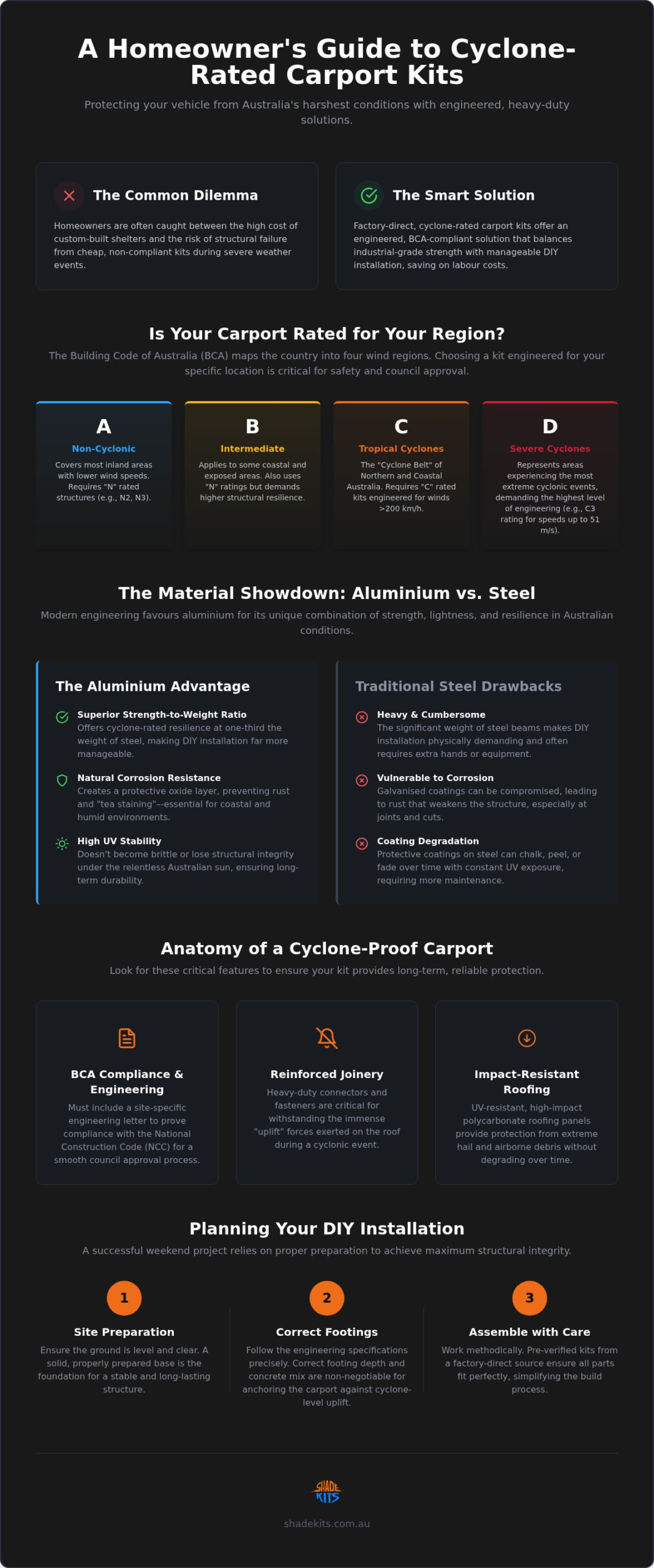
Successful assembly of heavy duty carport kits australia starts long before you pick up a power tool. A common mistake is rushing the site preparation, but your structure is only as reliable as the ground it’s anchored to. You must ensure a perfectly level base and consider how water will move away from the site during heavy rain. While standard carports might sit on a thin slab, heavy-duty kits often require deeper concrete piers. These piers act as an anchor, providing the ballast needed to counteract the forces exerted on the roof during a storm.
Starting with a “bottom-up” approach is essential. This means using string lines and a laser level to ensure your foundation is perfectly square. Even a few millimetres of misalignment at the base can translate into significant structural stress once you reach the roof beams. To achieve a professional finish, you’ll need a standard set of tools: a high-quality hammer drill, a socket set, a spirit level, and a reliable measuring tape. Most homeowners find that with the right preparation, our kits go together smoothly over a single weekend.
The choice between Dynabolts and Chemsets usually depends on the age and quality of your concrete. Dynabolts are mechanical anchors that expand inside the hole, making them suitable for most standard slabs. However, if you’re in a high wind zone or dealing with older concrete, Chemsets offer superior bond strength by using a resin to fuse the bolt to the slab. Base plates are equally important, as they spread the wind load across a larger surface area of the foundation. Uplift force refers to the powerful suction created as wind rushes over the roof surface, making robust anchoring the most critical step in ensuring a cyclone-rated build stays grounded.
Precision is your best friend during a build. Adopting a “near enough is good enough” attitude with structural alignment can lead to uneven tension in the frame, which compromises the wind rating of your heavy duty carport kits australia. Another critical step is the application of waterproofing silicone on all fasteners. Even though aluminium doesn’t rust, water ingress through fastener holes can lead to dripping and potential damage to your vehicle’s paintwork over time. For more detailed instructions on the assembly process, read The Ultimate Guide to DIY Carport Kits in Australia (2026).
Ready to start your project? You can browse our full range of engineered carport kits to find the perfect fit for your home.
Choosing the right shelter for your vehicle often comes down to a balance between cost and quality. At Shade Kits, we’ve streamlined this process by offering factory-direct heavy duty carport kits australia. By removing the traditional retail markup, we can focus our resources on what actually matters: structural integrity and long-term durability. Our commitment to using resilient aluminium frames and UV-resistant polycarbonate roofing ensures that your shelter is prepared for the 2026 weather standards without the “middleman” premium. Whether you’re in a metropolitan centre or a remote regional area, our Australia-wide delivery network ensures your kit arrives safely and ready for assembly.
We understand that the Australian landscape is diverse, and a kit that works in suburban Melbourne must be just as reliable in the humid, salt-heavy air of the Gold Coast. Our factory-direct model doesn’t just save you money; it allows for stricter quality control over every component that leaves our warehouse. We prioritise materials that won’t rust, warp, or degrade under the intense sun, providing a steady, expert hand to guide you through the selection process. This focus on transparency and dependability is why homeowners across the country trust our kits for their most valuable assets.
For those who aren’t ready for a permanent build, we’ve developed a specialised alternative that addresses a common gap in the market. The CarCave provides rapid hail defence and sun protection through a unique foldable design. It’s an ideal solution for renters, temporary sites, or homeowners awaiting council permits for a permanent structure. The engineering behind the CarCave involves a robust, foldable frame paired with a high-grade UV-resistant fabric cover. This offers a high level of protection that you can take with you if you move house, making it a pragmatic choice for secondary vehicle storage or high-risk hail zones.
Your carport should look like it belongs on your property rather than being an afterthought. We offer a range of colours and sizing options to ensure your kit matches your existing home’s aesthetic perfectly. Whether you need a compact single-vehicle shelter or a heavy-duty double carport, you can select the configuration that provides the best value for your specific needs. By choosing a kit that aligns with your home’s style, you’re not just adding protection; you’re adding long-term value to your property. Browse our range of heavy-duty carport kits today.
Choosing the right shelter for your vehicle doesn’t have to be a complicated or expensive ordeal. By focusing on BCA-compliant engineering and the long-term benefits of corrosion-resistant aluminium, you’re investing in a structure that will stand firm against the harshest elements. We’ve explored how understanding your local wind region and prioritising reinforced joinery can transform a weekend project into a professional-grade asset. Whether you need a permanent installation or the rapid hail defence of a CarCave, the right preparation ensures your investment is secure for decades.
When you’re ready to upgrade your property, our range of heavy duty carport kits australia provides the perfect blend of resilience and value. Each kit is specifically designed for Australian weather conditions, featuring durable aluminium frames and UV-resistant polycarbonate roofing to meet 2026 standards. By choosing our direct-to-consumer pricing, you’re getting industrial-strength protection without the retail markup. It’s about achieving a high-end result through a straightforward, manageable process.
Secure your vehicle with a factory-direct heavy-duty carport kit today. You’ve got the knowledge to build with confidence; now it’s time to create a space that offers true peace of mind.
Yes, we offer specific models that are fully certified for cyclonic wind regions C and D. These kits undergo rigorous engineering to ensure they meet the Building Code of Australia standards for extreme weather. When you select a cyclone-rated model, it includes the necessary structural reinforcements and high-tensile fasteners required to withstand wind speeds exceeding 200 km/h.
In most Australian states, you will likely need a building permit or council approval for a permanent carport, especially if it exceeds 10 to 25 square metres. Regulations vary between local councils, so it’s essential to check with your local planning authority before starting. We provide the necessary engineering documentation to help simplify the application process for your heavy duty carport kits australia project.
Yes, our kits are designed for straightforward DIY assembly by a team of two people. Because aluminium is significantly lighter than steel, the physical labour is manageable without the need for heavy machinery or cranes. Most homeowners find that with a standard set of tools and a clear weekend, they can complete the installation from the ground up, provided the site is already prepared.
The wind resistance depends on the specific rating of the kit you choose. A standard non-cyclonic N2 rated structure is designed for wind speeds up to 144 km/h, while our cyclonic-rated C2 models are engineered for speeds exceeding 200 km/h. It’s vital to choose a kit that matches the wind region map provided by your local council to ensure the structure remains safe during severe storms.
The CarCave is a specialised solution designed for rapid hail and sun protection rather than permanent cyclonic wind resistance. While it’s incredibly durable for its intended use as a foldable shelter, a permanent aluminium carport offers higher structural integrity for extreme weather events. It’s an excellent choice for renters or those needing immediate protection without the requirement for a permanent concrete foundation.
Aluminium requires very little maintenance compared to traditional timber or steel. You won’t need to sand back rust or repaint the frame over time. A simple wash down with mild soapy water once or twice a year is usually enough to remove salt spray or dust buildup. This keeps the UV-resistant polycarbonate roofing clear and ensures the structural components remain in top condition for decades.
We provide Australia-wide delivery for all our heavy duty carport kits australia, reaching both major capital cities and remote regional areas. Our logistics network is set up to handle large structural components safely, ensuring your kit arrives in perfect condition. Delivery times can vary depending on your specific location, but we work to ensure the most efficient transport route possible for every order.
No, aluminium is the ideal material for coastal environments because it doesn’t rust. When exposed to air, aluminium naturally forms a protective oxide layer that shields the metal from salt spray and moisture. Unlike steel, which can suffer from tea staining or structural corrosion near the ocean, our aluminium kits maintain their integrity and appearance without the need for constant protective treatments.