
Why settle for a boxy, industrial-looking shelter that detracts from your home’s character when you could have a structure that actually enhances it? For many Aussie homeowners, the struggle is real. You need reliable protection for your vehicle against harsh UV rays and sudden storms, but you don’t want your driveway to look like a warehouse loading dock. It’s a common frustration to find that custom timber builds are often prohibitively expensive, while many flimsy DIY options simply won’t stand up to our local climate.
This guide is here to show you that a pergola carport is the ultimate middle ground, offering a stylish architectural finish without sacrificing structural integrity. We’ll walk you through how to combine the elegant lines of a pergola with heavy-duty materials like aluminium and polycarbonate to elevate your kerb appeal. You’ll discover how modern DIY kits make it easier than ever to add value to your property while creating a durable, weather-resistant space that feels like a natural extension of your home.
A pergola carport is a dual-purpose structure providing vehicle shelter and architectural interest. It effectively bridges the gap between a decorative garden feature and a hardworking utility space. Most homeowners are familiar with the standard carport, which historically prioritised function over form, often resulting in a “boxy” or industrial look that clashed with the home’s facade. By contrast, this hybrid structure uses the open, decorative framing of a pergola but adds a weather-tight roof to ensure your car stays dry and protected.
This design is particularly effective for front-of-house installations. When your vehicle shelter is the first thing guests see, its appearance matters. Instead of a heavy steel structure that blocks out the sun and looks out of place, a pergola carport uses sleek lines and modern materials to complement your existing architecture. It’s about creating a structure that looks like it was always part of the house design rather than a late, utilitarian addition. It turns a simple driveway into a polished entrance.
For decades, the “tin shed” was the standard for Aussie vehicle protection. It did the job, but it rarely looked good. As suburban blocks have become smaller and property values have climbed, we’ve seen a massive shift toward integrated outdoor designs. Homeowners now expect their structures to be multi-functional. Modern materials like aluminium have been the real game-changer here. Aluminium allows for thinner, stronger profiles that mimic the look of timber without the high maintenance or the risk of rot. These lightweight frames make it possible to create elegant, open-feeling structures that can still handle heavy rain and intense UV levels without looking cumbersome.
Choosing a pergola-style structure isn’t just about vanity; it’s a smart financial move. A well-designed hybrid structure adds more property value than a standard utility carport because it enhances the home’s kerb appeal. The challenge lies in balancing that open-air aesthetic with the practical need for a 100% waterproof roof. By using high-quality polycarbonate sheeting, you can achieve a roof that is entirely weather-tight while still allowing “soft light” to filter through. This means the area doesn’t feel like a dark tunnel. In fact, many people find their carport kits double as a perfect overflow entertaining area for weekend BBQs when the cars are moved out. It’s this versatility that makes the hybrid model so appealing for modern Australian living.
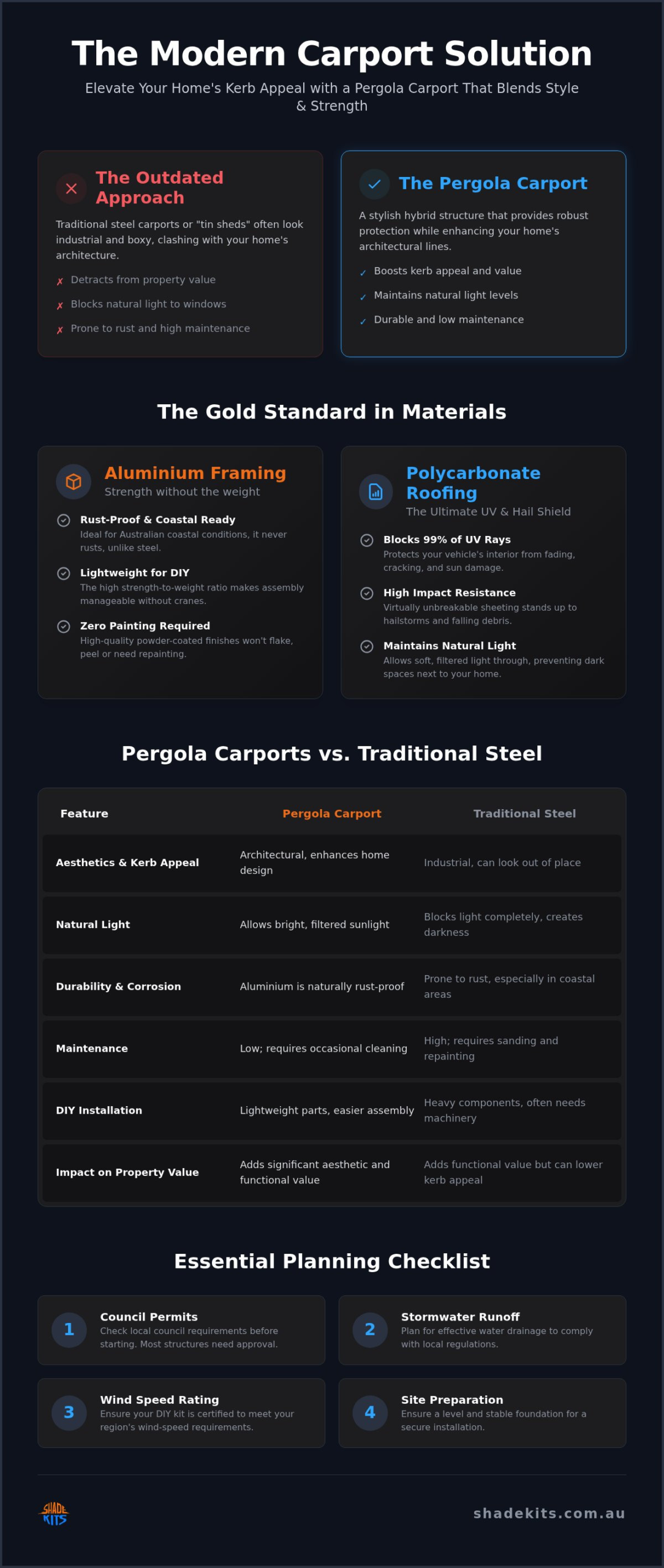
Choosing the right materials for your pergola carport is the difference between a structure that lasts a lifetime and one that becomes a maintenance headache. In Australia, we face extreme UV levels, high salt content in coastal air, and unpredictable storm seasons. Traditional materials often struggle here. Timber requires constant oiling to prevent rot and termite damage, while heavy steel can be difficult for a DIYer to handle without professional machinery. This is why the combination of aluminium and polycarbonate has become the gold standard for modern home improvements.
Aluminium frames are prized for their incredible strength-to-weight ratio. This makes the assembly process far more manageable for the average homeowner as you can lift beams without a crane. Because aluminium doesn’t rust, it’s vital for those living near the ocean. Our frames come with high-quality powder-coated finishes that won’t flake or peel, meaning you’ll never have to pick up a paintbrush to keep it looking new.
The lightweight nature of aluminium significantly reduces the physical strain during your DIY build, allowing you to focus on precision rather than heavy lifting. These modern finishes stay vibrant for years, ensuring your investment doesn’t lose its visual appeal after just a few summers. It’s a pragmatic choice for those who want structural integrity without the industrial weight of traditional steel.
The roofing material is vital for vehicle longevity. Polycarbonate offers massive impact resistance and is virtually unbreakable, which is a relief when a summer hailstorm rolls in. It acts as a UV shield, blocking up to 99% of rays that cause car interiors to crack. Unlike solid metal roofs, polycarbonate allows soft, natural light to pass through. It also manages heat expansion much better than rigid glass or heavy steel.
This light transmission is a major advantage for structures built close to the house, as it prevents adjacent rooms from becoming dark and gloomy. The material is specifically engineered to be hail-rated, providing a reliable canopy that absorbs impact without denting. It is a durable solution that protects your car while maintaining a bright, airy atmosphere in your outdoor space.
By opting for these advanced materials in your pergola carport, you’re choosing a structure that is essentially “set and forget”. You won’t be dealing with termites, you won’t be treating rust spots, and you won’t be replacing warped timber beams in five years. It’s a reliable, long-term investment in your property’s infrastructure that maintains its sleek, modern look with almost zero effort on your part. If you’re ready to see how these materials come together in a ready-to-assemble package, you might want to look at our carport kits to find the right fit for your driveway.
When you start looking at vehicle protection, the standard choice has long been a traditional steel structure. While steel is undeniably strong, it often brings an industrial aesthetic that can feel out of place in a residential garden or front driveway. A pergola carport offers a significantly different experience, focusing on how the structure interacts with your home’s light and overall look. Traditional steel carports typically use opaque metal sheeting which blocks all sunlight, creating dark and often uninviting spaces right next to your living areas.
Steel roofs have a tendency to absorb and radiate heat downwards, which can make the area underneath feel stifling on a 40-degree day. In contrast, the polycarbonate roofing used in pergola hybrids is designed with UV tints that reflect heat while allowing “soft light” to filter through. This ambient light is a genuine game-changer for carports attached to the side of a house. It ensures that your internal windows aren’t overshadowed, keeping your indoor living spaces bright and airy. For a deeper look at how these structures compare across different Australian regions, you can check out The Ultimate Guide to DIY Carport Kits in Australia (2026).
The difference in installation and upkeep is where the choice becomes very practical for the average homeowner. Traditional steel often requires heavy-gauge bolting or even on-site welding, which usually necessitates professional help. Aluminium kits are engineered for the weekend DIYer, featuring pre-drilled components that are much lighter and easier to organise. There is also a “silent” benefit to these modern materials. Polycarbonate is remarkably quieter during a heavy downpour compared to thin metal sheeting, which can be quite loud when it’s right outside a bedroom window.
From a maintenance perspective, powder-coated aluminium holds its own against galvanised steel. While steel is durable, any scratch in the coating can eventually lead to rust if not treated. Aluminium is naturally resistant to corrosion, making it a safer bet for longevity without the need for constant inspections. Ultimately, a pergola carport provides a more refined, garden-friendly appearance that blends into your landscaping rather than looking like an industrial afterthought. It offers the same level of heavy-duty protection as steel but with a focus on livability and ease of assembly.
The most common hurdle for homeowners considering a pergola carport isn’t the design; it’s the logistics. Many people ask, “Can I actually build this myself?” The answer is a resounding yes, provided you start with the right foundation. Modern kits have removed the traditional barriers to DIY success. By using pre-drilled, precision-cut components, the process becomes more like assembling high-end furniture than a complex construction project. You won’t need to worry about complex mitre cuts or specialized welding; you simply follow a logical, step-by-step sequence.
Before you pick up a drill, you must understand your local regulations. While some smaller structures may fall under “exempt development,” adding a solid roof often reclassifies the project. Most councils have strict rules regarding “setback” distances—the space between your structure and the property boundary—and overall height limits. Having a professional set of kit plans makes this approval process much smoother. It provides your local Council with the exact structural specifications they need to see. For a detailed breakdown of what to check before you start, read The Essential Australian Carport Checklist.
Getting the dimensions right is about more than just fitting the car under the roof. A standard single pergola carport typically measures 3m x 6m, while a double requires at least 6m x 6m. Don’t forget to account for door opening space. If you drive a large SUV or a 4WD with roof racks, you’ll need to pay close attention to the internal clearance height. We often recommend “oversizing” slightly if your block allows it. This extra space ensures you aren’t squeezing past the car in the rain and allows the structure to double as a comfortable entertaining area for larger gatherings.
Site preparation is the final, vital piece of the puzzle. Your structure is only as stable as the ground it sits on. You’ll need either a level concrete pad or secure, deep footings for the posts to ensure long-term structural integrity. Proper drainage is also essential; you must ensure that stormwater runoff is directed into your property’s existing system and not onto your neighbour’s land. Taking the time to get your site level and your permits in order ensures the actual assembly is the easiest part of the project. If you’re ready to measure up your space and get started, browse our range of carport kits to find the dimensions that work for your home.
Choosing a pergola carport is a significant investment in your home’s infrastructure. At Shade Kits, we’ve refined our process to ensure that this investment provides both immediate value and long-term reliability. We believe that professional-grade results should be accessible to every homeowner, which is why our structures are designed to bridge the gap between high-end architectural design and practical, DIY-friendly assembly. You don’t need a team of contractors or specialised machinery to achieve a polished, structural result that enhances your property.
One of the primary ways we support our customers is through our factory-direct model. By cutting out the middlemen, showrooms, and sales commissions, we can maintain premium material standards without the inflated price tags often found in big-box retail. This transparency means you know exactly what you’re paying for. You receive high-grade aluminium and UV-resistant polycarbonate directly from the source. Our Carport Kits come with every component required for the build, ensuring there are no frustrating mid-project trips to the hardware store for missing fasteners or brackets.
Australia’s weather is notoriously tough on outdoor structures. Whether it’s the intense coastal sun in Perth or the sudden summer hailstorms in Sydney, your shelter needs to be up to the task. Our kits are engineered for wind-speed compliance and feature the highest UV ratings available to protect your vehicle’s paintwork and interior. Because we are a local, Australian-owned business, we understand these specific environmental challenges intimately. We also recognise that not every situation requires a permanent fixture. For those needing high-quality, non-permanent protection, our Car Cave provides a robust alternative that still maintains our strict standards for durability.
A major benefit of our design is its inherent versatility, which is a point often overlooked by industrial suppliers. While the primary goal is vehicle safety, the aesthetic of a pergola carport allows it to function as a multi-use space. Many of our customers find that once the car is moved, the area transforms into a perfect shaded spot for weekend BBQs or a protected play zone for the kids. It’s this ability to serve two purposes—practical vehicle shelter and stylish entertaining area—that truly sets our kits apart. You’re not just building a place to park; you’re extending your home’s livable footprint.
With Australia-wide delivery, your complete project arrives at your door, ready for a straightforward weekend assembly using only basic household tools. Explore our range of Pergola Carport Kits and start your DIY project today.
Investing in a pergola carport is a smart way to blend high-end aesthetics with the practical necessity of vehicle protection. You don’t have to choose between a dark, industrial shed and an unprotected driveway. By opting for a hybrid design, you gain a multi-functional space that shields your car from the sun and rain while maintaining the open, airy feel of a traditional pergola. This structure serves as a durable extension of your home that requires almost zero maintenance over its long lifespan.
Getting started on this project is simpler than you might think. Our factory-direct Australian pricing removes the extra costs of showrooms, while our kits are designed for straightforward DIY installation using basic tools. With UV-resistant and hail-rated roofing as standard, your new structure is built to handle whatever the Aussie weather throws its way. View Our Range of DIY Pergola Carport Kits today and discover how easy it is to add professional-grade value to your home. You’ve got the plan; now it’s time to build it.
Yes, in most cases, you will need Council approval because adding a solid roof typically reclassifies the structure. While an open-frame pergola might be exempt under certain size and height limits, a structure intended for vehicle storage with a weather-tight roof usually requires a permit. It’s best to check with your local Council regarding specific setback distances and height regulations before starting your build. This ensures your project remains compliant with local building codes.
Yes, the high-impact polycarbonate used in our kits is specifically engineered to be hail-rated and virtually unbreakable. Unlike traditional metal sheeting that can dent or glass that can shatter, polycarbonate absorbs the impact of hailstones without structural damage. This resilience is essential for protecting your vehicle’s panels and glass during the unpredictable storm seasons common across many Australian states. It provides reliable, long-term security for your car.
Yes, our kits are designed specifically for the average homeowner to assemble using basic household tools. Every component is pre-drilled and precision-cut at the factory, which removes the need for specialised trade skills like welding or complex timber joinery. Most DIYers find that having a second person to help with lifting the beams makes the process much faster and safer. It’s a manageable weekend project that delivers professional results.
The primary difference lies in the roofing. A traditional pergola is an open-frame structure often used for aesthetics or light shade, whereas a carport must have a solid, weather-tight roof to protect a vehicle. A pergola carport hybrid combines the decorative, architectural framing of a pergola with the functional, waterproof roofing of a carport. This allows you to achieve a stylish look without sacrificing the practical protection your car needs from the elements.
Most homeowners can complete the assembly over a single weekend. For a standard single-vehicle structure, the process usually takes two people roughly 8 to 12 hours once the footings or concrete pad are ready. Larger double-carport kits might require an extra day of work. The clear, step-by-step instructions ensure you spend your time building rather than trying to figure out where each fastener goes, making the process efficient and predictable.
No, aluminium is naturally resistant to rust and corrosion, making it the superior choice for coastal Australian homes. Unlike steel, which can succumb to salt spray if the protective coating is scratched, aluminium develops its own protective oxide layer. Our powder-coated finishes provide an additional barrier, ensuring your structure remains structurally sound and visually appealing even in high-salt environments. It is a durable solution for any seaside property.
Yes, these structures are perfect for multi-use functionality. Because the polycarbonate roof allows natural light to filter through, the space feels bright and inviting rather than dark like a traditional shed. When you aren’t parking your car, the area serves as a large, protected zone for weekend BBQs, kids’ play, or outdoor dining. It’s a great way to maximise your property’s usable footprint and add genuine lifestyle value to your home.
Maintenance for an aluminium pergola carport is remarkably low and generally involves nothing more than an occasional wash with a garden hose. You don’t need to worry about the regular painting, staining, or oiling required for timber structures. We recommend checking the gutters for leaf debris once or twice a year to ensure proper drainage. The durable powder-coated finish and polycarbonate roof will stay in top condition for years with very little effort from you.