
Could your DIY project be doomed before you even pick up a drill? It’s a common worry for Australian homeowners who fear buying a kit that leaks or, worse, gets rejected by the local council. When researching carport kits with guttering Australia-wide, the difference between a frustrating weekend and a professional result usually comes down to the quality of your initial plan. You want a durable, rust-proof solution that manages heavy downpours without the stress of missing components or confusing instructions.
We understand that the logistics of permits and site requirements can feel overwhelming. That is why we have compiled this comprehensive checklist to simplify the process. This guide will walk you through exactly what you need to verify before you start, from checking your local Class 10a building regulations to ensuring your drainage system is up to standard for 2026 weather events. By following these steps, you will gain the confidence to choose a kit that offers long-term value, effective water runoff, and genuine structural integrity for your property.
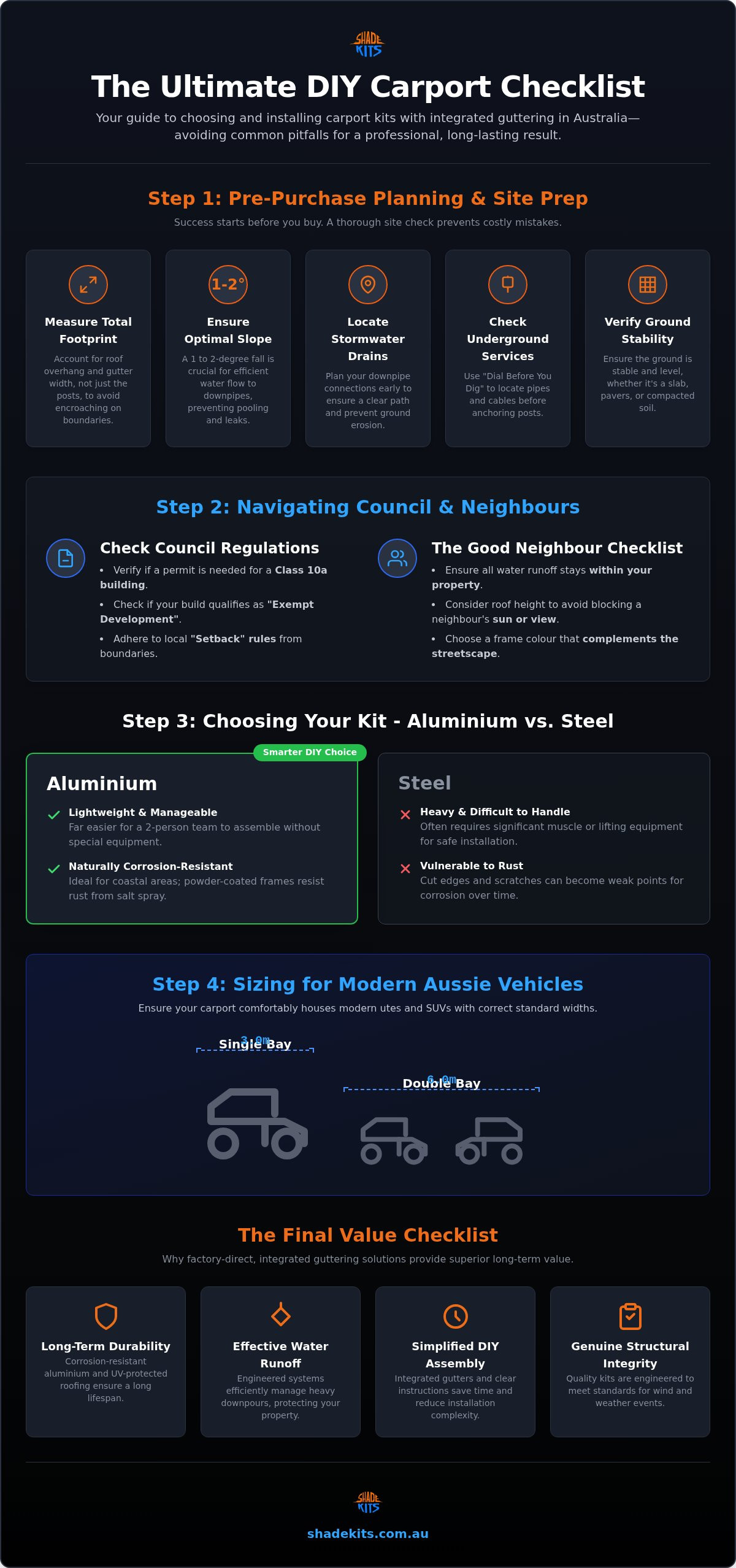
Success with a DIY build starts long before the delivery truck arrives at your driveway. A common mistake is assuming the space you have is exactly the space you need. When you are measuring, don’t just look at the distance between the posts. You must account for the total footprint, which includes the roof overhang and the width of the integrated guttering. If you skip this, you might find your structure encroaching on a boundary or blocking a walkway you use every day. It’s much easier to adjust your plan on paper than it is to move a bolted-down frame.
To get the most out of your project, it helps to understand the foundational design of these structures. Revisiting the basic definition of What is a Carport? highlights why drainage is such a vital component. Because these are open-sided structures, the roof bears the full brunt of Australian weather. Identifying the optimal slope is essential to prevent water from pooling, which can lead to leaks or structural strain over time. Most high-quality carport kits with guttering australia wide are engineered for a specific fall, typically between 1 and 2 degrees, to ensure water flows efficiently toward the downpipes.
Before you commit to a location, complete these essential site checks:
Building regulations differ significantly between states and local government areas. In some parts of Australia, a small structure may fall under “Exempt Development,” meaning you don’t need formal approval. However, you still need to adhere to “Setback” rules, which define how close you can build to your neighbour’s fence or the street. Always verify if a building permit is required for permanent carport kits, especially those with fixed guttering systems, as these are often classified as Class 10a buildings.
Maintaining a good relationship with your neighbours is just as important as the build itself. Ensure your guttering system is designed to keep all water runoff within your property. Flooding a neighbour’s yard is a fast way to trigger a council complaint. You should also consider the height of your roof. A very tall carport might block their afternoon sun or a cherished view. Finally, pick a frame colour that blends with the streetscape. A cohesive look keeps the whole neighbourhood happy and protects local property values.
Once your site is ready, the focus shifts to the hardware. Selecting from the variety of carport kits with guttering australia has to offer requires a balance between aesthetic appeal and structural performance. You aren’t just buying a roof; you’re investing in a system that needs to stand up to intense heat and sudden deluges. Choosing factory-direct kits allows you to avoid the hefty retail markups often found at big-box hardware stores, putting more of your budget into high-grade materials rather than a showroom’s overhead.
While many traditional suppliers push steel, aluminium is often the smarter choice for a self-installed project. Steel is heavy. It requires significant muscle and specialized equipment to position beams safely. Aluminium is much lighter, making it far more manageable for a two-person team. Beyond the weight, aluminium naturally resists corrosion. If you live near the coast, salt spray eventually finds cut edges on steel beams, leading to rust. A powder-coated aluminium frame bypasses this risk entirely.
The roof is your vehicle’s first line of defence. UV-resistant polycarbonate blocks 99% of harmful rays while allowing natural light to filter through. This material is also engineered for hail resilience, absorbing impacts that might dent metal. Finding the right carport kits with guttering australia means looking for a setup that handles the high-intensity storm events projected for 2026. You need a system that directs water away seamlessly, preventing overflow and foundation erosion.
Style choice also plays a major role in how your structure functions. Skillion (flat) roofs are popular for their simplicity and cost-effectiveness, while gable designs offer a traditional look that matches many Australian homes. If you have limited space, a cantilevered configuration can provide coverage without the need for multiple support posts, giving you more room to manoeuvre your car or ute. For those who need a durable yet manageable solution, exploring quality DIY carport kits ensures every component is engineered to fit perfectly from day one.
Finally, consider the long-term value of an integrated system. A kit that includes gutters, downpipes, and all necessary fasteners as part of the package saves you from making multiple trips to the hardware store. It ensures that every part is designed to work together, maintaining the structural integrity of the build while providing a clean, professional finish that enhances your property’s street appeal.
Choosing the right dimensions for carport kits with guttering australia homeowners rely on isn’t just about the width of the chassis. It’s about how you use the space daily. As of December 2025, the average Australian car is roughly 4.7 metres long, but utes and light commercial vehicles often reach 5.51 metres. If you drive a modern SUV or a dual-cab ute, a standard size might leave your bull bar or tow bar exposed to the elements. You don’t want to finish a build only to realize your tailgate can’t open without hitting the back beam.
For a single carport, a minimum width of 3.0m is essential. This provides enough clearance to open your doors comfortably without dings. If you are planning for two vehicles, a double carport with a 6.0m width is the pragmatic choice. This allows two large SUVs to sit side-by-side while leaving space for passengers to exit safely. When comparing carport kits with guttering australia wide, always account for the extra width the drainage system adds to the roofline to ensure you aren’t overstepping your boundary lines.
Don’t rely on the manufacturer’s spec sheet alone. Measure your vehicle mirror-to-mirror to get the true width. You also need to consider your approach angle. If your driveway requires a sharp swing to enter the carport, you’ll need wider spacing between the front posts to avoid a scrape. A wider entry point is much cheaper than a panel beaters bill.
Sometimes a permanent structure isn’t the right fit for your current situation. If you are living in a rental property or facing strict council limits on new builds, the CarCave foldable car protection offers a flexible alternative. Unlike a permanent carport kit, these foldable shelters can be set up in minutes and taken with you if you move house. They provide excellent protection from UV rays and rain without the need for concrete footings or long-term permits.
A smooth installation is the result of meticulous preparation. Before you think about drilling your first hole, perform a complete inventory audit. Lay out every fastener, beam, and bracket on a clean surface and cross-reference them against the packing list. There is nothing more frustrating than getting halfway through a build and realizing you’re missing a critical end cap. When you source carport kits with guttering australia wide, you expect a complete package, so verifying this on day one is a vital step for your peace of mind.
Safety is your top priority during the assembly. Always wear appropriate PPE, including cut-resistant gloves for handling metal edges and safety glasses when drilling into masonry or overhead beams. You should also check the Bureau of Meteorology for a clear 48-hour window. You don’t want to be caught with an unanchored frame or half-finished roof during a sudden southerly buster. While these kits are designed for DIY, don’t try to lift the main perimeter beams alone. You’ll need a mate to help position the heavy components safely while you secure the fasteners.
You don’t need a trade qualification to achieve a professional finish, but you do need the right gear. Most homeowners already have the basics, but a few specific items will make the job much easier. Make sure your kit includes:
Guttering is often treated as a minor detail, but it’s the most important part of protecting your property’s foundation. You need to set a consistent fall toward the downpipe outlet. Without this slight slope, water will pool, leading to stagnant debris and eventual leaks during heavy summer storms. Use high-grade neutral cure silicone on all joints and end caps to create a watertight seal. Finally, ensure your downpipe connection is secured to your home’s existing stormwater system to manage runoff effectively. If you’re ready to start your project, you can browse our range of DIY carport kits to find a structure that fits your space and skill level.
Investing in a structure to protect your vehicle is a significant decision. When you evaluate the best carport kits with guttering australia has to offer, the true value lies in how well the system performs five or ten years down the track. You aren’t just looking for a weekend project; you’re looking for a long-term asset that withstands the harsh reality of the Australian climate. By choosing a solution that integrates drainage directly into the structural design, you eliminate the common headaches of leaks and rust that plague cheaper, piecemeal alternatives.
Shade Kits designs are specifically tested for high UV exposure and coastal salt spray resilience. Unlike traditional timber that requires constant painting or steel that can succumb to edge-rust, powder-coated aluminium offers a virtually maintenance-free existence. A simple wash with a hose once or twice a year is usually all that is needed to keep the frame looking new. This durability ensures that your carport kits remain a functional and attractive part of your home for decades.
One of the biggest hurdles for DIYers is the price gap between retail stores and specialist suppliers. Retail markups can easily add 30% or more to your total bill. These extra costs don’t go into better materials; they go into showroom rent and third-party logistics. Buying directly from an Australian specialist allows you to secure premium materials without the inflated price tag. If you are working with a tight budget, our Inexpensive Carport Kits Guide provides savvy tips on how to maximize your investment without compromising on structural integrity.
Before you place your order, run through your planning checklist one last time. Ensure your site is level, your council requirements are clear, and you have a plan for your downpipe connections. Taking these final precautions ensures that your installation process is as smooth as possible. You can explore the full range of carport kits with guttering online to find the specific size and style that suits your property. If you have questions about site-specific engineering or custom configurations, our team is ready to provide the expert advice you need to get your project moving.
Planning a new structure is about more than just finding a space in the driveway. It’s about ensuring your investment stands up to the elements while meeting all local requirements. By following a structured checklist, you’ve already addressed the biggest hurdles: site preparation, permit navigation, and choosing the correct dimensions for your vehicle. You now know that rust-proof aluminium frames and UV-resistant roofing are non-negotiable for the Australian sun.
Selecting high-quality carport kits with guttering australia wide provides the peace of mind that your home and vehicle are protected from heavy storm runoff. With our focus on factory-direct value and Australia-wide delivery, you can achieve a professional finish without the retail markup. Taking that first step toward a durable, well-drained structure is simpler than you think. It’s a pragmatic way to add genuine value to your property while keeping your car safe from the next big summer storm.
Browse Our Factory-Direct DIY Carport Kits with Guttering today. You’ve done the research and prepped the plan. Now it’s time to build a solution that lasts.
Most permanent carports are classified as Class 10a buildings and generally require council approval or a building permit. However, exemptions often apply for smaller structures. For example, local regulations might exempt carports under 20 square metres if they meet specific height and setback requirements. You should always check with your local government authority before starting your build to ensure you comply with current 2026 regulations.
Guttering is not always a standard inclusion in budget kits, so it’s vital to check the inventory list before you buy. High-quality carport kits with guttering australia homeowners prefer will feature integrated drainage systems designed specifically for the frame. Choosing a kit with built-in gutters ensures that water runoff is managed correctly from day one, protecting your driveway and your home’s foundation from erosion.
Powder-coated aluminium is the most pragmatic choice for coastal areas due to its natural resistance to corrosion. Unlike steel, which can rust if the protective coating is scratched or at the cut edges, aluminium stands up to salt spray without structural degradation. This makes it a long-term, low-maintenance solution for properties near the ocean where the air is thick with salt and moisture.
A standard single carport usually takes a two-person team between one and two days to complete. This timeframe assumes your site is already level and you have your tools ready to go. Larger double carport designs or more complex gable configurations might require an extra day for the roofing and guttering installation. It’s a manageable weekend project for most confident DIYers.
You don’t need a professional tradie to assemble these kits, as they are engineered for straightforward DIY installation. While the process is designed to be simple, you will definitely need a mate to help with the heavy lifting, especially when positioning the main beams and roofing sheets. Having a second pair of hands ensures the frame stays square and safe during the anchoring process.
Connecting your drainage involves installing a downpipe outlet at the lowest point of the gutter’s fall. You then run a downpipe to your property’s existing stormwater system using standard PVC connectors. It’s essential to use high-grade neutral cure silicone on all joints to prevent leaks. In many regions, regulations require that all runoff must be connected to a legal discharge point rather than just dumping onto the ground.
UV-resistant polycarbonate is exceptionally resilient and is designed to withstand the impact of typical Australian hail storms. The material is flexible enough to absorb the energy of an impact without cracking or denting like traditional metal sheets might. This makes it a reliable choice for vehicle protection in regions prone to sudden summer storms and high-intensity weather events.
Yes, many kits offer different post length options to provide the extra clearance needed for caravans, boats, or 4WDs with roof racks. When ordering, you can often specify taller posts to ensure your tallest vehicle fits comfortably with at least 200mm of buffer space. It’s much better to plan for this extra height during the ordering phase than trying to modify a standard kit later.