
Your front door is likely the most exposed part of your home, yet it is often the most neglected until the frame begins to rot. You probably know the frustration of watching expensive entryway paint fade under the harsh Australian sun or dealing with a soaked doorstep every time a storm rolls through. While custom-built awnings are a traditional choice, the high costs and long wait times for trades can make them feel out of reach for many homeowners.
By opting for the professional-grade door canopy kits Australia has available, you can secure a durable, weather-resistant entryway on your own terms. This 2026 guide promises to show you exactly how to choose, measure, and install a kit that protects your home from heavy rain and UV rays while significantly improving street appeal. We will explore the benefits of aluminium frames and polycarbonate roofing, providing a clear path to a successful DIY installation that saves you money and stands the test of time.
A door canopy kit is a pre-engineered, wall-mounted shade structure designed specifically for straightforward DIY assembly. Unlike custom-built permanent structures that require a professional builder and weeks of lead time, these kits arrive with all the necessary components for a homeowner to install independently. When researching What is an Awning?, you’ll find that while they serve as a secondary covering, a modern structural kit provides much more than just a bit of shade. The primary goal of door canopy kits Australia wide is to safeguard your home’s most vulnerable point: the front entrance.
It’s important to distinguish between a purely decorative awning and a structural door canopy kit. While a fabric awning might look nice, a structural kit uses robust materials like aluminium and polycarbonate to withstand heavy rain and high winds. This isn’t just about looks; it’s about creating a rigid barrier that keeps moisture away from your door hardware and timber frames. Shading your entryway also plays a vital role in home energy efficiency. By blocking direct sunlight before it hits your door and sidelights, you reduce the heat build-up inside your hallway during peak summer heat.
Direct exposure to the elements is the fastest way to ruin a high-quality front door. Constant rain causes timber to swell, eventually leading to rot and sticking locks. By installing a canopy, you create a dry “transition zone” that protects guests and parcel deliveries from getting soaked. Beyond rain, UV rays are a silent threat. A canopy blocks the sun’s intensity, preventing paint from peeling and varnished timber from fading. It even protects your internal flooring from sun bleaching when the door is open, ensuring your interior remains in top condition for years.
A well-chosen canopy does more than protect; it adds architectural depth to an otherwise flat facade. It acts as a focal point that guides the eye to your entrance, instantly boosting street appeal. For a cohesive look, many homeowners match the canopy frame colours with their existing gutters or window frames. Investing in door canopy kits Australia can increase property value through low-cost external improvements. It’s a pragmatic way to make the house look finished and well-maintained without the price tag of a major renovation.
Australia’s climate demands more than just basic shelter. Whether you’re facing coastal salt spray or the scorching heat of the interior, selecting the right materials for door canopy kits Australia wide is a long-term investment in your home’s structural integrity. It is vital to ensure your chosen products meet the National Construction Code (NCC) requirements, as non-conforming materials can lead to premature failure or rapid degradation under our intense sun.
Aluminium frames are the gold standard for Australian conditions. Unlike timber, which requires regular sanding and repainting to avoid rot and termite damage, powder-coated aluminium is virtually maintenance-free. It won’t rust in humid or coastal environments, making it a reliable “set and forget” solution. From a DIY perspective, aluminium is incredibly lightweight. This makes the assembly process much safer and easier for a single person to manage compared to heavy steel or bulky timber alternatives that often require extra hands or specialised lifting equipment.
The roofing material is equally critical for a functional entryway. Modern polycarbonate panels are engineered to block 99% of harmful UV rays, protecting your front door from bleaching while still allowing soft, natural light to filter through. This is a significant advantage over solid metal or fabric covers that can make an entryway feel dark and uninviting.
Hail resistance is another factor where quality matters. High-grade polycarbonate is designed to withstand impact without cracking or shattering. When choosing your kit, consider the panel thickness and whether the material is UV-stabilised on both sides to prevent yellowing and brittleness over time. Tinted or frosted options are also available to help manage heat transmission if your entrance faces the harsh afternoon sun.
Maintenance is where the value of these materials really shines. While fabric awnings can attract mould and budget plastic frames often crack after just a few summers, an aluminium and polycarbonate system only needs a simple hose down twice a year to look new. If you want a solution that prioritises longevity and ease of use, you can view our durable awning kits to find a style that fits your home perfectly. By focusing on professional-grade materials, you ensure your entryway remains protected for decades rather than just a few seasons.
Deciding between a custom-built awning and a DIY kit often comes down to two factors: time and money. While a permanent verandah extension might seem like a grand solution, it frequently involves complex council approvals, expensive engineering fees, and the headache of managing a builder’s schedule. In contrast, high-quality door canopy kits Australia wide offer a streamlined, structural alternative that delivers professional results without the commercial markup. Taking the DIY route isn’t just about being handy; it’s a pragmatic choice for homeowners who want to improve their property on their own timeline.
A professional DIY kit is designed to eliminate the guesswork. When you receive your package, you’ll find every component is engineered for a precise fit. The package includes:
These components meet the same high standards found in The Ultimate Guide to DIY Carport Kits in Australia (2026), ensuring your entryway protection is as robust as a full-scale outdoor structure. You won’t need a specialised workshop to get the job done. Most homeowners already have the basics in their garage: a cordless drill, a spirit level, a tape measure, and a ladder.
The most significant advantage of a kit is the removal of the “retailer tax” and high labour costs. By purchasing factory-direct, you cut out the middleman fees that typically inflate the price of custom home improvements. DIY installation can save upwards of 50% on the total project cost compared to hiring a contractor for a bespoke build. This allows you to invest in higher-quality materials, like powder-coated aluminium and UV-stabilised polycarbonate, rather than spending that budget on a tradesman’s hourly rate.
Beyond the financial aspect, you also bypass the notorious “tradie wait-list.” Instead of waiting weeks for a quote and months for a start date, a standard installation of door canopy kits Australia can be completed in just a few hours on a Saturday morning. This immediate result is perfect for those who want to fix an urgent issue, like a rotting door frame or a leaking entrance, without the delays of traditional construction.
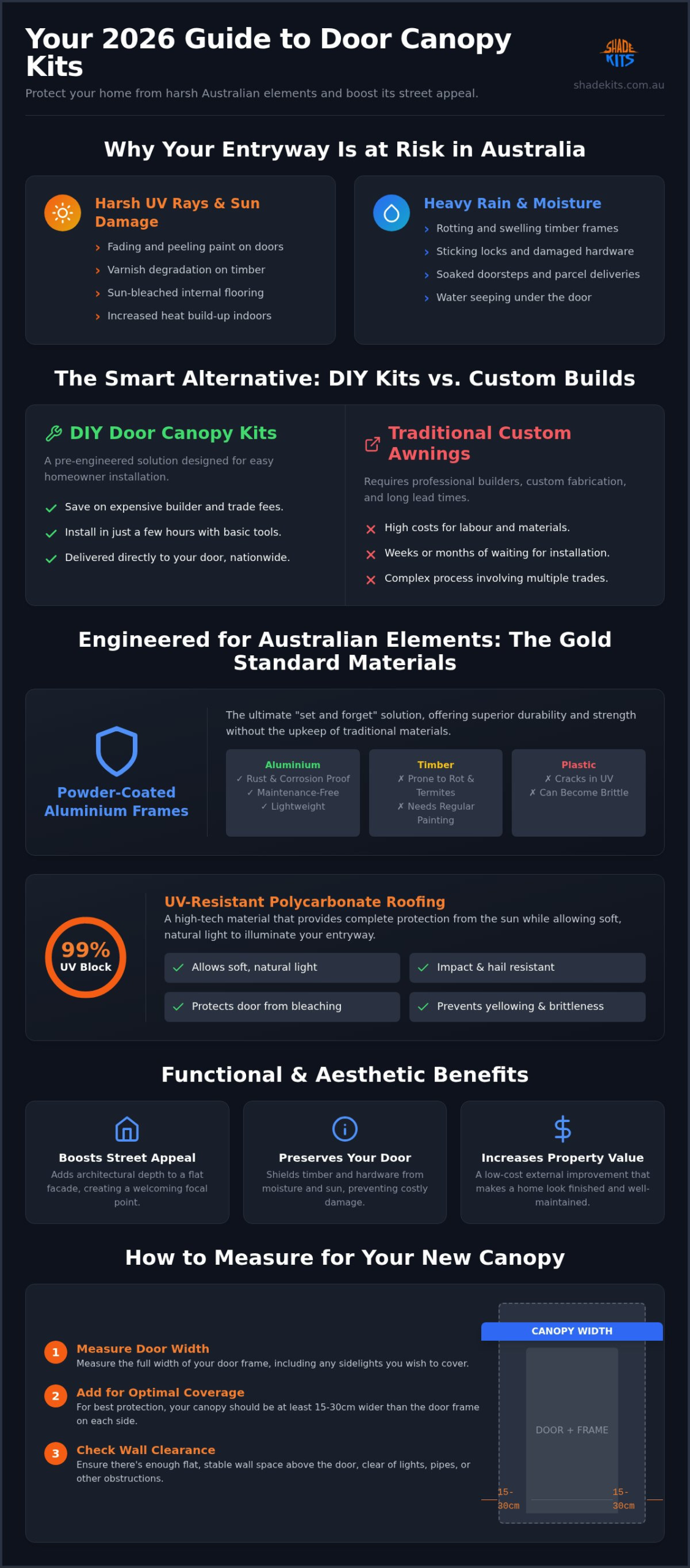
Selecting the right dimensions and style is the most critical step in the DIY process. While some retailers offer generic sizes, these often fail to account for the specific geometry of Australian entryways. When browsing door canopy kits Australia, you must look beyond the width of the door frame itself to ensure full protection and a professional finish. A canopy that’s too small won’t keep the rain off your doorstep, while one that’s too large might look out of proportion with your facade.
To prevent rain splashback from soaking your doorstep and rotting the threshold, your canopy should ideally extend 150mm to 300mm past the door frame on either side. This extra width ensures that wind-driven rain doesn’t bypass the shelter. You also need to calculate the vertical clearance carefully. Measure the distance from the top of the door to the eave or any existing light fittings to ensure there’s enough room for the mounting brackets. If your front door swings outward, it’s vital to check that the canopy height allows for full movement without the door clipping the underside of the structure.
Projection is the other half of the measurement puzzle. This refers to how far the canopy sticks out from the wall. You want enough depth to keep the area dry, but not so much that it becomes a hazard for tall visitors or interferes with a narrow walkway. A standard projection of 900mm to 1200mm usually strikes the right balance for most residential paths, providing ample cover for guests and parcel deliveries alike.
Your choice of design should complement the existing architectural lines of your home. A sleek cantilever design with a flat profile works exceptionally well for modern Australian homes with minimalist facades. These designs offer a clean, “floating” look that doesn’t require bulky support arms. Conversely, curved canopies are excellent for softening the harsh angles of traditional brick homes or adding architectural interest to a plain entrance. You can explore more about these design choices in The 2026 Guide to Aluminium Awnings for Australian Homes.
Matching your canopy to your home’s existing palette is the secret to a high-end look. Organising your colour selection to match your gutters, fascias, or window frames creates a cohesive appearance. Most homeowners opt for powder-coated frames in popular Australian shades like Monument or Surfmist to ensure the new addition looks like an original part of the build rather than an afterthought. If you’re ready to upgrade your entrance, you can browse our range of door canopy kits to find the perfect match for your home’s style.
Buying door canopy kits Australia wide shouldn’t be a gamble on the quality of the materials or the reliability of the supplier. When you choose to work with an Australian-owned specialist, you’re investing in a product designed specifically for our local environmental standards. Our factory-direct model is built on transparency and direct communication. We handle the design and the distribution, which means you gain access to expert support from the people who actually engineered the kit. If you have a specific question about a tricky mounting surface or local wind conditions, you’re talking to a seasoned specialist rather than a retail clerk.
Large retail chains often have significant overheads, including expensive floor space and massive staffing costs, which are inevitably passed on to the consumer. By choosing a factory-direct path, those middleman markups are eliminated entirely. This allows for the use of higher-grade aluminium and superior UV-stabilised polycarbonate without inflating the final price. You get a professional-grade structure delivered to your door with consistent quality control that retail chains simply can’t match. It’s a pragmatic way to ensure every dollar of your budget goes toward the durability of the components.
Shipping fragile components like polycarbonate panels across the vast Australian landscape requires more than just a standard courier. We’ve developed a safe Australia-wide delivery system specifically for these materials. Each kit is packed with precision to withstand the journey, ensuring your components arrive in perfect condition; they are ready for installation the moment they reach your driveway.
While the main entrance is often the first priority for homeowners, these kits are incredibly versatile across the entire property. They are an ideal solution for protecting laundry exits, side gates, or large windows that suffer from excessive afternoon heat. For those who want to extend this level of protection to their vehicles, it’s easy to transition from a small entryway shade to full-scale coverage with our Carport Kits. You can even integrate your canopy with other specialised shade solutions like the CarCave for total property protection. A single weekend DIY project can completely transform your home entrance, turning a vulnerable doorway into a durable, weather-protected architectural feature that adds lasting value to your home.
Protecting your entryway doesn’t need to be a complex or expensive renovation. By choosing high-quality door canopy kits Australia, you’re opting for a structural solution that combines modern aesthetics with genuine resilience. You now know how powder-coated aluminium and UV-resistant polycarbonate create a maintenance-free barrier that stands up to the harshest storms and the midday sun. These materials aren’t just for looks; they’re a pragmatic investment in your home’s longevity and structural health.
Taking the DIY route allows you to bypass retail markups and tradie wait-lists, putting you in control of your home’s street appeal. With factory-direct pricing and DIY-friendly aluminium designs, you can achieve professional results in a single afternoon. We support your project with Australia-wide delivery, ensuring your components arrive ready for immediate assembly. It’s about making high-end home improvement accessible and straightforward for every homeowner.
Browse our range of factory-direct Door Canopy Kits and protect your home today. It’s a simple, effective way to future-proof your entrance and enjoy a dry, shaded doorstep for years to come.
Small door awnings under 10 square metres usually fall under “exempt development” in most Australian states. This means you don’t typically need council approval for a standard installation. However, if your property is heritage-listed or located in a specific bushfire zone, rules can differ. It’s always a pragmatic step to check your local council’s website for their specific guidelines on minor external structures to ensure your project remains fully compliant.
Yes, a single person can install our aluminium door canopy kits Australia wide because the materials are remarkably lightweight. The pre-drilled components are designed for easy handling. While one person can manage the assembly and fixing, having a second pair of hands is helpful when you are positioning the main frame against the wall. This ensures the structure stays level while you mark out and drill the initial anchor points for a perfect finish.
Modern polycarbonate panels are surprisingly quiet compared to traditional corrugated iron. While you will hear the sound of heavy rain, the material properties of multi-wall or solid polycarbonate naturally dampen the acoustic impact. It creates a soft, rhythmic sound rather than the loud metallic drumming associated with metal roofing. This makes it an excellent choice for entryways located near bedrooms or living areas where you want to maintain a peaceful indoor environment.
Maintenance is straightforward because aluminium and polycarbonate are naturally resilient. You only need to hose down the structure twice a year with fresh water to remove salt, dust, and debris. For more stubborn dirt, use a soft sponge and a bucket of mild soapy water; avoid abrasive cleaners or stiff brushes that could scratch the UV coating. Keeping the gutters clear of leaves ensures that rainwater flows freely and prevents any overflow onto your doorstep.
The fixing method depends entirely on your home’s substrate. For brick or rendered walls, you should use high-quality masonry anchors or sleeve bolts to ensure a rigid connection. For timber-clad walls, it’s essential to locate the internal wall studs and use heavy-duty coach screws to secure the brackets. Fixing only into the thin cladding won’t provide enough structural support. Our kits are engineered to be compatible with standard Australian wall types when the correct anchors are used.
High-quality door canopy kits Australia homeowners choose are engineered to meet Australian Standard AS/NZS 1170.2:2021 for wind actions. This ensures they can withstand standard wind loads in most residential areas. However, if you live in a designated cyclonic region, you should verify that the specific kit’s engineering drawings meet the higher wind rating requirements for your zone. Choosing a kit with a robust aluminium frame and secure wall fixings is the best way to ensure long-term stability.
Every Shade Kits package arrives as a complete DIY solution. We include all the necessary structural bolts, weather-resistant gaskets, and heavy-duty wall fixings required for a standard installation. You don’t need to make extra trips to the hardware store for specialised components. You only need to provide the basic tools, such as a cordless drill and a spirit level, to complete the assembly. This ensures a streamlined experience from the moment the kit arrives.
A well-maintained aluminium door canopy is built for longevity. The powder-coated aluminium frames are designed to last 20 to 25 years in typical Australian conditions without rusting or warping. The high-grade polycarbonate panels generally have a lifespan of 10 to 15 years before the intense UV exposure begins to affect their clarity. Because the kits use professional-grade materials, they offer far greater long-term value than budget plastic or timber alternatives that degrade much faster.