
Did you know that installing the right window shade can reduce solar heat gain in your home by up to 77%? In the middle of a scorching Australian summer, high-quality aluminium awnings are often the difference between a comfortable lounge room and an indoor oven. If you are tired of watching your energy bills climb while your expensive carpets and furniture fade under the relentless UV glare, you aren’t alone. Many homeowners find that traditional fabric options simply don’t last, often tearing or succumbing to mould after just a few seasons.
Choosing a durable, low-maintenance shade solution is a pragmatic way to protect your home for the long term. This 2026 guide explains why factory-direct DIY kits are the most cost-effective way to lower your indoor temperatures and secure your windows against the elements. We will walk you through the latest building standards, compare material benefits, and show you how to achieve professional-looking results without the professional price tag.
Aluminium awnings are permanent, rigid shade structures designed to shield windows and doors from the intense Australian elements. These structures serve as your home’s primary defence against solar heat gain by blocking thermal energy before it can penetrate the glass. While many people still associate the term with the scalloped “window hoods” of previous decades, the 2026 market has seen a massive shift toward modern architectural shade kits. These contemporary designs offer clean lines and structural integrity that complement modern Australian homes while providing far superior performance. They’ve evolved from mere functional add-ons into integrated features that enhance a property’s street appeal.
The resurgence in popularity isn’t just about aesthetics. With the full adoption of the National Construction Code (NCC) 2025 across various states in 2026, there is a heightened focus on residential energy efficiency. Homeowners are looking for ways to meet these standards without relying solely on expensive double-glazing or high-powered air conditioning. Modern aluminium awnings provide a practical, structural answer to these new requirements.
Passive solar design is all about managing how much sun hits your home at different times of the year. External shading is far more effective than internal blinds because it stops the heat from reaching the glass in the first first place. Once heat passes through a window, it becomes trapped inside, creating a greenhouse effect that forces your air conditioner to work overtime. During a typical Australian summer, effective external shading can drastically reduce cooling loads. Homeowners in 2026 are increasingly opting for permanent metal structures over temporary fabric because they want a solution that won’t tear in a storm or fade under the punishing UV index. It’s a long-term strategy for a more comfortable home.
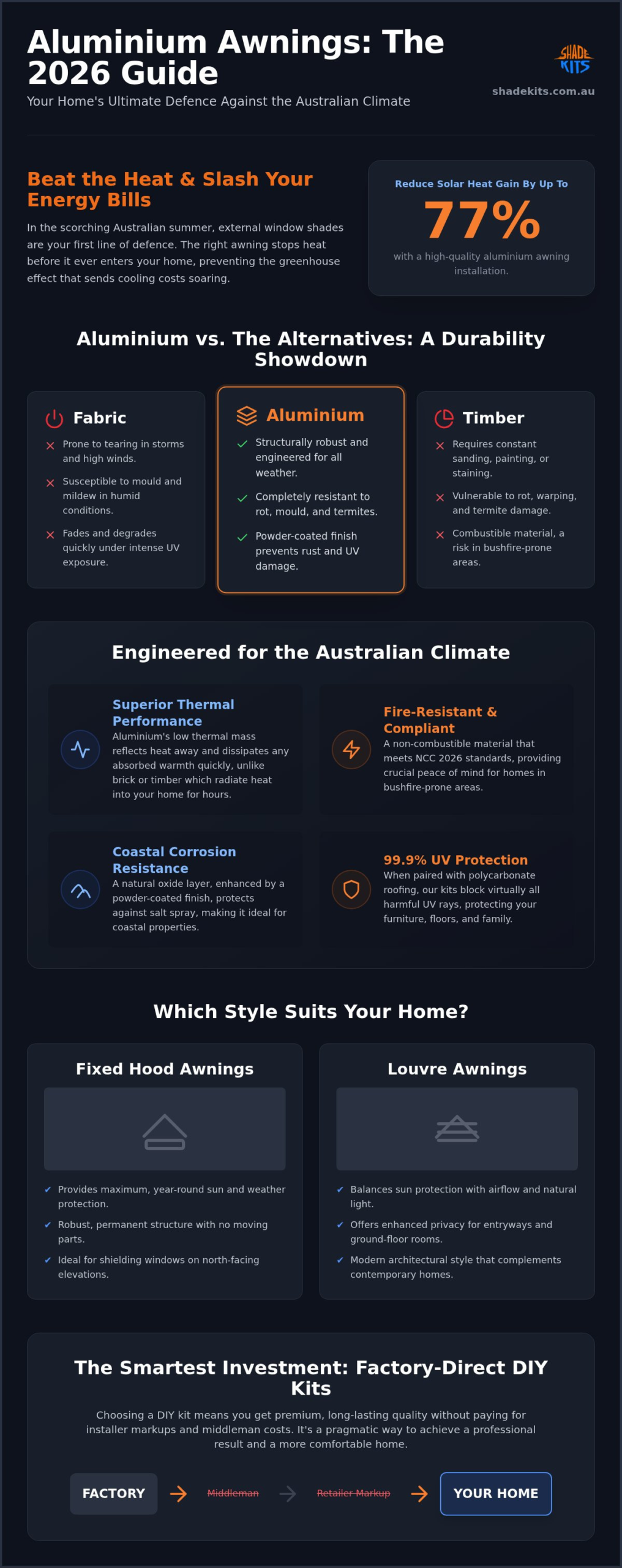
When you compare materials, the choice often comes down to longevity and maintenance. Fabric awnings might look soft, but they are prone to mould, tearing, and mechanical failure. Timber requires constant sanding and painting to prevent rot and termite damage. In contrast, powder-coated aluminum awning frames offer a “set and forget” solution that stands up to the harshest conditions. They don’t rust, warp, or rot, making them perfect for coastal environments where salt spray destroys lesser materials. Many modern kits also incorporate UV-resistant polycarbonate roofing. This allows natural light to brighten your rooms while blocking 99.9% of harmful UV rays and the majority of radiant heat.
Selecting aluminium awnings is a strategic decision rooted in material science. While many homeowners focus on the look, the real value lies in how aluminium manages thermal energy. Unlike timber or brick, which can store heat and radiate it back into your home long after the sun has set, aluminium has low thermal mass. It reflects a significant portion of radiant heat and dissipates what it does absorb very quickly. This makes it an essential component of well-designed external shading, ensuring your windows remain a barrier rather than a heat bridge during a heatwave.
Safety is another critical factor in the Australian landscape. With the 2026 updates to the National Construction Code now in effect, non-combustible materials are more important than ever. Aluminium is naturally fire-resistant, providing peace of mind for those living in bushfire-prone areas. It won’t ignite or contribute to the spread of flames, unlike traditional timber or synthetic fabric alternatives. For coastal residents, the benefits are equally clear. Aluminium develops a natural oxide layer that resists corrosion from salt spray, a process further enhanced by high-quality powder-coated finishes that won’t peel, flake, or blister under the punishing UV index.
Our local weather involves extreme temperature swings that cause lesser materials to warp, rot, or crack. Aluminium remains structurally stable through these cycles, maintaining its shape and integrity for decades. When paired with UV-resistant polycarbonate roofing, these kits block 99.9% of harmful UV rays while still allowing soft, natural light to enter your home. This combination is also incredibly resilient against the elements. If you are concerned about extreme weather, you might also find our guide on hail protection useful for understanding how these materials defend your property.
One of the most pragmatic reasons to choose aluminium is the “set and forget” lifestyle it offers. While fabric awnings typically require replacement every five years due to mould or tearing, a well-maintained metal awning can easily last 15 years or more. Maintenance is remarkably simple. A quick wash-down with a garden hose once or twice a year is usually all it takes to remove salt and dust buildup. Because the material is inorganic, it is completely resistant to termites, rot, and mould, which are common headaches in more humid Australian regions. If you’re looking for a long-term solution that saves you both time and money, exploring our factory-direct kits is an excellent place to start.
Despite this incredible durability, aluminium is surprisingly lightweight. This makes it the ideal material for a DIY project. It reduces the physical strain during installation and ensures that the structure doesn’t put unnecessary stress on your home’s external walls. You get a professional, heavy-duty result that is easy to handle and even easier to maintain.
A common misconception about aluminium awnings is that they only come in a single, “old-fashioned” window hood style. While the classic bullnose shape is still available for heritage homes, the 2026 range has expanded to include sleek, architectural designs that suit any modern Australian aesthetic. Choosing between a fixed hood and a louvre system isn’t just about looks. It’s about how you want the space to function. Your decision should be guided by the official guide to passive design and shading, which suggests that the orientation of your window is the most important factor in selecting a shade structure.
For example, north-facing windows benefit from horizontal projections that block high summer sun but allow lower winter sun to enter. West-facing windows, however, face the brunt of the afternoon heat and often require more comprehensive coverage. Understanding these nuances helps you choose a kit that offers the best return on investment for your specific floor plan. Whether you want to completely block out the weather or simply manage the light, there is a configuration designed for your specific needs. If you’re also planning to extend your outdoor living area beyond the windows, exploring aluminium pergola kits is a natural next step for creating a fully shaded backyard retreat.
Fixed hoods are the heavy lifters of the awning world. They provide a solid, permanent barrier against both sun and rain, making them the perfect choice for protecting entryways or laundry doors. By keeping the area directly outside your door dry, they prevent water from pooling at the threshold and protect your door’s finish from sun damage. You can choose between solid metal panels for total light block-out or UV-stabilised polycarbonate panels if you want to keep the area bright while filtering out the heat. If you’re still weighing up your options, you might want to read our comparison on Awning vs Awnings to see how these rigid structures stack up against other shade styles.
If your priority is maintaining airflow while blocking the sun’s glare, louvre or slat-style aluminium awnings are an excellent alternative. The angled slats are engineered to stop direct sunlight from hitting the glass, yet they allow breezes to pass through easily. This is a significant advantage for windows that you like to keep open during the warmer months to encourage cross-ventilation. These designs also offer superior privacy. Because the slats are angled, they block the line of sight from the street or neighbouring properties without making your room feel like a dark cave. This style integrates perfectly with modern “Hamptons” or “Industrial” home designs, providing a crisp, textured look that adds immediate street appeal and value to your facade.
Many homeowners feel a sense of hesitation when they first consider installing their own aluminium awnings. However, modern kits are engineered for simplicity, designed specifically so you don’t need to be a qualified builder to achieve a professional result. The key to a successful project lies in the preparation. Before you even order your kit, you need to understand exactly where it will sit and how it will attach to your home’s exterior. Taking the time to plan ensures that your new shade solution looks like an intentional architectural feature rather than an afterthought.
Measuring for aluminium awnings involves two main figures: width and projection. For the width, you should measure the window opening and add an overlap. A good rule of thumb is to add at least 100mm to 150mm on each side. This extra distance ensures that the sun doesn’t “creep” around the edges during the early morning or late afternoon when the angles are at their harshest. The projection is how far the awning sticks out from the wall. You need enough depth to provide effective shade, but you must also ensure it doesn’t become a head-height hazard for people walking past.
It is vital to identify your mounting surface before you begin. Are you fixing into solid masonry, or is it a timber-framed wall? If you’re working with timber, you must locate the internal studs or the top plate to ensure a secure fix. Screwing into just the cladding or “blue board” won’t provide the structural integrity needed to withstand high winds. You likely already have most of the necessary equipment in your shed, including a power drill, a spirit level, a measuring tape, and a sturdy ladder. Having a socket set or an adjustable spanner on hand will also make the assembly of the frame much faster.
When calculating the “drop” (the vertical height of the awning), ensure it doesn’t obstruct your view from inside or sit too low over a doorway. If you have downpipes, light fittings, or security cameras near the window, you’ll need to account for these obstructions before choosing your final width. A quick check now prevents a major headache during the mounting phase. If you’re ready to select a size that works for your home, you can explore our range of durable shade kits to get started.
Most standard window awning kits can be assembled and mounted in about 1 to 2 hours. Because factory-direct kits come with pre-drilled components and all the necessary hardware, the complex engineering is already done for you. Always have a second person to help hold the frame in place while you secure the first few bolts. Working at heights requires care, so ensure your ladder is on level ground and you are handling the lightweight aluminium extrusions with steady hands. Once the frame is secured, the polycarbonate or metal panels typically slide or bolt into place, completing the transformation of your home’s facade.
Buying aluminium awnings shouldn’t be a complex or overly expensive ordeal. The traditional retail model often involves multiple layers of markups, from showroom overheads to sales commissions. By choosing a factory-direct DIY kit, you effectively remove these unnecessary costs. You’re investing your money where it matters most: in high-grade materials and precision engineering. This approach allows you to secure a premium product for a fraction of the price of a fully installed custom solution. It’s about getting the best return on your home improvement dollar.
Logistics often deter people from ordering large outdoor structures online. We’ve streamlined this by offering reliable Australia-wide delivery for all our bulky kits. Whether you’re in a bustling metro area or a regional town, your kit arrives safely packaged with all the components ready for assembly. This convenience, combined with the massive savings on professional labour, makes the DIY route the most logical choice for the modern homeowner. You get the satisfaction of a job well done without the inflated price tag of a middleman.
The resilience of our kits comes down to the quality of our raw materials. We use heavy-duty aluminium frames that are powder-coated to resist the corrosive effects of the Australian environment. Unlike generic imports that may use thinner extrusions, our kits are built to stay rigid and silent even in high winds. The roofing is another area where we don’t compromise. Our UV-resistant polycarbonate panels are specifically treated to prevent yellowing and brittleness, ensuring they remain a high-performance thermal barrier for decades. If you have a larger project in mind, such as protecting a boat or caravan, our carports utilise the same robust engineering standards. Homeowners on tighter blocks who also need to shelter their vehicle without sacrificing driveway space will find that our cantilever carport kits Australia homeowners rely on are built to the same exacting specifications. Homeowners who want to extend that same quality engineering into a full outdoor entertaining area will find that our aluminium pergola kits are built to the same exacting specifications.
Updating your home’s exterior doesn’t require a massive renovation budget or weeks of disruption. The process is simple: measure your space, order your kit, and follow our straightforward installation guides. By spending a few hours on a weekend, you can add thousands of dollars in street appeal to your property. You’ll enjoy a cooler home, protected interiors, and a more polished look for your facade. It’s a pragmatic solution for anyone who values long-term quality and sensible spending. Explore our range of Aluminium Awning Kits today and see how easy it is to upgrade your home independently.
Investing in your home’s exterior is about more than just aesthetics. By choosing a permanent shade solution, you’re opting for long-term thermal comfort and lower energy costs. We have explored how these structures act as a primary defence against solar heat gain, and how the right style can enhance your property’s privacy and street appeal. Modern aluminium awnings provide a resilient, fire-safe, and low-maintenance alternative to temporary fabric options that simply don’t last in our climate.
Because our kits are designed for straightforward DIY installation, you can achieve a high-end, professional finish without the heavy labour costs. With factory-direct pricing, Australia-wide delivery, and UV-resistant polycarbonate roofing, we make it simple to upgrade your home’s efficiency. Browse our Australia-wide range of DIY Aluminium Awning Kits today and take the first step toward a cooler, more comfortable living space. You’ve got the tools and the knowledge; now it’s time to transform your home for the better.
Aluminium awnings do not produce excessive noise during a downpour, contrary to what some might expect from a metal structure. Because the frames are rigid and the panels are securely fastened, there is very little vibration to create a loud drumming effect. If you choose a kit with polycarbonate roofing, the sound is even more dampened, providing a soft patter rather than a metallic ring. It’s comparable to the sound of rain on a standard house roof.
You can certainly install these kits on weatherboard homes, provided you secure the mounting brackets directly into the structural timber studs. Fixing an awning solely to the weatherboard cladding is unsafe, as the boards aren’t designed to carry the weight or the wind load. Using a stud finder to locate the vertical timber supports ensures your installation is robust and permanent. Most kits include the necessary hardware for standard timber or masonry fixing to make this process easier.
The amount of light entering your room depends entirely on the material and style you choose. Solid aluminium panels provide a total block-out, which is excellent for west-facing windows that suffer from intense afternoon glare. If you prefer a brighter interior, choosing a kit with UV-resistant polycarbonate roofing allows soft, filtered light to enter while still blocking 99.9% of harmful UV rays. Louvre designs also offer a middle ground, using angled slats to manage light without making the room feel dark.
In most Australian states, small window awnings are considered exempt development and don’t require formal council approval. However, there are specific triggers that might change this, such as if the structure exceeds 10 square metres in plan area, stands more than 2.4 metres high, or if your property is in a heritage-listed area. It is always a pragmatic step to check your local council’s website for their specific minor works or exempt development guidelines before you begin.
Maintenance is remarkably simple and usually only requires a quick wash-down with a garden hose every six months. For homes in coastal areas, a more frequent rinse helps prevent salt buildup that could eventually dull the powder-coated finish. You don’t need harsh chemicals or abrasive scrubbers; a mild detergent and a soft cloth are plenty for stubborn spots. It’s also a good idea to check the tightness of your mounting bolts once a year to ensure everything remains secure.
Yes, aluminium awnings are significantly more resilient in high winds than fabric alternatives. While fabric can flap, tear, or even pull away from the wall during a storm, rigid metal structures are designed to withstand much higher wind loads. Modern kits are engineered to meet Australian Standard AS/NZS 1170.2:2021, which governs wind actions on structures. This makes them a far more reliable choice for homes in exposed or weather-heavy regions.
A high-quality aluminium awning kit typically has a lifespan of 15 years or more. This is a significant improvement over fabric awnings, which often need replacing or re-skinning every five years due to UV degradation and mould. The combination of corrosion-resistant aluminium and UV-stabilised polycarbonate ensures the structure remains functional and attractive for decades. It’s a set and forget investment that adds long-term value to your home.
Most factory-direct kits are available in a range of powder-coated colours designed to complement the standard Colorbond palette used across Australia. While custom one-off colours can be expensive, the standard range usually includes popular shades like Monument, Surfmist, and Woodland Grey. This allows you to achieve a seamless look that matches your existing gutters, roof, or fence. Choosing a colour that aligns with your current scheme is a simple way to boost your home’s street appeal.