
A cramped driveway with poorly placed posts is more than just an eyesore; it’s a daily logistical headache for many Australian families. If you’re tired of dodging heavy timber supports or worrying about the next summer hailstorm denting your pride and joy, you aren’t alone. When researching the best cantilever carport kits Australia has available, it’s clear that you need a solution that offers shade and security without the bulky footprint of a standard garage.
We understand that you want a clear, accessible driveway and a modern aesthetic that actually adds value to your property. This guide will show you exactly how to choose and install a kit to maximise your driveway space and defend your vehicle against the harsh Australian elements. It’s about finding that perfect balance between sleek architectural style and the rugged durability required for our climate.
We’ll explore the latest 2026 design trends, explain how these kits handle high wind ratings, and break down the council approval process so you can build with confidence. From UV-resistant polycarbonate roofing to lightweight aluminium frames, you’ll discover everything needed to achieve a professional, space-saving result on a DIY budget.
A cantilever design is essentially an overhanging roof structure supported by vertical posts on only one side. Unlike a traditional Carport that relies on four or more corner pillars, these modern structures use a robust, weighted foundation to balance the weight of the roof. This “floating” appearance isn’t just for show; it’s a practical response to the shrinking blocks and narrow driveways common in many Australian suburbs. When looking for cantilever carport kits australia, homeowners often prioritise the ability to reclaim lost space without sacrificing vehicle protection.
By removing the posts from one side, you’re effectively performing a “space hack” on your property. This layout is particularly useful for older brick or render homes where a bulky, traditional structure might look dated or block natural light. A cantilever kit modernises the facade, providing a sleek, minimalist aesthetic that can increase property value. Beyond the family car, these kits are incredibly versatile. They provide the perfect height and clearance for boats or caravans that might struggle to fit under standard garage doors. Because there are no side posts to navigate, backing a trailer into position becomes a stress-free task rather than a difficult chore.
Eliminating posts from the entry side of your driveway removes the constant risk of “door-dings” in tight residential spaces. It makes manoeuvring larger SUVs and 4WDs, which are staples of the Australian lifestyle, significantly easier. Without those front pillars in the way, you can swing into your parking spot with confidence. This design also transforms the area into a multi-use space. When the car is out, the area doubles as a shaded patio for outdoor entertaining or a dry spot for kids to play during a rainy afternoon. You can explore our range of carports to see how these designs fit different property layouts.
Our environment presents unique challenges, from blistering summer heat to sudden storm fronts. High-quality kits are designed to handle heat expansion and contraction without compromising the integrity of the frame. Wind rating is another critical factor, as structures with large surface areas can act like a sail during high winds. A cantilever carport functions as a rigid, counterbalanced beam where the downward force of the roof is offset by the structural mass of the footings and the strength of the upright supports. This engineering ensures that even with a heavy load of rain or during a gusty afternoon, the structure remains stable and secure.
Selecting the right frame configuration is the most important decision you’ll make after deciding on a cantilever model. Your block’s specific dimensions and the number of vehicles you need to protect will dictate whether a single or double span is necessary. When browsing cantilever carport kits australia, you’ll generally encounter three primary shapes, each designed to solve a different logistical parking problem.
The L-shape is the classic single-carport solution. It features a single row of robust posts along one side, allowing the roof to project over the vehicle. This is the go-to choice for narrow driveways where you want to keep one side completely clear for pedestrian access or to avoid blocking a side-path. By tucking the posts against a boundary or the side of the house, you reclaim every possible centimetre of driveway width.
For dual-vehicle households, the Y-shape and M-shape designs offer different advantages. The Y-shape, often called the “butterfly” design, uses a central line of posts with two roof sections extending outwards like wings. This is perfect for shared driveways or large open areas where you want to keep the outer edges free of obstructions. Conversely, the M-shape links two L-shapes together to create a wide, double-carport span. This provides a continuous roofline without any central posts, offering maximum manoeuvrability for larger cars. For specialised spaces where side support is impossible due to underground services or boundary restrictions, back-pull cantilevers provide a unique alternative by placing supports at the rear of the structure.
Assessing your driveway width and boundary setbacks is the first step in the planning process. If you have a narrow side-access path, an L-shape is usually the only viable option to ensure you don’t block the way. For dual-vehicle households with more room, a Y-shape or M-shape provides superior coverage. You must also consider your local council’s boundary setbacks; post placement must comply with specific distance requirements from your neighbour’s fence line to avoid legal headaches later.
Different shapes don’t just change where you park; they also dictate how water runoff and guttering are managed. A Y-shape directs water toward a central gutter system between the two roof sections, while an L-shape sends it to the side. If you’re unsure which layout suits your specific driveway, you can view our detailed carport range to compare specific dimensions and heights. The table below provides a quick reference for the most common configurations.
| Shape | Ideal Use Case | Post Placement | Vehicle Capacity |
|---|---|---|---|
| L-Shape | Side-of-house, narrow paths | Single side line | Single vehicle |
| Y-Shape | Shared driveways, centre parking | Central line | Double vehicle |
| M-Shape | Wide driveways, dual parking | Dual side lines | Double vehicle |
When comparing cantilever carport kits australia, the structural materials and roofing technology are the two most important factors for long-term performance. A high-quality kit should feel robust yet remain manageable enough for a weekend DIY project. While many traditional structures use heavy steel, modern cantilever designs have shifted toward high-grade aluminium extrusions. This shift isn’t just about weight; it’s about ensuring the structure can survive the specific environmental pressures found across the country without requiring constant maintenance.
Corrosion resistance is a non-negotiable feature for coastal homes. Salt spray can quickly degrade traditional steel, leading to structural weakness and unsightly rust. Aluminium naturally forms a protective oxide layer, making it virtually maintenance-free even in salty environments. Beyond durability, aluminium is much easier to handle during the DIY assembly process. You won’t need heavy lifting equipment to position the frame components, which reduces the risk of injury and makes the project far more approachable for a two-person team. We focus on high-grade aluminium to ensure a premium architectural finish that stays looking new for decades.
The roof is your vehicle’s primary line of defence against the elements. Modern polycarbonate panels are engineered to block 99% of harmful UV rays while still allowing natural light to filter through the area. This prevents your car’s paintwork from fading and keeps the cabin temperature significantly lower on a 40-degree summer day. Perhaps most importantly for those in storm-prone regions, these panels offer exceptional impact resistance. If you want to learn more about protecting your investment, check out our guide on hail protection for cars. This technology ensures the roof won’t crack or shatter when the weather turns volatile during storm season.
A well-designed kit includes an integrated guttering and drainage system. This ensures that rainwater is channelled away from your driveway, preventing the pooling and flooding that can occur with cheaper, basic covers. Finally, consider the visual integration with your existing property. Quality kits come in a range of contemporary colours such as Anthracite, White, and Grey. These options allow you to match the carport to your home’s existing palette, ensuring the new addition looks like a deliberate architectural feature rather than a temporary afterthought.
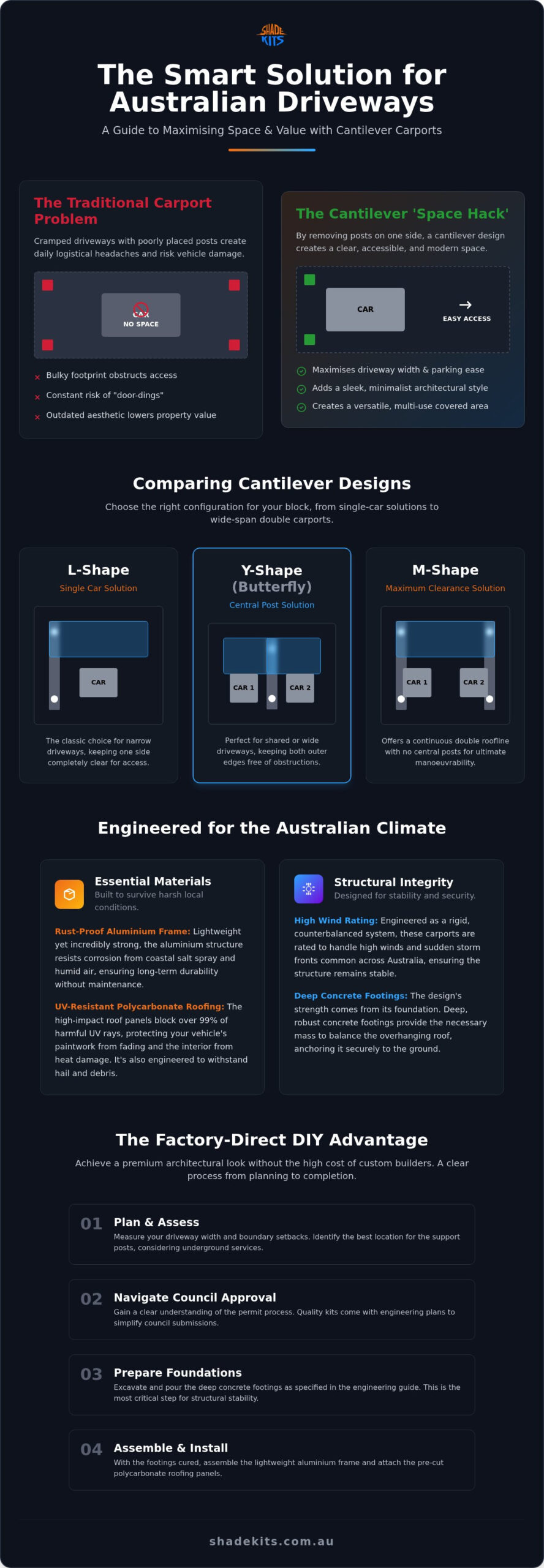
Installing one of the many cantilever carport kits australia offers is a rewarding project, but it requires a methodical approach. While the assembly of the aluminium frame is straightforward, the groundworks are where the structural integrity is truly won or lost. You don’t need to be a professional builder to achieve a high-end result, but you do need to follow the engineering specifications to the letter. A successful build starts with an organised site and a clear understanding of the structural forces at play.
The foundation of a cantilever structure is fundamentally different from a standard four-post design. Because all the weight is supported from one side, the footings must be significantly deeper and heavier to act as a counterweight. You’ll typically need to excavate holes to a depth specified in your engineering drawings, often exceeding one metre, and fill them with high-strength concrete. The substantial depth of these footings is necessary to counteract the rotational leverage force generated by the overhanging roof, ensuring the structure remains perfectly balanced and upright. Before you pour, ensure your site is level and that you’ve accounted for the necessary concrete volume to avoid mid-project delays.
Once the footings have cured, the assembly of the frame can begin. This is strictly a two-person job. Having a mate to help hold the beams in place while you secure the fasteners is essential for both safety and precision. Regarding the roof stage, take extra care with the polycarbonate panels. Use the provided seals and avoid over-tightening the screws, as the material needs room to expand and contract in the Australian sun. Using a spirit level at every stage ensures the “floating” roof remains perfectly horizontal.
Before you pick up a shovel, you must address the legal side of the build. In Australia, carports are classified as Class 10a structures under the National Construction Code. While some small structures might fall under “exempt development,” most cantilever kits will require a building permit or council approval due to their size and structural nature. Requirements vary between local government areas, so checking your specific setbacks and height limits is vital. For a smooth process, refer to The Essential Australian Carport Checklist to ensure you haven’t missed any critical planning steps.
Ready to transform your driveway? Browse our range of carport kits to find a design that fits your property and local requirements.
Selecting a provider for cantilever carport kits australia involves more than just comparing the lowest prices. At Shade Kits, we’ve developed a streamlined system that prioritises structural integrity and long-term value. Our approach is built on transparency, ensuring that every component in your kit is designed to withstand the local climate while remaining affordable for the average homeowner. We focus on providing a professional-grade product that doesn’t require a commercial construction budget.
By operating a factory-direct model, we’ve successfully removed the traditional retail middleman. This doesn’t just lower the final cost; it allows us to maintain strict quality control over every aluminium extrusion and polycarbonate panel that leaves our warehouse. You won’t find hidden “budget” substitutes here. Every material is selected for its resilience and suitability for Australian conditions. For a detailed breakdown of how this compares to other market options, you can read our guide on Aluminium Carport Prices Australia.
Getting a large structure from a warehouse to your driveway in perfect condition requires specialised logistics. We organise national delivery across the country, serving customers from Perth to Brisbane with consistent care. Each kit is packed to prevent transit damage, ensuring that your project starts on the right foot the moment it arrives at your door. This national reach ensures that even if you’re in a regional area, you have access to the same high-quality shade solutions as those in the major capitals.
We also understand that DIY doesn’t mean doing it alone. Our team provides comprehensive support, including detailed instructions that demystify the assembly process. If you hit a snag during your build, our experts are available to provide technical advice and guidance. This combination of high-quality manufacturing and dedicated support is why we are a trusted name for cantilever carport kits australia. We focus on providing a manageable, well-organised experience from the first click to the final screw.
If you’re ready to upgrade your property with a modern, space-saving solution, Browse our range of Cantilever Carport Kits today. We are here to help you protect your vehicle with a structure that’s built to last in the harsh Australian sun.
Choosing a cantilever design is about more than just aesthetics; it’s a practical investment in the longevity of your vehicle and the functionality of your home. By opting for one of the high-quality cantilever carport kits australia has available, you remove the physical barriers of traditional posts and create a safer, more accessible driveway. You’ve seen how the right configuration, whether L-shape or Y-shape, can completely transform a tight residential block without the high costs of a custom build.
Our structures are specifically engineered for Australian wind and snow loads, featuring lightweight, rust-proof aluminium frames and 99% UV-block polycarbonate roofing as standard. This ensures your car stays cool and protected from hail during the unpredictable storm season. Achieving a professional finish is entirely possible on a DIY budget when you have the right components and expert support. Shop Factory-Direct Cantilever Carport Kits and give your vehicle the protection it deserves today. With national delivery and a focus on durability, we’re here to help you get the job done right.
Most cantilever carport kits australia require council approval before installation begins. As a Class 10a non-habitable structure under the National Construction Code, any carport exceeding 10 square metres in area or 2.4 metres in height typically needs a permit. Because regulations vary significantly between local government areas, you must consult your local council. They will assess setbacks and height limits to ensure your new structure complies with safety and boundary standards.
Footings for a cantilever structure typically need to be at least 1 metre deep, though specific engineering drawings will dictate the exact requirements for your site. This depth is essential because the footings act as a counterweight against the rotational force of the overhanging roof. Unlike standard carports with four corner posts, a cantilever design places immense pressure on its foundations. Using the correct volume of high-strength concrete ensures the structure remains stable during high winds.
Yes, a correctly engineered cantilever kit is designed to withstand the volatile Australian storm season. These structures are built to specific wind region ratings, such as Region A or B, ensuring they remain secure during high-velocity gusts. Shade Kits uses durable aluminium frames and impact-resistant polycarbonate roofing to handle these conditions. It is vital to verify that your kit complies with the latest 2026 standards for your specific geographic location to ensure long-term structural integrity.
Most DIY installers can complete the assembly of the frame and roof panels within one to two days. This timeframe assumes you have a second person to assist with lifting and positioning the larger aluminium components. It’s important to remember that this doesn’t include the time needed for the concrete footings to cure. You should allow several days for the foundations to reach full strength before you begin attaching the heavy structural beams to the base.
Aluminium is often the superior choice for DIY kits due to its lightweight properties and natural corrosion resistance. Unlike steel, which can rust if the coating is scratched, aluminium forms a protective oxide layer that makes it ideal for coastal environments. It is much easier to handle during the installation process, reducing the need for heavy machinery. This allows you to achieve a premium architectural look without the high maintenance or weight issues associated with steel.
Modern polycarbonate roofing is engineered to block 99% of harmful UV rays and can significantly reduce the sun’s heat. This technology prevents the area underneath from becoming a heat trap, keeping your car’s cabin much cooler than if it were left in the open sun. While the panels allow natural light to filter through, they are specifically designed to reflect thermal energy, ensuring the space remains comfortable even on 40-degree summer days.
One of the primary benefits of an aluminium cantilever carport is the minimal maintenance required to keep it looking new. You should occasionally wash the frame and roof panels with water and a mild detergent to remove salt spray or dust buildup. It is also important to clear any leaves or debris from the integrated guttering system to prevent blockages. This simple routine ensures the drainage functions correctly and maintains the structural integrity of the components for decades.
It is generally not possible to install a cantilever carport directly onto a standard existing concrete slab. Most residential driveways are only 100mm thick, which is insufficient to counteract the massive leverage force generated by the overhanging roof. To ensure safety and stability, you must excavate through the slab to create the deep, reinforced concrete footings required by the engineering specifications. Attempting to bolt the structure to a thin slab can lead to structural failure.