
Did you know that high-quality external awnings can reflect up to 95% of solar energy before it even touches your window glass? It’s a staggering statistic that explains why internal blinds often feel like a losing battle against the summer heat. Most Australians are all too familiar with the struggle of a home that feels like an oven by mid-afternoon, watching energy bills climb while furniture and flooring slowly fade under the intense UV glare.
The good news is that you don’t need to rely on complex, custom-made solutions to protect your home. This guide will show you how to select and install the most effective window shade kits Australia has available, allowing you to achieve a professional result on a DIY budget. We’ll walk you through the latest 2026 standards for structural integrity, explain how to choose durable aluminium and polycarbonate materials, and provide a clear roadmap for a seamless installation that keeps your interior cool and your exterior looking sharp.
When you want to keep your home cool during a sweltering Australian summer, closing the indoor curtains is often the first instinct. However, this only manages the heat once it has already entered your living space. The window shade kits Australia homeowners are now choosing provide a more strategic solution by stopping solar energy before it ever touches the glass. These external structures act as a primary thermal barrier, significantly reducing the energy required to maintain a comfortable temperature indoors.
While there are many different types of awnings available, modern DIY kits focus on high-performance materials like aluminium and polycarbonate. These kits offer a pragmatic way to upgrade your home’s exterior without the high costs associated with bespoke trades. By installing a physical shield over your windows, you aren’t just adding a decorative element; you’re fundamentally changing how your home interacts with the harsh local environment.
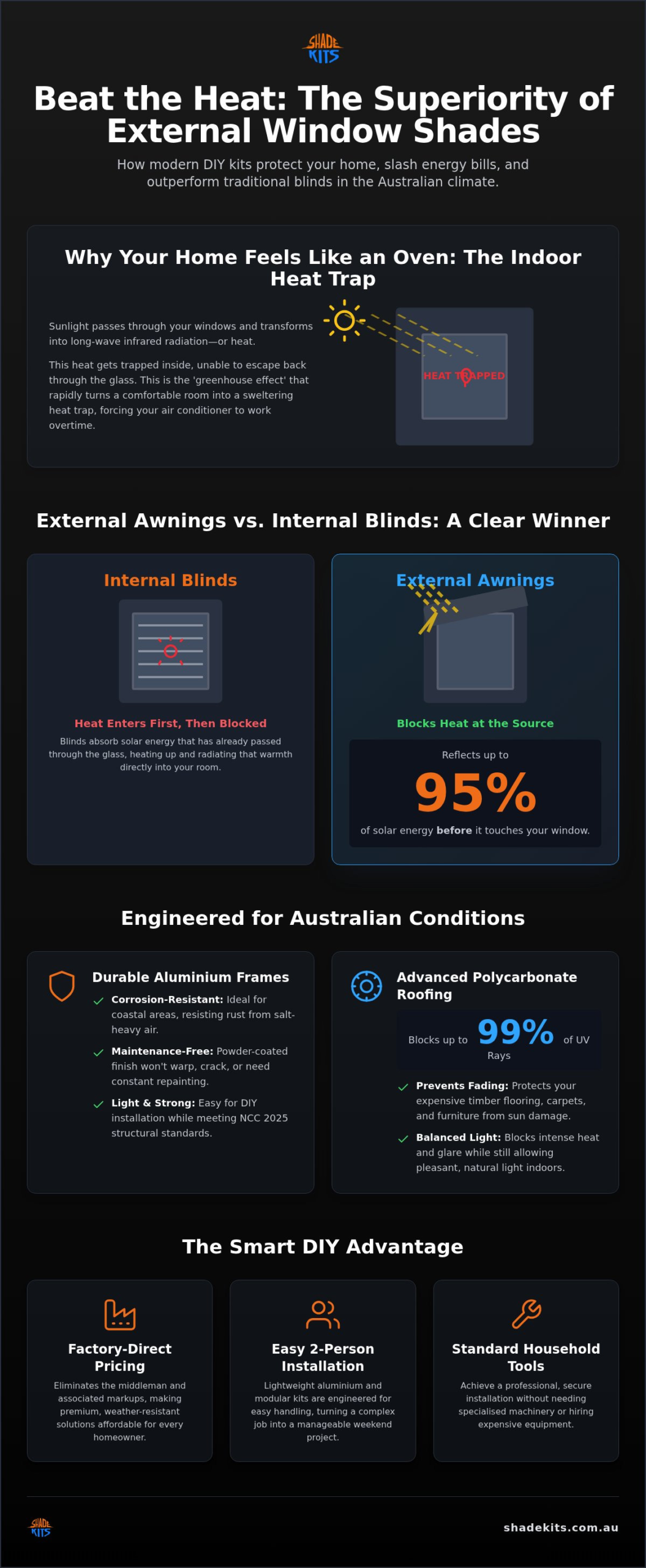
The greenhouse effect is a common issue in modern homes with large windows. When sunlight passes through glass, it transforms into long-wave infrared radiation, which becomes trapped indoors. This process quickly turns a pleasant room into a heat trap. External window shade kits prevent this by reflecting up to 95% of solar energy before it reaches the pane. This is far more efficient than internal blinds, which often heat up themselves and then radiate that warmth into the room.
Beyond temperature control, these kits offer vital protection against UV radiation. High-quality polycarbonate roofing can block up to 99% of harmful UV rays, which is essential for preventing the fading of expensive timber flooring, carpets, and upholstery. Unlike heavy, fixed shutters that can block airflow, these kits are designed to allow for natural ventilation, ensuring your home stays fresh and breezy even on the hottest days.
Choosing a DIY kit over a custom professional installation is a smart move for the budget-conscious homeowner. By opting for factory-direct supply, you eliminate the middleman and the associated markups. Modular aluminium kits are specifically engineered for ease of handling. They are significantly lighter than traditional timber or steel structures, making them manageable for a two-person DIY team using standard household tools.
Durability is another key factor. In coastal Australian conditions, salt air can quickly corrode inferior materials. Powder-coated aluminium frames are the gold standard here because they resist rust and corrosion without the need for constant repainting or oiling. When you invest in the durable window shade kits Australia requires for its unique climate, you get a professional-looking finish that adds genuine value to your property without the hefty price tag of a custom build.
Selecting the right window shade kits Australia offers means looking beyond basic aesthetics. You need materials that can withstand the intense UV levels and unpredictable weather patterns found across the country. High-quality kits focus on a combination of structural integrity and thermal performance, ensuring they remain a functional part of your home for decades.
Aluminium is widely considered the gold standard for external shading structures. Its natural corrosion resistance is vital for homes in coastal areas where salt-heavy air can quickly degrade timber or steel. Unlike timber, which requires regular sanding and oiling to prevent rot, powder-coated aluminium remains virtually maintenance-free. It won’t warp in the heat or crack after a sudden cold snap.
From a DIY perspective, the strength-to-weight ratio is a game-changer. It’s strong enough to meet the National Construction Code (NCC) 2025 standards for structural safety while remaining light enough for two people to handle during the installation process. This makes the assembly of premium awning kits a manageable weekend project rather than a complex construction job requiring specialised machinery.
The roofing material is where the thermal heavy lifting happens. High-quality polycarbonate panels are engineered to reduce unwanted heat gain by blocking up to 99% of UV radiation. This is a critical feature for protecting your home’s interior finishes, such as timber flooring and upholstery, from solar damage and fading.
A common concern with external shading is that it might leave the home feeling dark and gloomy. Polycarbonate solves this by balancing light transmission with heat rejection. You can block the searing heat of a summer afternoon while still enjoying diffused natural light indoors. These panels are also incredibly resilient, providing excellent impact resistance against hail and falling debris. This is a significant advantage over traditional fabric awnings that can tear, sag, or grow mould over time.
Modern window shade kits Australia wide are designed to complement contemporary architecture. With sleek lines and various powder-coated finishes, you can choose a colour that matches your existing window frames or guttering. This ensures the addition looks like an original part of the house rather than an afterthought. Customisation options allow you to select the exact dimensions required for your specific window aspect, ensuring maximum coverage where it is needed most.
Selecting the right window shade kits Australia requires a clear understanding of your home’s orientation. Not all windows face the same challenges. A north-facing window deals with high-altitude sun during the middle of the day, whereas a west-facing window bears the brunt of the punishing, low-angle afternoon heat. Getting your selection right means balancing the physical dimensions of the kit with the specific solar path of your location.
Correct measurement is the foundation of a successful DIY project. You should aim for a kit that is slightly wider than the window opening itself to prevent “light bleed” around the edges. When you consider the “drop” or projection, think about the coverage needed to shield the glass during the hottest parts of the day. While retractable options exist, permanent DIY aluminium kits offer superior structural integrity and a “set and forget” level of maintenance that many homeowners prefer for long-term value.
The effectiveness of your awning is often measured by its shading coefficient, which indicates how much solar heat passes through the structure. To maximise this, you need to calculate the ideal projection length. For north-facing windows, a shorter projection might suffice to block the high summer sun while still allowing warm winter light to enter. However, west-facing windows often require a deeper projection to deal with the horizontal rays of a setting sun. By creating a stable “micro-climate” of shaded air directly against the glass, you can significantly lower the temperature of the room inside.
Before you commit to a specific kit, you must evaluate the mounting surface of your home. Brick walls are generally the most straightforward for mounting, but weatherboard or rendered finishes require a bit more care to ensure you are anchoring into the structural studs. It’s also vital to check the wind ratings for your specific area, especially if you live in a region prone to high gusts or storms. Understanding these requirements is a key part of planning and choosing your carport or shade structure.
Finally, don’t forget the aesthetic integration. Most high-quality kits come in standard powder-coated colours designed to match common Australian gutter and fascia tones. Choosing a matching shade ensures the kit looks like a seamless extension of your home’s architecture rather than a temporary addition. This attention to detail is what separates a basic DIY job from a professional-grade exterior finish.
Installing your own external awning is a rewarding project that immediately boosts your home’s street appeal and thermal performance. While custom trades often come with significant lead times and high costs, the modular window shade kits Australia homeowners trust are specifically designed for straightforward assembly. Before you pick up your drill, clear a large, flat area to work on. Lay out a soft drop cloth to ensure the powder-coated aluminium finish remains scratch-free throughout the process.
Accuracy is the difference between a professional result and a DIY struggle. Start by marking your mounting points on the wall using a spirit level to ensure your horizontal line is perfectly straight. If you’re mounting to brickwork, drill into the brick rather than the mortar for maximum structural integrity. For weatherboard homes, it’s vital to locate the internal studs. Most kits include standard masonry anchors, but you should verify if your specific wall type requires different fixings, such as coach screws for timber. Organising your workspace now will save you from hunting for tools mid-install.
Most aluminium kits follow a logical sequence where side brackets are joined by front and rear rails. Once the frame is loosely assembled, slide the polycarbonate panels into the channels before tightening all bolts. Lifting the unit is strictly a two-person job. While one person supports the awning, the other should secure the primary anchors to the wall. After it’s mounted, check the drainage. A slight fall away from the house ensures water runoff doesn’t pool against your window sills or soak into the frames.
To finish the job, apply a bead of exterior silicone along the top edge where the awning meets the wall. This simple step prevents water from dripping behind the structure and causing damp issues. Finally, wipe down the panels with a soft cloth to remove fingerprints. By following these steps, your window shade kits Australia project will provide years of reliable service. If you’re ready to start your home improvement journey, you can shop our full range of awning kits to find the right size for your windows.
Choosing factory-direct solutions is the most effective way to secure premium protection without the traditional markup of retail showrooms. The window shade kits Australia families rely on from our range are built to last, using high-grade aluminium that won’t succumb to the elements. By cutting out the middleman, we ensure that professional-grade materials are accessible for every DIY enthusiast. It’s about getting the best possible return on your home improvement investment through smart, durable choices.
Our range extends far beyond simple window coverings. Whether you’re looking for Pergola Kits to create an outdoor entertaining area or Patio Covers to extend your living space, the principles remain the same: durability, ease of assembly, and sleek design. We also understand that your home protection strategy should include your driveway. For those concerned about unpredictable storms, we offer the CarCave for vehicle hail defence, a specialised solution designed to keep your car safe when the weather turns nasty.
A truly efficient home uses a combination of shading solutions to manage heat and protect assets. You might start by installing awnings on your west-facing windows, but the real value comes from a cohesive approach. Combining window awnings with DIY carport kits ensures that both your interior comfort and your vehicles are protected from the sun’s relentless UV rays. This consistency doesn’t just lower cooling costs; it significantly boosts the kerb appeal of your property by creating a unified look. For a deeper dive into these structures, see the ultimate guide to DIY carport kits in Australia.
Our products aren’t generic imports; they’re designed specifically for the unique challenges of the Australian environment. We know how intense the sun can be and how quickly a hailstorm can arrive. That’s why we use impact-resistant polycarbonate and corrosion-proof aluminium frames across our entire range. We empower the average homeowner with straightforward assembly instructions that remove the guesswork. You don’t need a trade background to achieve a professional finish. Plus, you have the peace of mind that comes from dealing with a local Australian business that provides direct support and nationwide delivery for all DIY kits.
Managing the sweltering Australian heat doesn’t have to mean high energy bills or complicated custom renovations. As we’ve explored, the most effective way to keep your interior cool is to stop solar radiation before it hits your glass. By choosing the high-quality window shade kits Australia offers, you can transform your property’s thermal performance while adding modern kerb appeal through a straightforward DIY project.
Whether you’re shielding a north-facing living room or protecting a west-facing bedroom from the afternoon sun, the combination of durable aluminium frames and UV-resistant polycarbonate roofing provides a long-term solution that stands up to our unique weather conditions. With factory-direct pricing and Australia-wide delivery, professional-grade protection is more accessible than ever before. You now have the knowledge to achieve a sleek, functional finish that adds genuine value to your home.
Browse our range of factory-direct DIY Window Shade and Awning Kits today!
Take the first step toward a cooler, more comfortable home and enjoy the satisfaction of a professional result you’ve achieved with your own hands.
Council approval requirements vary depending on your local government area and the specific size of the structure. Many small external awnings under 10 square metres are considered “exempt development” in various Australian states; however, it is always best to check with your local council before starting. For larger structures or those in heritage-listed areas, specific permits might be necessary to ensure compliance with the National Construction Code (NCC) 2025.
Yes, high-quality window shade kits Australia wide are engineered to handle the country’s unpredictable weather patterns. The polycarbonate panels used in these kits are specifically chosen for their high impact resistance; this provides essential protection against large hail and falling debris. When anchored correctly to a structural surface like brick or timber studs, the durable aluminium frames maintain their integrity during high wind events and heavy summer storms.
Powder-coated aluminium is the superior choice for the frame due to its strength-to-weight ratio and resistance to corrosion. For the roofing, UV-stabilised polycarbonate is ideal because it blocks up to 99% of harmful UV radiation while still allowing natural light to enter the home. This combination ensures your DIY kit is light enough for easy handling during assembly but strong enough to last for decades in harsh environmental conditions.
External window shades are incredibly effective at lowering cooling costs because they block solar heat before it reaches the glass. By reflecting up to 95% of solar energy, these kits prevent the greenhouse effect that occurs when heat is trapped indoors. While exact savings depend on your home’s insulation and orientation, reducing the thermal load on your air conditioning system can lead to noticeable reductions in your summer energy consumption.
Aluminium window shade kits Australia are perfectly suited for coastal properties where salt spray can quickly destroy steel or timber structures. The powder-coated finish provides an extra layer of protection against the corrosive effects of salt air and high humidity. Unlike traditional materials that may rot, rust, or require constant repainting, aluminium remains structurally sound and visually appealing even when exposed to the constant moisture of a seaside environment.
We strongly recommend a two-person team for the installation of any external awning or shade kit. While the aluminium components are lightweight, the physical dimensions of the assembled unit make it difficult for one person to hold the kit level while securing the anchors. Having a second pair of hands ensures the structure is mounted safely and accurately, reducing the risk of injury or accidental damage to your home’s exterior finish.
One of the primary benefits of aluminium window shade kits is their exceptionally low maintenance requirement. Unlike timber, which needs regular oiling or painting, aluminium only requires a simple wash with soapy water and a soft cloth every few months to remove dust and salt residue. This keeps the powder-coated finish looking new and ensures that any drainage channels remain clear of debris, allowing water to run off effectively during heavy rain.
Modern polycarbonate panels are treated with UV-stabilisers to prevent yellowing, brittleness, or cracking even under the intense Australian sun. These panels are designed to maintain their clarity and structural strength over many years of exposure. High-quality kits use roofing materials that block up to 99% of UV rays, protecting both the panel itself and your home’s interior furnishings from solar damage while ensuring long-term durability and consistent performance.