
Can a layer of fabric thinner than your bedsheets really save your bonnet from a golf ball-sized hailstone hurtling at 100 kilometres per hour? It’s a question thousands of Aussies ask every summer as the sky turns a bruised purple and the storm sirens begin to wail. You’ve probably felt that sharp spike of anxiety, wondering if your insurance policy covers “acts of God” or if you’re about to face a massive panel beating bill. When you’re staring down a severe weather warning, the big question is: does a car cover prevent hail damage effectively, or is it just a false sense of security?
We understand the urge to find a quick, budget-friendly solution to protect your pride and joy. This article demystifies the “hail-proof” marketing claims you see online and provides an honest look at what actually works when the ice starts falling. You’ll discover the physical limitations of traditional covers and learn about more robust structural alternatives. We’ll compare the level of defence offered by different materials and introduce DIY solutions, such as impact-resistant carports and foldable shields, that provide the long-term peace of mind every Australian car owner deserves.
Many Australian car owners rush to the local auto shop when they see a storm front approaching, hoping a $100 fabric cover will save their vehicle. It’s a common misconception. While a standard cover is excellent for keeping bird droppings and dust off your paintwork, it rarely offers the structural integrity needed to stop a high-velocity ice stone. When asking does a car cover prevent hail damage, you have to look at the specific purpose of the product. Most retail covers are designed for UV protection and breathability, not impact resistance.
The main differentiator is material density. A standard dust cover is typically only 1mm to 2mm thick. In contrast, a genuine hail-rated protector is significantly bulkier, often ranging from 4mm to over 7mm in thickness. If you use a thin polyester or nylon cover during a storm, it can actually do more harm than good. High winds often cause these lightweight fabrics to flap violently, trapping grit and debris against the car’s surface. This results in micro-scratches across the clear coat. There’s also the risk of the fabric tearing. Once a stone pierces the thin material, the jagged edges of broken hail can shred the cover further, leaving your car exposed.
Australian storms are notorious for producing stones that fall at incredible speeds. To understand the damage potential, it helps to look into hail formation and impact physics. Once a stone reaches its terminal velocity, a thin layer of fabric offers almost zero resistance. For protection to be effective, the material must facilitate “impact displacement” by spreading the force of the hit across a wider area. A standard cover lacks the internal structure to do this. A hail-rated cover is a multi-layered padded barrier designed for impact absorption. Without this specialised padding, the kinetic energy from the hail transfers directly through the fabric into your car’s metal panels, resulting in the dreaded “golf ball” texture that insurers hate.
Relying on thin fabric provides a sense of psychological comfort, but the physical reality often tells a different story. If your goal is true resilience, you might find that structural options like carport kits or the Car Cave offer the reliable barrier you’re actually looking for. These solutions create a physical gap that fabric simply cannot replicate, ensuring your vehicle remains untouched regardless of the storm’s intensity.
To understand why many car owners still find dents after a storm, we need to look at the basic physics of kinetic energy. The damage potential of a hailstone is determined by its mass and its velocity squared. While a stone might only weigh a few grams, its speed when falling from the clouds can exceed 100 kilometres per hour. When that stone hits a padded surface resting directly on your car’s bonnet, the energy doesn’t just disappear. Instead, it transfers through the soft material at a concentrated contact point. This is the primary reason why asking does a car cover prevent hail damage often leads to disappointing results; if the padding isn’t thick or rigid enough to dissipate that energy, the metal underneath still takes the hit.
Modern vehicles are engineered to be lightweight and fuel-efficient, which often means using thinner aluminium or high-tensile steel panels. These materials have a specific deformation threshold. Once the kinetic energy of a hailstone exceeds this limit, the metal stretches and dents permanently. Even if you use a padded cover, a large stone (4cm or larger) carries enough force to bypass un-reinforced fabric layers entirely. The angle of impact also plays a critical role. While a cover might help with glancing blows on the sides of the vehicle, it offers the least protection on flat surfaces like the roof and boot, where stones strike at a direct 90-degree angle.
This is where structural solutions provide a distinct advantage. By creating a permanent air gap between the elements and your vehicle, aluminium carport kits ensure that the kinetic energy is absorbed by a rigid, impact-resistant roof rather than your car’s delicate panels. This gap is the only way to guarantee that no force is transferred to the vehicle itself.
A significant flaw in many padded covers is how they react to the rain that almost always precedes a hailstorm. Traditional padded covers, or the blankets often suggested as DIY alternatives, are frequently made of absorbent materials. Once these fabrics become water-logged, they lose their ability to compress and absorb impact effectively. A wet, heavy blanket effectively becomes a liquid-filled layer that transfers shock waves directly to the paintwork. To better understand these forces, it helps to look into hail formation and impact physics to see how terminal velocity affects different surfaces.
The added weight of the water often compresses the padding against the car before the hail even starts falling. This physical compression removes the tiny pockets of air that are supposed to provide cushioning. For reliable protection that isn’t compromised by moisture, exploring a dedicated Car Cave or a permanent shade structure is a much more pragmatic choice for the Australian climate. These systems maintain their structural integrity regardless of how much rain falls, ensuring the impact-absorption layer remains functional throughout the entire storm event.
Choosing the right protection involves balancing your living situation with the level of risk you’re willing to accept. If you’re a renter, a permanent structure might not be an option, but for homeowners, the choice is often between a temporary fix and a long-term solution. When you consider the question, does a car cover prevent hail damage, you must also consider the hidden costs of convenience. A fabric cover is highly portable, but that portability comes at the expense of structural strength. Structural solutions provide a dedicated barrier that fabric simply cannot replicate, ensuring the force of an impact never reaches your vehicle’s bodywork.
To help you decide, it’s useful to look at how these options stack up against each other:
For those who need a non-permanent solution, the CarCave offers a distinct advantage over traditional covers. The most significant benefit is that it doesn’t touch your car. By using a self-supporting frame, it eliminates the risk of paint abrasion caused by wind-blown fabric. These foldable structures are also far more resilient in high winds. While a standard cover can flap or even blow away if not strapped perfectly, a framed shelter stays grounded. Deployment speed is another factor; you can pull a foldable shelter over your car in less than a minute, which is vital when a storm cell is moving in fast.
If you have the space, a permanent structure is the most pragmatic way to lower your risk of insurance claims. Explore our range of DIY Carport Kits to understand how a rigid roof can neutralise weather threats. These kits utilise UV-resistant polycarbonate roofing that is specifically designed to be impact-resistant. Unlike fabric, which thins and weakens after a few seasons in the Australian sun, these materials maintain their integrity for years.
Installing a carport kit also eliminates “storm panic.” You won’t need to monitor weather apps or rush outside in the rain to secure a cover. Beyond the immediate protection for your vehicle, a carport is a structural addition that increases your home’s functionality and resale value. It provides a set-and-forget security level that ensures your vehicle remains in showroom condition, regardless of what the summer storm season throws at it.
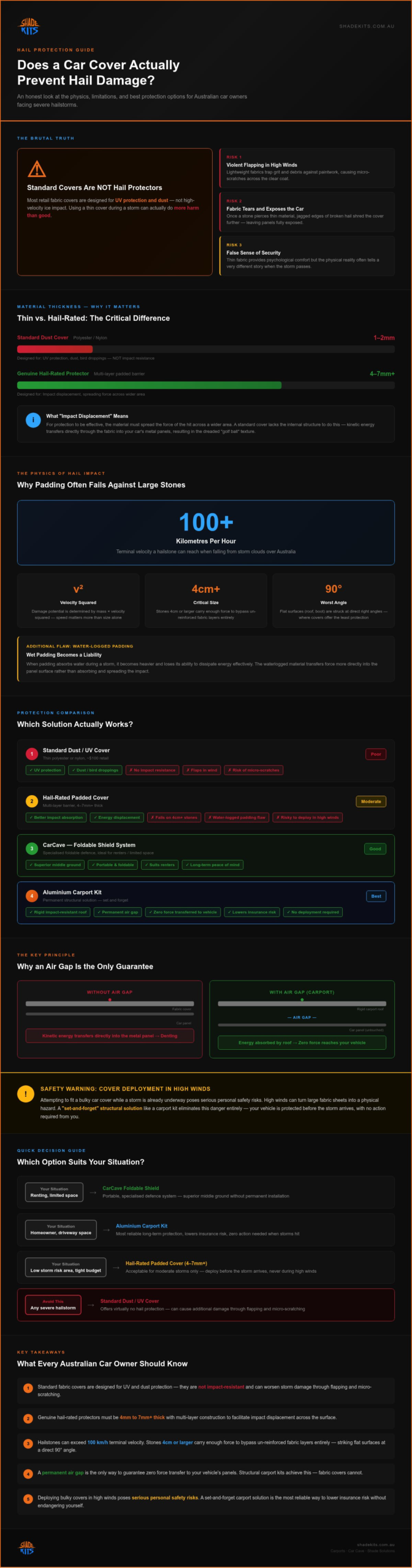
Practicality is often the deciding factor when choosing between different types of vehicle protection. While we’ve explored the physics of impact, the logistical reality of an Australian summer storm is just as critical. Many owners find that while they’ve invested in a cover, the “deployment window”-the time between receiving a Bureau of Meteorology warning and the first hailstone hitting-is often too short to safely secure the vehicle. If you’re wondering does a car cover prevent hail damage, you also need to ask if you can realistically get it onto the car in the middle of a gale.
Handling large fabric sheets in high winds is inherently risky. A heavy, multi-layered hail cover can easily weigh over 10kg, and in a sudden gust, this fabric acts like a sail. It’s capable of knocking a person over or being ripped from your hands, potentially damaging nearby property or the car itself. There’s also the very real danger of lightning strikes and falling branches while you’re standing in an exposed driveway. This is why a pre-installed structural solution is always the safer choice for the owner. It removes the need to be outdoors when conditions are deteriorating. If a cover isn’t perfectly strapped down, the wind can even use the fabric to buffet the car’s panels, causing the very dents you were trying to avoid.
The longevity of your chosen protection is another pragmatic concern. Australian UV levels are some of the highest in the world; constant sun exposure eventually degrades the fibres of fabric covers. This makes them brittle and significantly less capable of absorbing impact over time. You also need to consider storage requirements. When it’s not in use, a bulky, 10kg padded cover takes up significant shelf space in a garage or shed. If you’re forced to pack it away while it’s still damp from a storm, you’ll likely face issues with mould and mildew that can ruin the internal lining and eventually affect your car’s paintwork.
Storing a damp cover also risks introducing moisture-related damage to your vehicle’s clear coat during the next use. You can learn about the durable materials in the CarCave to see how specialised engineering overcomes these common fabric-specific weaknesses. By using a frame-supported system, you eliminate the “sail effect” and the need for precision strapping in the wind. For those who want the most reliable, set-and-forget security, investing in a DIY carport kit ensures your vehicle is protected 24/7 without you ever having to step out into a storm.
Evaluating your space is the first step toward moving away from temporary fixes. You need to consider your driveway’s width and any height restrictions, especially if you drive a 4WD with a roof rack or a large SUV. While we’ve established that a simple fabric option rarely provides complete security, asking does a car cover prevent hail damage is often the catalyst for finding a more permanent, reliable alternative. Whether you’re a renter needing a portable solution or a homeowner ready for a weekend project, there’s a structural option that fits your specific logistical needs and budget.
The CarCave is specifically designed for those who can’t build a permanent structure. It offers a middle ground that a standard cover simply can’t match. Its structural frame ensures the fabric never touches your paintwork, while the UV-resistant materials are built to withstand the harsh Australian sun. This system provides a clear air gap, which is the most effective way to neutralise impact energy before it reaches your vehicle. For a deeper look at the various ways to secure your vehicle, you can read our Hail Protection for Cars: The Ultimate Guide to Defending Your Vehicle in Australia. It outperforms a loose cover because it stays grounded in high winds and won’t trap moisture against your clear coat, preventing the mould issues common with padded blankets.
For homeowners, a DIY carport kit represents a long-term investment in vehicle security and property value. These kits use factory-direct aluminium and impact-resistant polycarbonate roofing, materials that win on durability compared to any textile solution. You can customise the dimensions to suit everything from standard sedans to high-clearance caravans. The assembly process is designed for a straightforward weekend project, using pre-drilled components that eliminate the need for specialised construction skills.
A permanent structure is the ultimate answer to the question: does a car cover prevent hail damage? While a cover might offer a thin layer of hope, a structural roof provides a physical guarantee. By choosing a solution that removes the need for last-minute storm prep, you’re choosing peace of mind. Protect your vehicle today with a Shade Kits DIY solution and stop worrying about the next storm warning or expensive panel beating bill.
Protecting your car in Australia requires moving beyond the false security of thin fabric. While standard covers serve a purpose for dust and UV protection, they lack the density and structural gap needed to neutralise high-velocity ice. When deciding does a car cover prevent hail damage effectively, remember that a structural barrier is the only way to ensure kinetic energy doesn’t transfer directly into your panels. Whether you choose a permanent carport or a portable shield, the goal is to eliminate the contact points that lead to expensive insurance claims.
Our factory-direct DIY kits offer maximum value by removing the middleman, providing you with professional-grade protection at a manageable price. Every solution is engineered specifically for harsh Australian weather conditions, utilising durable aluminium and UV-resistant polycarbonate materials that stand the test of time. You don’t have to face the next storm season with anxiety. Take a proactive step today and protect your vehicle from the next storm with the CarCave. It’s a simple investment that ensures your pride and joy remains in showroom condition for years to come.
Standard fabric covers rarely provide enough impact resistance to stop dents from large hailstones. While they might help with very small ice pellets, they lack the structural density required for severe Australian storms. For reliable protection, you need a solution that creates an air gap or uses heavy-duty padding. If you’re asking does a car cover prevent hail damage effectively, the reality is that fabric alone is often insufficient for anything larger than a marble.
The most effective materials for impact resistance are high-density, multi-layered padded fabrics or rigid structural components. Look for covers with a thick inner layer of compressed foam, usually between 4mm and 7mm. However, for 24/7 reliability, UV-resistant polycarbonate roofing used in carport kits is superior. It offers permanent impact resistance that doesn’t degrade like fabric does when exposed to the harsh Australian sun over several consecutive storm seasons.
Using blankets is a common DIY tactic, but it carries significant risks. Blankets are highly absorbent; once they soak up the rain that typically precedes hail, they become heavy and lose their cushioning ability. This wet weight can compress against your car’s panels, transferring the force of the hail directly to the metal. Additionally, damp blankets trapped under a cover can lead to mould and mildew issues that damage your vehicle’s clear coat.
The CarCave is specifically engineered to defend vehicles against typical Australian hail and severe UV exposure. Unlike a standard cover that rests on the paint, its structural frame creates a protective canopy that absorbs and deflects impact energy. While no portable solution is indestructible against extreme weather events, its design provides a much higher safety margin than fabric alone by ensuring the impact occurs on the tensioned material rather than your car’s delicate panels.
Shade Kits designs every carport kit for straightforward self-installation, making them accessible for those with basic tools. The components are factory-direct and pre-engineered for a precise fit, which simplifies the assembly process into a manageable weekend project. You don’t need professional construction experience to achieve a high-quality result. Each kit comes with clear instructions to guide you through the structural assembly, ensuring your vehicle gains permanent protection without the need for expensive on-site labour.
Yes, a car cover can cause micro-scratches if wind-blown grit or dust gets trapped between the fabric and the paintwork. During a storm, high winds cause the cover to flap and rub against the vehicle’s surface. This abrasive action acts like sandpaper on your clear coat. To avoid this, it’s essential to ensure both the car and the cover are perfectly clean, or better yet, use a frame-supported shelter like the CarCave that avoids paint contact entirely.
Relying solely on insurance can be a costly mistake. Most policies involve a significant excess, and a major hail claim can lead to your vehicle being written off or suffering a permanent loss in resale value. When considering does a car cover prevent hail damage, it’s also about avoiding the logistical headache of being without a car during repairs. Investing in a reliable protection system is a pragmatic way to lower your long-term ownership costs and insurance premiums.
Securing your shelter is vital to prevent it from becoming a hazard in a gale. For portable structures, use heavy-duty ground anchors or weighted bags designed for the frame. Permanent DIY carports should be bolted directly into a concrete slab or footings to ensure maximum structural integrity. Always check that all straps and fasteners are tight before the storm hits. A well-anchored system provides peace of mind, knowing your vehicle and property are safe from wind-blown debris.