
Have you ever sat inside during a sudden summer storm, listening to the roar of thunder and feeling a pit of dread in your stomach because your car is parked out on the street? Most Australian car owners know that feeling all too well. Between the scorching UV rays that peel your clear coat and the unpredictable hail that can turn your bonnet into a golf ball, our climate is incredibly tough on vehicles. If you’re renting or simply don’t want the hassle of a permanent build, finding a reliable portable car shelter is the smartest way to protect your investment.
We understand that you need a solution that’s both durable and straightforward to manage without hiring a contractor. You’ll discover how to select a structure that won’t buckle in the wind and how to master a secure DIY setup that gives you total peace of mind before the next storm warning hits. This guide covers everything from choosing UV-resistant materials to the best anchoring techniques; ensuring your vehicle stays cool and protected regardless of what the Bureau of Meteorology predicts for the weekend.
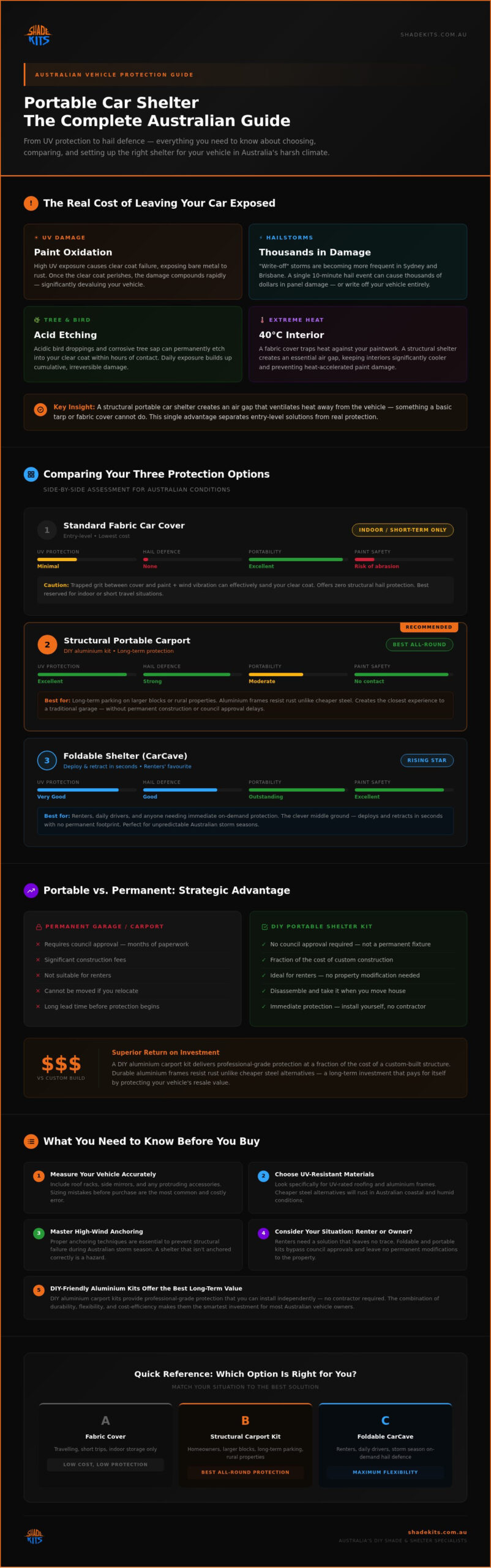
A portable car shelter is a non-permanent, structural solution designed to shield vehicles from environmental damage; it stands as a flexible, high-durability alternative to permanent garaging. While many people consider a basic fabric cover enough, these often trap moisture and heat against the paintwork, which can actually accelerate damage during a 40-degree summer day. A structural portable car shelter creates an essential air gap, allowing for ventilation while providing a rigid barrier against the elements. This approach ensures your vehicle stays significantly cooler than it would under a simple tarp or fabric wrap.
The Aussie sun is brutal. High UV exposure leads to paint oxidation and clear coat failure, which significantly devalues your asset over time. It’s not just about aesthetics; once the clear coat perishes, the metal underneath is vulnerable to rust. Then there’s the hail. “Write-off” storms are becoming more frequent in capital cities like Sydney and Brisbane, where a single ten-minute event can cause thousands of dollars in panel damage. Beyond these major weather events, daily threats like acidic bird droppings and corrosive tree sap can etch into your paintwork within hours. A dedicated shelter provides a constant line of defence against these cumulative costs.
One of the biggest hurdles for homeowners is council approval. Building a permanent brick or timber garage often requires months of paperwork and significant fees. A portable car shelter bypasses most of these bureaucratic headaches because it isn’t a permanent fixture. This makes it an ideal choice for renters who want to protect their pride and joy but can’t modify the property. If you move house, you simply disassemble your setup and take it with you.
When you compare the return on investment, a DIY kit offers professional-grade protection at a fraction of the cost of a custom-built structure. Our carport kits are designed for longevity, using durable aluminium frames that won’t rust like cheaper steel alternatives. For those needing maximum flexibility, the Car Cave provides a foldable solution that can be deployed or retracted in seconds. Choosing a portable option means you get immediate protection without the long-term commitment or high price tag of traditional construction.
Selecting the right level of protection depends on your specific driveway space and how often you use your vehicle. In Australia, we generally see three tiers of portable protection, each offering a different balance between cost, setup speed, and structural resilience. While a simple cloth cover might suffice for a car tucked away in a suburban garage, it’s rarely enough for a daily driver parked out in the elements. Finding the right balance for your property means looking beyond just the price tag and considering how the structure interacts with your vehicle and the local environment.
These are the most common entry-level options. They are affordable, easy to fold into a boot, and take up very little storage space. However, they come with significant drawbacks for outdoor use. If dust or grit gets trapped between the fabric and your car, the wind can cause the cover to vibrate, effectively sanding your clear coat over time. They also offer zero protection against heavy hail. We typically recommend these only for indoor storage or very short-term protection while travelling.
A structural portable car shelter is a much more robust investment. These units feature durable aluminium or steel frames with high-clearance roofing that can handle heavy downpours without pooling. Because they don’t touch the vehicle, there is no risk of paint abrasion. They do require a larger footprint and more assembly time than a cover, making them best suited for long-term parking on larger blocks or rural properties. If you have the space, these provide the closest experience to a traditional garage. You can view our range of carport kits to see how these structures provide a more permanent feel without the need for fixed construction.
The “foldable” category is the rising star for Australian daily drivers. Solutions like the CarCave offer a clever middle ground. They provide a rigid, structural frame that defends against hail and UV rays but can be opened or closed in seconds. Unlike standard covers, they never touch the vehicle’s paint, which eliminates the risk of scratches. This design is particularly effective for those with limited driveway space who still want high-level protection. You can discover the CarCave foldable protection to see how this flexible design handles local conditions.
When deciding between these options, consider your ground surface and local wind conditions. A lightweight cover might blow away in a sudden southerly buster, whereas a structural portable car shelter can be anchored securely to concrete, pavers, or grass. If you’re on a tight block in a metropolitan area, the footprint of your choice is just as important as its height. Choosing a system that fits your lifestyle ensures your car stays protected without turning your driveway into a cluttered construction zone.
Selecting a portable car shelter requires a methodical approach to ensure it actually fits your vehicle and property layout. It’s easy to look at a spec sheet and assume a standard size will work, but the Australian environment and modern vehicle dimensions demand more precision. You need a structure that accommodates your daily habits, not just the static footprint of the car. Following a clear decision framework helps you avoid the frustration of a shelter that’s too tight or materials that fail after one summer.
The most common mistake is measuring the car’s body but forgetting the “Door Swing” rule. You must ensure there’s enough width to fully open the driver and passenger doors so you can get out comfortably without hitting the frame. For those with utes or 4WDs, height clearance is the critical factor. Don’t just measure to the roofline; you have to account for UHF antennas, roof racks, and any mounted recovery gear or roof pods. Finally, check the length requirements by leaving enough room to open the boot or tailgate fully while the vehicle is parked inside. If you drive a large SUV with a vertical lift gate, this extra metre of clearance is essential.
In coastal Australian regions, aluminium frames are the clear winner for longevity. Unlike steel, which can begin to rust as soon as the powder coating is chipped, aluminium remains resilient against salt spray and high humidity. This makes it the superior choice for a portable car shelter intended to last several years. For the roofing, polycarbonate is the gold standard. It offers a perfect balance by blocking 100% of harmful UV rays while still allowing natural light to filter through; preventing that “dark tunnel” feeling in your driveway. If you’re considering a soft-shell or fabric option, pay close attention to the denier rating. A higher denier indicates a thicker, more durable weave that’s less likely to become brittle and tear under the intense Aussie sun.
Before making your final choice, assess your ground surface. Whether you’re setting up on a concrete pad, pavers, or grass will dictate how you anchor the unit. Always look for weather ratings that specifically mention UV stabilisation and wind resistance. Materials that aren’t treated for our local conditions will degrade rapidly, so choosing high-quality components from the start is the best way to ensure long-term value and protection for your asset. For a comprehensive walkthrough of every factor to consider, our guide on how to choose and install a portable car shelter for Australian conditions covers the full selection and setup process in detail.
Setting up a portable car shelter is a straightforward DIY task, but it requires a disciplined approach to anchoring. Without proper ground fixings, a large structure acts exactly like a sail during a coastal gale or a sudden summer thunderstorm. Ensuring your shelter stays put isn’t just about protecting your car; it’s about the safety of your property and your neighbours. You won’t need a trade qualification to get this right, but you will need a few standard tools like a cordless drill, a socket set, a spirit level, and a tape measure.
For concrete driveways, Dynabolts or expansion anchors provide the most reliable grip. You’ll need a masonry bit to drill into the slab before driving the anchors home and tightening them to the manufacturer’s torque settings. If you’re installing on soft ground or grass, standard tent pegs won’t cut it. Instead, use heavy-duty auger stakes that screw deep into the subsoil, potentially combined with weighted sandbags for extra ballast during storm season. Be particularly careful with pavers. Never anchor your portable car shelter to a single paver, as the wind can easily lift that individual stone right out of its sand bed. In these cases, it’s safer to remove specific pavers and pour small concrete footings or use long stakes that reach the compacted base underneath.
Start by organising all your components on a flat surface. This lay-out phase prevents you from searching for specific bolts or brackets halfway through the build. Once the modular frame is upright, take the time to square it. Measure the diagonals from corner to corner; if the measurements match, your frame is perfectly square and structurally sound. When you reach the roofing stage, handle your polycarbonate sheets with care. Avoid over-tightening the fixings, as the material needs a tiny amount of room to expand and contract during 40-degree days.
A quick post-storm inspection is essential for long-term reliability. Check the tension on all bolts and ensure your anchors haven’t shifted after a period of high winds. If you live near the coast, regularly wash down the aluminium frame and roof to remove salt spray, which can eventually dull the finish if left to sit. For those using foldable designs, learning how to secure your Car Cave during high winds is vital for protecting the mechanical hinges. Keep these moving parts lubricated with a silicone spray to ensure the structure remains easy to operate year-round.
Take control of your vehicle’s safety by choosing one of our high-strength carport kits for your next DIY project.
Choosing a portable car shelter shouldn’t mean compromising on quality or paying inflated retail prices. We cut out the middlemen to ensure you receive premium aluminium components at a significantly lower cost than traditional custom-built alternatives. This factory-direct model allows us to focus entirely on the structural integrity of the kits, ensuring that every bolt and bracket meets the high standards required for the Australian environment. By handling the engineering and supply chain ourselves, we provide a streamlined experience that prioritises both your budget and your vehicle’s safety.
Our kits aren’t generic imports; they’re designed specifically for the intense heat and sudden weather shifts found across the country. The UV-resistant polycarbonate roofing sheets are treated with protective coatings that won’t go brittle or yellow after a single summer in the sun. These structural designs account for common Australian storm patterns, providing a rigid barrier that resists wind uplift far better than standard fabric alternatives. Shade Kits is committed to providing reliable Australia-wide delivery and local support to ensure every customer can protect their vehicle with confidence. If you need a rapid-deploy solution for hail and sun protection, the CarCave offers a unique Australian design that can be set up in minutes.
We believe that high-quality vehicle protection should be accessible to everyone, regardless of their construction experience. Our modular designs are engineered for the DIYer, featuring pre-drilled components and clear, Australian-centric instructions that remove the guesswork from the assembly process. You won’t need a specialised toolkit to get the job done; most of our kits require only basic household tools for a professional finish. This approach empowers you to take control of your home improvement project without the expense of hiring external contractors.
Throughout your project, you have access to expert advice that acts as a steady hand, guiding you from the initial measurement phase to the final anchoring. Whether you’re a renter looking for a temporary fix or a homeowner wanting a durable, non-permanent addition to your driveway, our solutions provide the flexibility you need. Explore Our Full Range of Carport Kits to find the perfect fit for your property. When you’re ready to secure your asset against the elements, you can browse our DIY Carport and Shelter Kits today and enjoy the peace of mind that comes with professional-grade protection.
Protecting your car from the harsh Australian climate doesn’t have to be a complicated or expensive ordeal. By choosing a high-quality portable car shelter, you’re investing in long-term value through durable aluminium frames and UV-resistant polycarbonate roofing. We’ve explored how a methodical approach to measuring and a commitment to secure anchoring can transform a simple DIY project into a professional-grade defence against hail and sun damage. Whether you’re a renter needing flexibility or a homeowner looking for a pragmatic alternative to a permanent garage, the right setup provides immediate peace of mind.
Our kits are engineered specifically for local conditions, combining resilience with an easy assembly process that requires only basic tools. With factory-direct pricing and reliable Australia-wide shipping, getting your vehicle under cover has never been more accessible. Don’t wait for the next storm warning to take action. Start your project now and enjoy the confidence that comes with a well-protected vehicle.
View our range of DIY Portable Car Shelters and CarCaves
Most portable structures don’t require council approval because they’re classified as non-permanent or temporary additions to a property. However, local regulations can vary significantly between different states and municipalities. It’s always a sensible move to check with your local council before installation; especially if you live in a heritage-listed area or have strict strata bylaws that govern driveway structures.
Yes, a structural portable car shelter provides a rigid barrier that absorbs the impact of heavy hailstones. Unlike standard fabric covers that can still allow dents to form through the material, units with polycarbonate roofing or heavy-duty foldable frames create a physical shield. This setup ensures that even large hailstones are deflected away from your vehicle’s sensitive panels and glass during a storm.
Anchoring your shelter correctly is the only way to prevent it from moving during a summer storm or a coastal gale. For concrete surfaces, you should use expansion anchors or Dynabolts to fix the frame securely to the slab. If you’re setting up on grass or soil, heavy-duty auger stakes are essential fixings. These provide the necessary resistance to counter the sail effect created by the roof.
A standard car cover is a fabric layer that sits directly on your vehicle’s paintwork, which can lead to scratches if dust is trapped underneath. In contrast, the CarCave is a structural, foldable unit that never touches the car. It offers superior hail defence and much faster access; you simply pull it over or retract it in seconds without needing to fold and store large sheets of fabric.
You can absolutely install our carport kits and CarCaves independently without hiring a contractor. We design these products specifically for the DIY market, including pre-drilled components and clear instructions tailored for the Australian homeowner. You only need basic household tools like a drill and a socket set to achieve a professional result. This approach saves you the significant expense of professional installation labour.
Assembly time depends on the specific model you choose and your level of DIY experience. A foldable CarCave can typically be set up and anchored in about one to two hours. Larger modular carport kits usually take a full morning or afternoon to complete, especially if you’re working with a partner. Taking the time to lay out your components before starting will significantly speed up the process.
Aluminium is the superior choice for coastal regions because it’s naturally resistant to rust and salt spray corrosion. While steel frames are strong, they can begin to degrade quickly if the protective coating is scratched or chipped in a high-salt environment. Our aluminium kits provide long-term structural integrity and maintain their appearance without the constant maintenance and repainting often required by cheaper steel alternatives.
Most of our shelters are designed to accommodate modern Australian vehicles, including large 4WDs and dual-cab utes. However, you must check your specific height clearance if you have a lift kit, roof racks, or a UHF antenna. We provide detailed dimensions for every kit to help you ensure a comfortable fit that allows for both the vehicle height and enough width to open your doors.