
Why do so many outdoor structures look like yellowing, brittle relics after just two seasons in the Australian sun? It is a common frustration for homeowners who want to improve their outdoor living space without committing to the massive expense of a custom-built extension. You deserve a shaded retreat that stands up to the elements, yet many off-the-shelf options simply aren’t engineered for our harsh UV levels or sudden summer storms.
We understand that you’re looking for a solution that balances longevity with a straightforward setup. This 2026 buyer’s guide is designed to help you navigate the market for polycarbonate patio awning kits, ensuring you choose a system that offers genuine UV protection and structural integrity. We’ll show you how to find kits that fit your specific space and provide a professional, rust-free finish through a manageable DIY project.
In the following sections, we will explore the essential features of high-grade aluminium frames and the benefits of factory-direct pricing. By the end of this guide, you’ll have the confidence to select a kit that transforms your patio into a functional, light-filled sanctuary that lasts for years to come.
Choosing the right material for your outdoor extension is a decision that impacts your home’s comfort for decades. Polycarbonate is a high-impact, lightweight thermoplastic that has become the industry standard for high-quality patio roofing. Unlike traditional materials, it combines the clarity of glass with a level of toughness that is almost impossible to match. When you invest in polycarbonate patio awning kits designed for full-scale patio coverage, you aren’t just buying a plastic sheet; you’re securing an engineered solution designed to handle the rigours of the environment.
The primary challenge for any Australian structure is the sun. Standard plastics often yellow and become brittle within a few years of exposure. High-grade polycarbonate solves this through co-extruded UV-resistant coatings. These layers deflect up to 99% of harmful radiation, protecting both the structure itself and the people sitting beneath an awning or overhang. This ensures your outdoor space remains clear and structurally sound through years of intense summer heat.
Many homeowners consider glass for its premium look, but it carries significant risks. Glass is heavy, expensive, and can shatter during the severe hailstorms common across many parts of the country. Polycarbonate is virtually indestructible by comparison. It offers superior impact resistance, making it the safest choice for regions prone to storm debris or large hail. Fabric and canvas alternatives often struggle with mould and fading; however, a polycarbonate kit requires almost no maintenance beyond an occasional wash with soapy water to keep it looking new.
A well-designed patio should be bright without becoming a hothouse. Modern polycarbonate patio awning kits manage this balance perfectly. By using tinted or multi-wall sheets, these systems filter out significant solar heat while still allowing soft, natural light to flood the area. This creates a genuine “outdoor room” feel that remains cool enough for midday entertaining. Additionally, by shading your home’s exterior walls and windows, these structures can actually improve your home’s overall energy efficiency by reducing the heat load on your internal living spaces.
Evaluating the quality of polycarbonate patio awning kits requires looking beyond the price tag. While a basic door canopy might suffice for a small entrance, a full-scale patio structure must manage significantly higher wind loads and weight. Choosing a kit that is fit for purpose means scrutinising the materials and the engineering behind the design to ensure it can handle the local environment.
Powder-coated aluminium is the gold standard for frame materials in Australian conditions. Unlike steel, it doesn’t rust in coastal air, and unlike timber, it won’t warp, rot, or require annual staining. It is the ultimate low-maintenance material for a permanent outdoor structure. You should also examine the roofing thickness carefully. Solid 3mm polycarbonate provides a sleek, glass-like appearance that is perfect for modern homes, while multi-wall sheets offer excellent thermal insulation properties and are exceptionally lightweight for easier handling during assembly.
A truly professional kit must be complete from the moment it arrives at your door. This means including every necessary bracket, seal, and high-tensile fastener required for the job. High-quality systems often feature integrated guttering to manage rainwater effectively, preventing drips from ruining your outdoor furniture during a downpour. If you are looking for a reliable solution that fits your specific space, you can explore customisable patio covers that provide the exact dimensions and structural support you need.
Safety is paramount when installing a permanent structure over your entertaining area. Always verify that the kit design complies with the Australian Standard for plastic roof installation. Cheap, generic kits often lack the heavy-duty wall brackets and reinforced support posts required to withstand a typical summer storm. A robust kit should provide clear engineering data regarding its wind rating to ensure it remains secure and stable during high-wind events.
Your new awning should complement your home’s existing architecture rather than look like an afterthought. Most premium kits offer a range of frame colours, such as modern anthracite grey or classic white, to ensure a seamless match with your window frames or gutters. The tint of the polycarbonate roofing also plays a functional role. Clear sheets maximise natural light, which is ideal for south-facing patios, while bronze or grey tints are better suited for north-facing areas where heat control is a higher priority. These choices allow you to create an outdoor space that looks as good as it performs.
When planning an outdoor upgrade, the choice often boils down to a permanent fixture or a flexible, retractable system. While the idea of folding away your shade sounds appealing, the practical reality of the Australian climate often dictates a different approach. For many homeowners, polycarbonate patio awning kits offer a superior balance of permanent protection and light transmission that retractable fabric systems simply cannot match. It’s about deciding whether you want a seasonal accessory or a year-round extension of your home.
The long-term value of your investment depends heavily on how the structure handles wear and tear. Fixed structures are built to withstand the elements without constant monitoring. In contrast, retractable systems involve mechanical arms, rollers, and often motorised components that require regular maintenance. Over a ten-year period, the cost of replacing worn fabric or repairing a jammed motor can often exceed the initial price of the unit. Fixed polycarbonate systems provide a “set-and-forget” solution that remains reliable through every season.
If you use your outdoor area for dining or as a permanent BBQ station, fixed polycarbonate patio awning kits are almost always the better investment. These structures provide 24/7 protection from both rain and UV rays, meaning your furniture stays dry and your deck remains shaded year-round. Because they are static structures with no moving parts, fixed kits are significantly more DIY-friendly. You don’t have to worry about calibrating motors or tensioning springs. They are designed to stay up during a summer storm, providing shelter exactly when you need it most.
Retractable options offer flexibility, but they come with inherent trade-offs in durability. Fabric canopies are prone to mould and fading, especially in humid coastal regions. More importantly, they are highly sensitive to wind. Most manufacturers require you to retract the awning as soon as the wind picks up to avoid structural damage. This means that during a sudden downpour accompanied by wind, you might lose your outdoor cover entirely. When you factor in the higher price points for reliable motorised components, the long-term value of retractable systems often falls short of a solid patio cover solution.
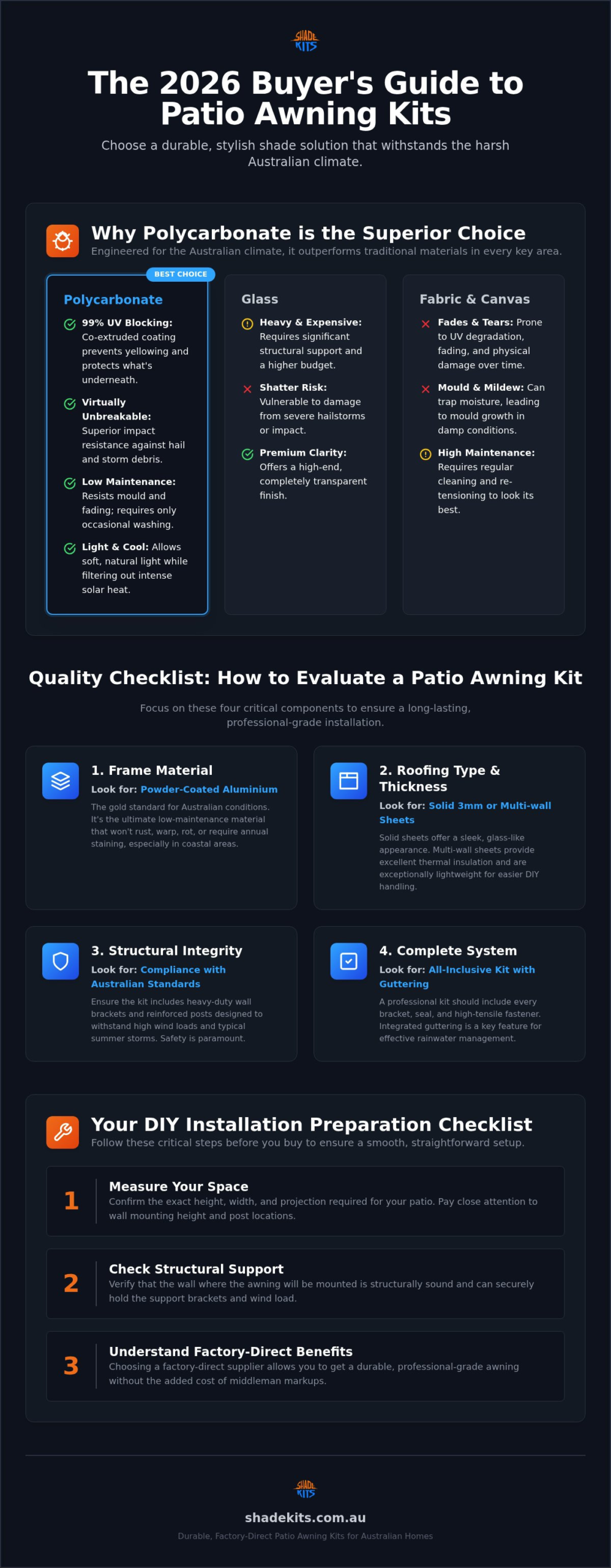
Installing your own outdoor cover is a rewarding project that can be completed in a weekend. However, the success of polycarbonate patio awning kits depends largely on the preparation you do before the first bolt is tightened. You don’t need to be a professional builder, but you do need to be methodical and have a clear plan for your specific site.
Start with accurate measurements. You’ll need to confirm the height clearance to ensure there’s enough room above your door or window for the wall brackets while still allowing for a comfortable walk-under height. The projection, or how far the roof extends from the wall, needs to cover your desired area without obstructing garden paths or neighbouring fences. Confirming your wall or fascia can support the weight is also vital. If you’re attaching to a timber fascia, check for any signs of rot or instability before you begin. Mounting to brickwork requires high-quality masonry anchors to ensure the structure stays put during high winds.
Before the kit arrives, gather your tools. You’ll need a power drill with appropriate bits, a spirit level, a sturdy ladder, and a tape measure. While the aluminium components are lightweight, the scale of these kits makes them a two-person job. Having a buddy to help steady the beams while you secure the fasteners ensures a safer and more precise result. It makes the process much faster and prevents accidental damage to the panels during the lifting phase.
Ready to start your project? Browse our range of DIY patio covers and find the perfect fit for your home.
Most polycarbonate patio awning kits follow a logical assembly sequence. First, mark your bracket positions using a spirit level to ensure a perfectly horizontal line across your mounting surface. Once the wall brackets are secured, you’ll assemble the aluminium frame and support beams according to the manual. The final step involves sliding the polycarbonate panels into their designated channels. These systems are engineered for a watertight finish, so take care to ensure the rubber seals are correctly seated to prevent leaks during heavy rain.
To keep your awning looking brand new through 2026 and beyond, follow a simple maintenance routine. Clean the polycarbonate panels using a soft cloth and non-abrasive, mild soap. Avoid harsh chemicals, as these can strip the UV-protective layer that prevents yellowing. If your kit includes integrated guttering, clear out any leaves or debris every few months to prevent water pooling. A quick annual inspection of the fasteners and seals will provide structural peace of mind and ensure the longevity of your investment.
Buying an outdoor structure shouldn’t involve paying for three different companies’ overheads. Shade Kits operates on a factory-direct model, which means when you order one of our polycarbonate patio awning kits, you’re dealing directly with the people who understand the product best. This “no middleman” approach keeps our pricing transparent and competitive. It allows you to invest your hard-earned money into higher-quality materials, such as architectural-grade aluminium, rather than paying for retail markups or showroom floor space.
We design every kit specifically for the local landscape. Our engineering accounts for the intense UV radiation and unpredictable storm patterns that define the Australian climate. Every component is selected for its longevity, from the rust-free frames to the impact-resistant roofing. Because we control the entire production process, we can ensure that every kit delivered Australia-wide meets our strict internal standards for durability and ease of assembly. We don’t just ship boxes; we provide a complete, engineered solution that arrives safely at your door.
We believe that professional results should be accessible to every homeowner without the need for specialized trades. Our guarantee centres on providing premium materials as standard, including powder-coated aluminium and UV-stable polycarbonate that won’t yellow or crack in the sun. We focus on “straightforward self-installation” to empower you to take control of your home improvement project with confidence. For a deeper look at our material standards and design philosophy, you can read The 2026 Guide to Aluminium Awnings for Australian Homes.
A well-designed patio is often just the beginning of a cohesive outdoor space. Many of our customers find that our patio solutions perfectly complement other structures, such as our Carport Kits, to create a unified look across the property. This consistency doesn’t just improve your daily living experience; it can also boost your home’s resale value by providing professional-grade, permanent shade. Browse our range of DIY Patio Awning Kits today! and see how easy it is to upgrade your lifestyle with a durable, factory-direct solution.
Investing in your home’s outdoor lifestyle shouldn’t be a gamble. By choosing high-impact materials and a structure engineered specifically for our local conditions, you ensure your entertaining area remains comfortable for years. We’ve explored how the right frame and roofing thickness can withstand the harshest summer storms while providing essential UV protection. A successful installation starts with careful measurement and a solid surface check, ensuring your new structure is as stable as it is attractive.
Moving away from flimsy retail options toward professional-grade polycarbonate patio awning kits means you won’t have to worry about yellowing or structural failure down the track. These systems offer a permanent, low-maintenance solution that enhances both the value and functionality of your property. Ready to take the next step? View Our Full Range of Factory-Direct DIY Awning Kits and benefit from factory-direct pricing, heavy-duty UV-resistant materials, and reliable Australia-wide delivery.
You have the knowledge and the tools to choose a kit that fits your space perfectly. Now is the ideal time to start your project and create the shaded retreat you’ve always wanted.
Yes, polycarbonate is highly effective at reducing heat while allowing natural light to pass through. Tinted options like bronze or grey are particularly good at filtering solar energy. Multi-wall sheets provide even better thermal insulation by trapping air between the layers. This helps keep your outdoor area cool during a typical Australian summer. By shading exterior walls, these polycarbonate patio awning kits can also lower the internal temperature of your home.
A high-quality polycarbonate awning typically lasts between 10 and 25 years in our local climate. The lifespan depends heavily on the presence of co-extruded UV-blocking layers that prevent the material from becoming brittle. Aluminium frames used in these kits are rust-proof and corrosion-resistant, which significantly extends the structure’s overall life. Regular maintenance, such as clearing debris from gutters, ensures your polycarbonate patio awning kits remain functional for many decades.
You can absolutely install these kits yourself without hiring a professional builder. Most systems are specifically designed for straightforward self-installation by homeowners with basic DIY skills. You’ll need standard tools like a drill, spirit level, and ladder. While the aluminium components are lightweight and easy to handle, we recommend having a second person available to help with lifting and securing the larger beams safely. It makes the process much faster and safer.
There is some noise during heavy downpours, but it is generally comparable to a traditional metal roof. If sound dampening is a priority for you, multi-wall polycarbonate is an excellent choice as the air pockets within the sheets act as a natural acoustic buffer. Proper installation is also key; ensuring all fasteners and seals are tight prevents the panels from rattling, which keeps the sound to a completely manageable level.
Yes, high-quality polycarbonate is virtually indestructible and provides excellent protection against hail and falling storm debris. The material is engineered with high impact resistance, making it much safer than glass in regions prone to severe weather. Many homeowners use these structures as dedicated carports or patio covers to shield their vehicles from the elements. It’s a reliable way to prevent costly panel damage during a typical summer storm in 2026.
Solid polycarbonate is a single, dense sheet that offers a sleek, glass-like appearance with maximum clarity. It’s perfect for modern designs where you want an unobstructed view. Multi-wall polycarbonate features a layered, ribbed structure that creates internal air channels. These channels provide superior thermal insulation and weight reduction. While both types are extremely durable, multi-wall is often preferred for larger patio spaces where heat reduction is the primary goal for the homeowner.
In many parts of Australia, permanent outdoor structures require council approval to ensure they comply with local wind-load safety and setback regulations. However, some smaller, low-impact structures might be classified as “exempt development” depending on your specific location. It’s always best to consult your local council or a private certifier before you start work. Reputable suppliers provide engineering drawings to help streamline this certification process and ensure your home remains compliant.
Maintenance is very simple and only requires a wash with warm, soapy water and a soft cloth every few months. You should avoid using abrasive cleaners or harsh chemicals, as these can damage the UV-protective coating on the panels. It’s also a good idea to clear any leaves or twigs from the gutters to prevent water pooling. A quick annual check of the fasteners ensures the structure stays secure and stable for years.