
Could your home’s exterior be the secret to slashing those soaring summer electricity bills by a significant margin? It’s a frustrating reality for many Australians: watching beautiful indoor furniture fade under harsh UV rays while the air conditioner works overtime just to keep the lounge room liveable. You likely already know that external shading is the most effective way to block heat before it hits the glass, yet the perceived complexity of DIY installation often holds people back. This guide simplifies the process, helping you understand awning kits prices australia market trends for 2026 and how to select a system that stands up to our toughest storms.
We’ll show you how to transform your facade with sleek, minimalist designs that offer a professional finish without the premium price tag of custom trades. From the latest National Construction Code energy standards to the durability of powder-coated aluminium, we’ve gathered everything you need to know. You’ll discover how these factory-direct kits provide a reliable, structural solution for a cooler home and improved curb appeal. We’ll explore material benefits, 2026 regulatory updates, and the step-by-step logic of a successful DIY project.
The modern Australian home has evolved, and so has the way we manage our harsh climate. Awnings are no longer just functional afterthoughts; they are precision-engineered additions that define a property’s silhouette. Today’s kits favour minimalist frames and high-tech materials that blend seamlessly with contemporary architecture. If you’re researching awning kits prices australia, you’ll find that the value lies in their ability to act as a primary line of defence against solar heat gain while adding a sophisticated finish to your facade.
Unlike heavy, permanent custom builds that require weeks of onsite labour, 2026 homeowners are increasingly turning to DIY kits. These solutions offer the same structural integrity as traditional builds but arrive ready for immediate assembly. This shift is driven by a desire for architectural flexibility and the significant cost savings found in factory-direct models. For those new to the concept, this comprehensive guide to awnings explains the fundamental transition from simple sunshades to the advanced weather-protection systems we use today.
External shading is remarkably efficient. Research suggests that blocking the sun before it reaches the window glass is up to three times more effective than using internal blinds or curtains. By stopping radiation from entering the home, you prevent the “greenhouse effect” that keeps rooms sweltering long after the sun goes down. It’s a pragmatic solution for anyone looking to maintain a cooler interior without constantly relying on expensive mechanical cooling.
This setup also facilitates a thermal chimney effect. When an awning is positioned correctly, it allows hot air to rise and escape away from the window rather than trapping it against the glass. The ROI is clear: every degree you lower your internal temperature naturally is a degree your air conditioner doesn’t have to fight. Over a long Australian summer, this translates to noticeable reductions in household energy consumption and a much more comfortable living environment.
Our environment demands materials that don’t just look good but survive. Aluminium is the gold standard for modern frames because it’s naturally resistant to termites and will never rot, unlike traditional timber. This is crucial in coastal or high-humidity regions where salt spray and moisture quickly degrade lesser materials. Choosing a powder-coated aluminium frame ensures your investment remains structurally sound and visually appealing for years with zero maintenance.
The roofing material is equally vital. High-quality kits use hail-resistant polycarbonate that offers 99% UV blockage. This protection is essential for preventing the costly fading of your carpets, timber flooring, and designer furniture. While Australian Standard 1288 focuses on the safety requirements of glass in buildings, modern awning kits complement these regulations by providing a protective barrier that reduces the thermal stress on your windows. This ensures your home remains a sanctuary, regardless of the temperature or storm activity outside.
Understanding what goes into a high-quality kit is the first step toward a successful installation. Modern designs are engineered as modular systems, meaning every component is precision-cut to fit perfectly with the next. This modularity is what makes the DIY approach so accessible. When comparing awning kits prices australia, it’s vital to look beyond the initial figure and examine the structural integrity of the components provided. A kit is only as strong as its weakest bracket or fastener.
Powder-coated aluminium is the undisputed gold standard for awning frames in 2026. Timber might offer a classic look, but it’s prone to rotting, warping, and termite attacks, especially in humid northern regions. Steel is incredibly strong, yet its weight makes it difficult for a solo DIYer to handle, and it remains vulnerable to rust if the coating is scratched. Aluminium solves these issues by being naturally corrosion-resistant, which is vital for coastal homes facing salt-laden winds.
The lightweight nature of aluminium frames doesn’t compromise their strength. They are engineered to support the roofing material even during heavy downpours or high-wind events. Because they are light, you don’t need a team of professionals to lift them into place. This makes them a pragmatic choice for homeowners who want a durable, zero-maintenance solution that they can realistically install themselves over a weekend. Proper shading is essential for the Australian climate, and choosing the right frame material ensures that protection lasts for decades.
The roofing material does the heavy lifting when it comes to climate control. Modern kits typically feature either solid or multi-wall polycarbonate sheets. Multi-wall options provide excellent thermal insulation by trapping air within their structure, while solid sheets offer a sleek, glass-like appearance with superior impact resistance. Both types are designed to handle the natural thermal expansion and contraction that occurs as temperatures fluctuate throughout a typical Australian day.
Standard polycarbonate in a quality kit provides 99% UV blockage. This is the primary mechanism that prevents your interior carpets and furniture from fading. You can tailor the light transmission by choosing different tints; clear sheets maximise natural light, while grey or bronze tints reduce glare and further lower heat gain. If you are looking for a way to balance light and heat, exploring the range of high-performance DIY kits can help you find the right match for your home’s orientation.
Don’t overlook the unseen components like fasteners and flashings. A high-quality kit includes weather-sealed gaskets and corrosion-resistant screws that prevent leaks at the mounting point. These small details ensure a professional, leak-free finish that protects your wall’s structural integrity while maintaining a clean, minimalist aesthetic.
Selecting an awning is an architectural decision that influences your property’s overall silhouette. While researching awning kits prices australia, it’s helpful to consider how the design integrates with your home’s existing structural lines. A well-chosen kit doesn’t just provide shade; it enhances the facade’s visual balance. Whether you’re looking for a sharp, geometric look or something more subtle, the right style ensures your DIY project looks like a professional installation rather than a weekend afterthought.
The 2026 trend for Australian homes is firmly rooted in “less is more.” Homeowners are moving away from bulky, ornate styles in favour of streamlined silhouettes. Modern kits often feature hidden fixings and integrated gutters, ensuring the focus remains on the home’s architecture. This minimalist approach is particularly effective for cantilever designs, which provide shade without visible support arms, creating a clean, floating effect. If your home has more traditional structural lines, bracketed designs offer a robust, grounded aesthetic that still feels contemporary.
For a truly unified look, consider how your window shading integrates with other outdoor features. Pairing your window awnings with modern carport kits ensures every addition to your property shares a consistent design language. This consistency is a hallmark of high-end architectural design, providing a polished finish that can significantly boost curb appeal and property value.
Colour coordination is your most powerful tool for visual integration. In Australia, the palette is currently dominated by sophisticated, architectural tones. Matching your awning frame to popular window joinery or roofing colours like Monument or Surfmist creates a seamless look. Monument offers a bold, grounding effect that works well against light-coloured render, while Surfmist provides a crisp finish that reflects heat and suits coastal environments perfectly.
The tint of your polycarbonate roofing also affects the light quality inside your home. Clear sheets allow for maximum natural brightness, which is ideal for south-facing windows that need more winter sun. Conversely, grey or bronze tints create a cooler, more subdued atmosphere that’s perfect for reducing glare in home offices or bedrooms. You might also consider using contrasting colours for a bold statement. A dark frame against a white weatherboard wall highlights the awning as a distinct feature, adding depth and modern character to your home’s exterior.
Finally, think about the scale of your project. A door canopy should be wide enough to protect the entrance without overwhelming the porch, while window awnings should match the window’s width precisely to maintain symmetry. By understanding how these elements work together, you’ll find that awning kits prices australia represent an investment in both your home’s energy efficiency and its long-term aesthetic value.
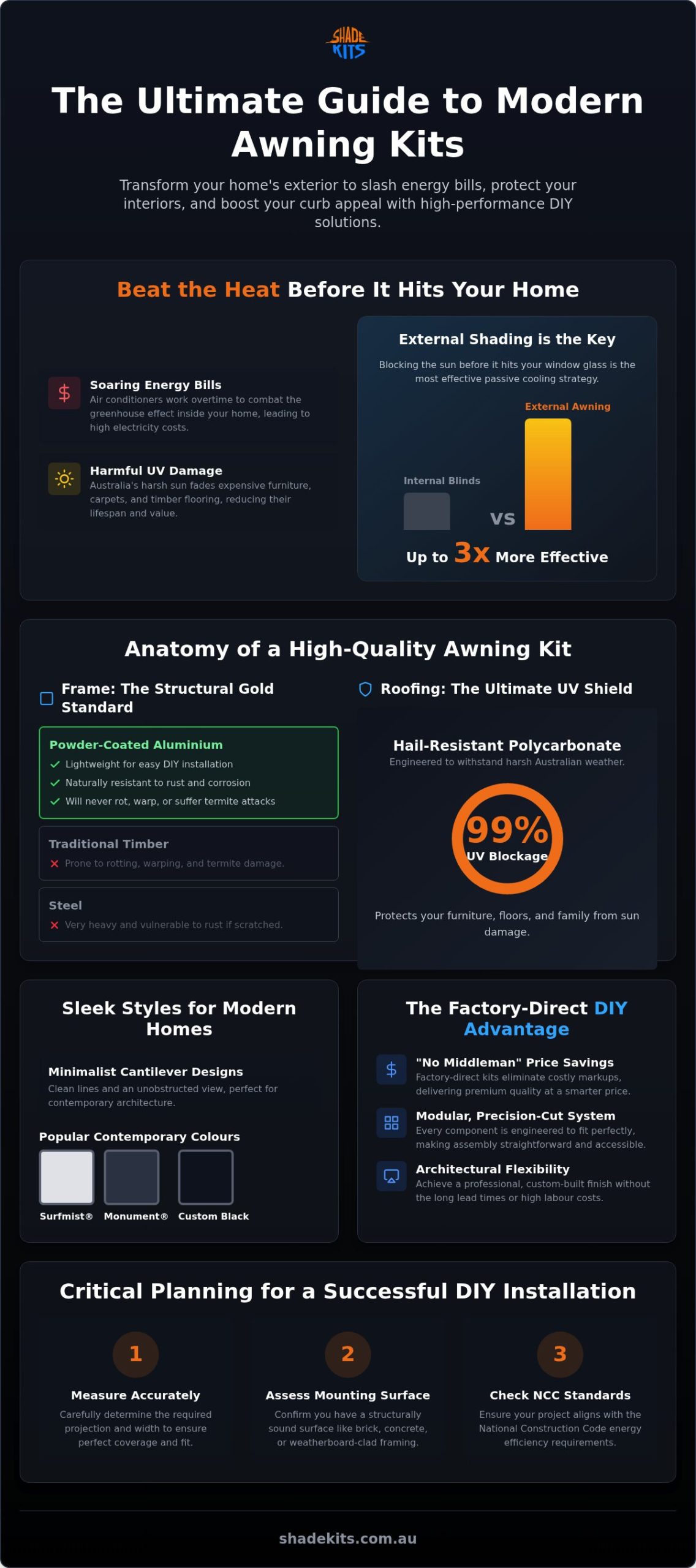
Successful DIY installation starts long before you pick up a drill. While awning kits prices australia are often lower than custom-installed alternatives, the real value is realised when the planning is handled with precision. You’ll need to measure three critical dimensions: the total width, the height above the opening, and the projection. Ensure the width extends at least 150mm beyond each side of the window or door frame to provide adequate side-shading. For projection, consider the sun’s angle at different times of the year to ensure the area remains protected when you need it most.
Mounting surfaces vary significantly across Australian homes. If you’re fixing to brickwork, ensure you aren’t drilling into the mortar joints, as this compromises structural integrity. For weatherboard or cladding, you must locate the internal studs or lintels to provide a secure anchor point. Rendered surfaces require a cautious approach; use a high-quality masonry bit and avoid over-tightening to prevent the render from cracking. Understanding awning kits prices australia involves recognising that a comprehensive kit includes the specialised fasteners needed for these varied surfaces.
In many Australian states, small window or door awnings are considered “exempt development” if they are under 10 square metres and meet specific height requirements. However, it’s a pragmatic move to check with your local council, especially if your home is heritage-listed or in a high-density area. Navigating these rules early prevents logistical headaches later and ensures your project remains fully compliant with local building standards.
Before your kit arrives, go through a pre-installation checklist. Identify exactly where your structural supports are located using a stud finder if necessary. Check for existing obstructions like downpipes, external lights, or security cameras that might interfere with the awning’s frame. For more detailed preparation tips, you can review the Essential Australian Carport Checklist, as many of the site preparation principles are identical for any external structure.
Once your kit arrives, organise your components in a clean, flat workspace. This prevents scratches on the powder-coated aluminium and ensures you have every fastener ready to go. Pre-drilling is essential when working with aluminium to ensure clean holes and prevent snapping screws. Use a neutral-cure silicone sealant on all mounting points to create a weather-tight seal against your wall. Safety is paramount; handling large polycarbonate sheets can be tricky if there’s a breeze, so always work with a partner and use stable ladders or scaffolding. If you’re looking for a structural solution that combines durability with ease of assembly, explore our factory-direct awning kits today.
Choosing a factory-direct model is about more than just finding the most competitive awning kits prices australia. It’s about transparency and material integrity. When you cut out the middleman, you aren’t paying for retail showroom overheads or third-party markups. Instead, that value is reinvested into the structural components of the kit. This direct relationship with the manufacturer ensures better consistency in the aluminium extrusions, as the factory maintains oversight from the initial design to the final powder-coating process. You receive a precision-engineered product that meets strict quality control standards, ensuring every bracket and rail fits exactly as intended.
Modern kits also offer a unique balance between standardisation and flexibility. While the core components are standardised for structural reliability, the modular nature of these systems allows for significant customisation to suit your specific wall space. This approach provides the professional look of a custom build at a fraction of the cost. It’s a pragmatic way to upgrade your home’s exterior without the logistical delays often associated with bespoke trades.
Shade Kits products are designed specifically for the unique challenges of the Australian environment. We understand that a home in a tropical region faces different pressures than one in a temperate coastal zone. Our kits are built to endure these extremes while remaining simple enough for a solo DIY project. We provide reliable Australia-wide delivery, ensuring regional homeowners can access premium shading solutions regardless of their location. While we focus on permanent external shade, we know that vehicle protection is also a priority for many. If you need a flexible, non-permanent solution for your driveway, the CarCave is an excellent portable alternative.
One of the most compelling reasons to choose aluminium over traditional timber is the drastic reduction in upkeep. Timber requires regular sanding, staining, or painting to prevent rot, warping, and termite damage. In contrast, powder-coated aluminium is virtually maintenance-free. To keep your awning looking new, simply wash the frame and polycarbonate with mild soapy water once or twice a year to remove salt spray and dust buildup. For a detailed breakdown of how to preserve your investment, refer to The 2026 Guide to Aluminium Awnings.
Finally, consider the impact on your property’s resale value. In 2026, energy-efficient features are a major selling point for Australian buyers. A well-installed awning kit is a functional asset that improves passive cooling and protects the interior from sun damage. It’s a durable investment that adds immediate curb appeal while paying dividends through reduced energy costs and long-term protection of your home’s assets.
Investing in a modern shading solution is one of the most pragmatic steps you can take to improve your home’s thermal performance. By choosing a system built from durable aluminium and UV-resistant polycarbonate, you’re ensuring long-term protection that requires almost zero maintenance. We’ve seen how these precision-engineered kits act as a primary defence against heat, helping to lower your energy bills while preserving your interior furniture. When you consider awning kits prices australia in 2026, the factory-direct model clearly offers the best balance of architectural quality and straightforward affordability.
With our factory-direct pricing ensuring maximum value and the convenience of Australia-wide delivery on all DIY kits, achieving a professional finish has never been more accessible. You don’t need a team of trades to transform your property’s exterior and boost its curb appeal. Ready to get started? Browse our range of modern aluminium awning kits today and take the first step toward a cooler, more resilient home. You have the plan and the expert guidance; now it’s time to make it a reality.
In most Australian states, small window awnings under 10 square metres and 2.4 metres high are considered exempt development and don’t require council approval. This applies provided the property isn’t in a heritage-listed area. Regulations can vary between local government areas, so it’s always a pragmatic move to verify with your specific council before ordering. Staying within these limits helps you avoid the paperwork often associated with larger, permanent structures.
High-quality DIY kits are specifically engineered to withstand the challenging Australian environment, including high wind loads and hail. Modern polycarbonate is virtually unbreakable and far more impact-resistant than glass or traditional acrylic. When you examine awning kits prices australia for 2026, ensure the product meets Australian Standard AS/NZS 1170.2:2021 for wind actions. This certification provides peace of mind that your investment will remain structurally sound during severe storm events.
You can certainly install an awning kit on a weatherboard or fibro home, provided you secure the brackets directly into the internal structural studs or lintels. Mounting purely into the cladding isn’t sufficient for the weight and wind load. It’s a straightforward process if you use a reliable stud finder to locate the timber frame. For fibro houses, always follow safe handling procedures regarding older materials and use appropriate masonry bits for clean, pre-drilled holes.
A properly installed awning can reduce heat gain through your windows by a significant margin. External shading is roughly three times more effective than internal blinds because it stops solar radiation before it hits the glass. This passive cooling method can lower your reliance on air conditioning and reduce energy bills. By blocking up to 99% of UV rays, these kits also protect your indoor furniture from the fading typically caused by direct sunlight.
Installing a Shade Kits awning requires a few standard DIY tools that most homeowners already own. You’ll need a power drill with appropriate bits, a spirit level to ensure a straight finish, a tape measure, and a stable ladder. A caulking gun with neutral-cure silicone is also essential for sealing the mounting points against weather. Because our kits are precision-engineered for straightforward assembly, you won’t need specialised trade equipment or heavy machinery to achieve professional results.
Polycarbonate is generally superior to glass for residential awnings because it’s significantly lighter and easier to handle for DIY installation. It offers high impact resistance against hail and provides 99% UV blockage, which glass cannot achieve without expensive specialised coatings. While glass is heavy and prone to shattering, polycarbonate is designed to handle thermal expansion and contraction. It’s a more resilient and cost-effective material for the varying temperatures found across the Australian landscape.
While modern kits come in standard sizes, their modular design provides a level of flexibility to suit different wall spaces. You can often choose from various widths and projections to match your specific windows or doors. When comparing awning kits prices australia, look for kits that offer multiple configurations. This allows you to achieve a custom look without the high costs and long lead times associated with bespoke, made-to-order architectural shading solutions.
For a standard window awning, most DIYers can complete the installation in approximately two to four hours. This includes the time needed for measuring, pre-drilling, and final assembly. Having a second person to help hold the frame while you secure the fasteners makes the process much faster and safer. Because the components are precision-cut at the factory, you won’t spend time on the manual adjustments or cutting often required with traditional construction projects.