
What if your outdoor area could actually stay cool instead of acting like a magnifying glass for the harsh Australian sun? While there are many pergola roofing options available, most homeowners find themselves retreating indoors when the backyard temperature climbs or when their old roofing sheets start yellowing and cracking. It’s a common frustration to want a beautiful, shaded space only to be met with a complex construction project or materials that simply don’t stand up to our local climate.
We understand that choosing the right material can feel overwhelming, especially with the 2026 updates to the National Construction Code and shifting material costs. You deserve a comfortable outdoor entertainment area that offers high UV protection for your family without requiring a professional builder for every step. In this guide, we’ll break down the most durable materials available, comparing modern polycarbonate with traditional steel. You’ll discover how to select a roof that looks contemporary, resists the elements, and transforms your backyard into a year-round retreat.
The modern Australian backyard has evolved into a high-functioning extension of the home interior. No longer just a spot for a rotary hoist, these spaces now serve as outdoor dining rooms, home offices, and relaxation hubs. To understand this transition, one might ask, What is a pergola? Historically, it was an open-air structure, but in 2026, the demand for year-round utility has made roofing a central component of the design. Selecting the right pergola roofing options is the single most important decision for ensuring your investment adds genuine value to your property.
The “UV Challenge” remains the primary driver for this shift. With Australia experiencing some of the highest UV levels globally, a roof that offers 99% UV block is a non-negotiable health requirement. It protects your family from skin damage while preventing your outdoor furniture from fading and becoming brittle. Beyond health, a roofed structure significantly increases your home’s “liveability” by creating a predictable environment regardless of the weather forecast. A well-designed roof transforms a seasonal space into a permanent asset that boosts property appeal.
Australian conditions are notoriously brutal on building materials. A roof must perform during 40 degree summer days and withstand the sudden, heavy tropical downpours common in our northern regions. Materials that lack high-grade UV stabilisers often buckle, yellow, or become prone to cracking within just a few seasons. Thermal comfort is the ultimate goal here; if the space feels like an oven, it won’t be used. In the context of patio roofing, Solar Heat Gain refers to the increase in temperature within a space caused by solar radiation passing through the roofing material.
We’ve seen a significant move toward factory-direct DIY kits in recent years. Many homeowners are bypassing the traditional build process to avoid the high costs of on-site installation labour and middleman markups. These modern kits are designed for simplicity, often featuring pre-cut aluminium frames that are perfectly compatible with various pergola roofing options. Aluminium is particularly favoured over timber because it won’t warp or rot in the Aussie sun, providing a low-maintenance foundation for your chosen roof. By choosing a kit, you gain professional-grade structural integrity while maintaining the flexibility to manage the assembly on your own schedule. If you’re new to the process, our complete guide to DIY pergola kits in Australia walks you through design, selection, and installation from start to finish.
When evaluating different pergola roofing options, you’re essentially choosing how you want to manage light, heat, and weight. In Australia, all structural components must align with the National Construction Code (NCC) to ensure they can handle local wind loads and weather extremes. While many homeowners are tempted by traditional materials, the rise of DIY kits has shifted the focus toward components that don’t require heavy machinery or a team of builders to install.
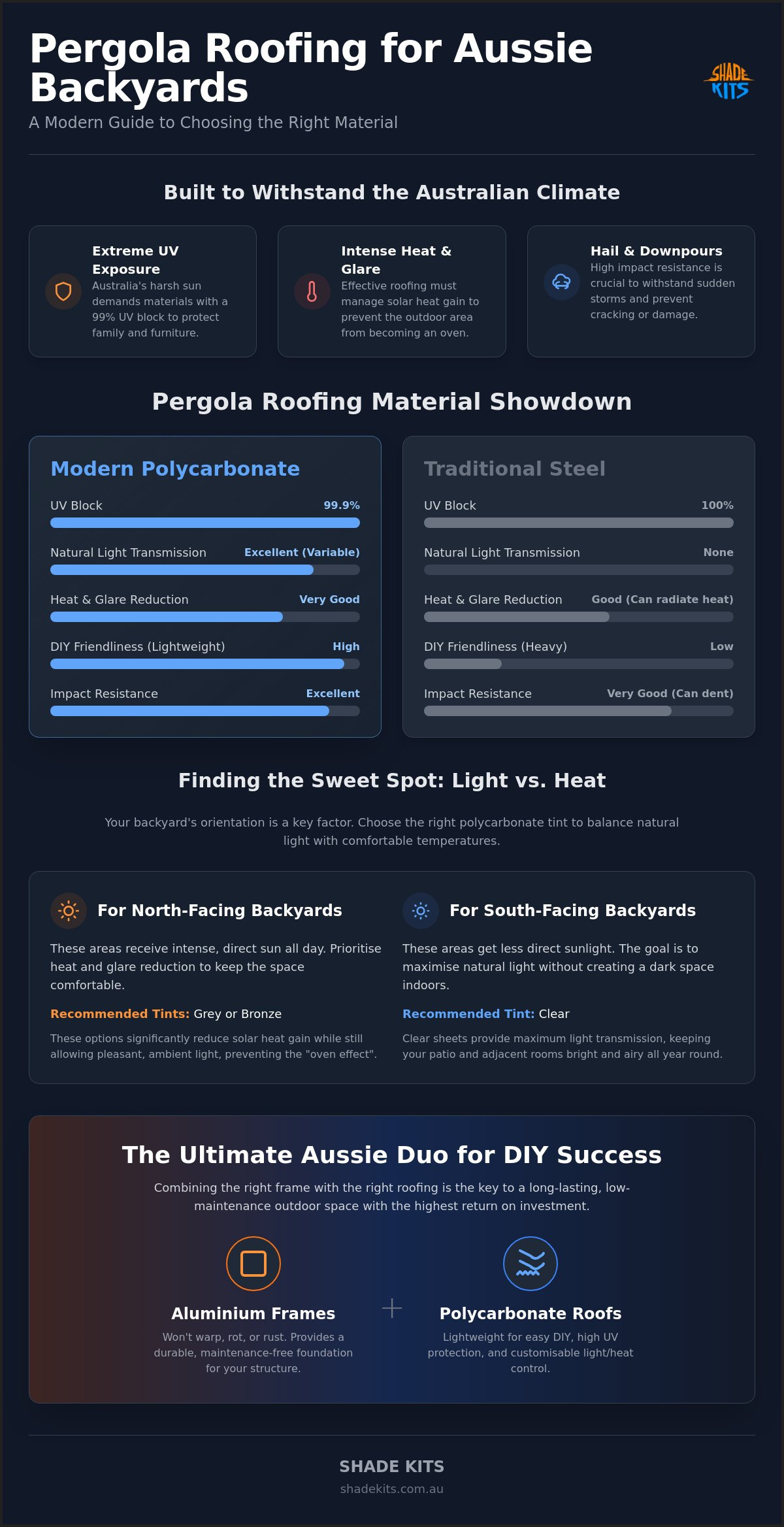
Polycarbonate has quickly become the modern standard for residential projects. It’s favoured because it offers high impact resistance while allowing natural light to filter through. This is a significant advantage over colour-bonded steel, which can inadvertently create a “dark cave” effect in the interior rooms adjacent to your patio. If you value a bright kitchen or living room, a translucent roof is usually the better choice. For those seeking maximum temperature control, insulated panels are an option, though they’re significantly heavier and often require a more expensive, reinforced frame to support the load. High-end louvre systems offer great flexibility, but their moving parts and complex assembly make them a challenging choice for the average DIY enthusiast.
Polycarbonate is incredibly lightweight, making it easy to handle on a ladder without assistance. Modern multi-wall sheets are designed with “dead-air” gaps between the layers, which act as a natural thermal barrier to keep the area underneath cooler. You can also customise your comfort with different tints. Clear sheets provide maximum light, while Grey or Bronze tints are excellent for reducing glare and heat on north-facing decks. If you’re planning a weekend project, choosing DIY pergola kits with pre-cut polycarbonate is often the most efficient path to a professional result.
Steel remains a popular choice when 100% shade is the priority. It’s incredibly durable and allows you to match your pergola roof exactly to your existing house roof for a seamless aesthetic. However, steel acts as a heat sink, absorbing solar energy and radiating it downward. To avoid trapping hot air, these structures need plenty of height or open sides for cross-ventilation. It’s a robust solution, but one that requires careful planning to ensure the space remains comfortable during a peak Australian summer.
Choosing between a bright patio and a cool one shouldn’t feel like a compromise. In the Australian climate, the relationship between light transmission and heat reduction is usually inverse. The more transparent a material is, the more solar energy it allows to pass through. To navigate this, you need to understand the Solar Heat Gain Coefficient (SHGC). This metric measures the fraction of solar radiation admitted through a window or roof. When comparing pergola roofing options, a lower SHGC indicates better heat rejection, which is vital for maintaining a comfortable temperature during a sweltering January afternoon.
Your backyard’s orientation dictates which opacity level will work best. North-facing outdoor areas receive the most intense sun throughout the day, often requiring a material with a higher heat block to remain usable. Conversely, south-facing spaces or those heavily shaded by trees might benefit from clearer sheets to prevent the area from feeling gloomy. One of the biggest advantages of translucent roofing is its impact on your home’s interior. A solid roof can turn an adjacent kitchen or living room into a dark space, while a well-chosen pergola roof keeps your indoor areas flooded with natural light without the associated heat.
The tint you choose acts as the “sunglasses” for your patio. Clear sheets are excellent for capturing winter sun, but they can feel intense during a scorching Australian summer. Grey and Bronze tints are highly effective at reducing glare and visible light, making them ideal for high-exposure areas. If you want a soft, even glow, Opal or White sheets are the premium choice. They provide diffused light that eliminates harsh shadows, creating a bright but gentle environment that feels much cooler than clear alternatives.
Modern polycarbonate technology has solved many of the issues found in older materials. While some competitors suggest that plastic roofing inevitably yellows, high-quality sheets now feature co-extruded UV-stable coatings. This technology reflects infrared radiation, which is the primary source of heat, while allowing visible light to pass through. By scattering sunlight evenly, diffused light reduces the need for artificial indoor lighting during the day. To further enhance comfort, ensure your structure has a sufficient pitch and height. This allows trapped hot air to rise and escape, naturally cooling the space through convection. If you’re looking for the best balance of performance and longevity, exploring high-grade pergola roofing options is the most reliable way to future-proof your outdoor lifestyle.
A well-chosen structure is only as good as the care it receives. While modern pergola roofing options are designed for extreme durability, a small amount of routine maintenance goes a long way in preserving the clarity of your roof and the strength of your frame. Unlike timber structures that require frequent oiling or painting, aluminium and polycarbonate systems are built to be low-maintenance assets for your home. However, the Australian environment is relentless, and staying on top of a few simple tasks will ensure your outdoor area remains in peak condition for decades.
Cleaning your polycarbonate roof doesn’t require specialised chemicals or expensive equipment. You should avoid abrasive cleaners or stiff brushes, as these can scratch the surface and damage the co-extruded UV-protective layer. Use a soft sponge and a mild soap solution to gently remove dust, salt spray, and bird droppings. For the aluminium frame, a simple hose down every few months is usually enough to keep the powder-coated finish looking new. If you live in a coastal area, doing this more frequently helps wash away salt deposits that could otherwise dull the finish over time.
After extreme weather events, it’s a good habit to perform a quick visual inspection. Check that the fixings are still snug and that no debris has clogged the guttering or the sheets’ drainage channels. High winds can sometimes shift sheets if they weren’t tightened correctly during the initial DIY build, so a five-minute check ensures everything remains watertight. Lichen and moss often thrive in shaded, damp sections of a roof. If left unchecked, they can trap moisture against the seals and eventually lift the edges of your roofing tape. Regular cleaning prevents these organisms from taking hold, protecting the structural integrity of the entire system.
Australian storms are famous for hail, which is why impact resistance is a top priority for any backyard structure. Polycarbonate is significantly more resilient than glass or older PVC materials. It has the unique ability to flex under pressure, absorbing the energy of a hailstone without shattering. When you source through factory-direct channels, you ensure the sheets are fresh and haven’t become brittle from years of sitting in a warehouse. For those using our structures as carports, our Car Cave kits are specifically designed with this high-level impact defence in mind to protect your vehicles from the elements.
The structural support is just as vital as the roof itself. Aluminium is the superior choice for the Australian sun because it won’t rot, warp, or invite termites like timber often does. A powder-coated aluminium frame is virtually “set and forget”, requiring no painting or oiling. You should ensure your roofing fixings include EPDM rubber washers; these prevent water ingress and stop galvanic corrosion between the different metal surfaces. If you’re ready to upgrade your backyard with a durable, low-maintenance solution, explore our range of DIY pergola kits today.
After weighing up the various pergola roofing options, the combination of a structural aluminium frame and a polycarbonate roof stands out as the most pragmatic choice for the Australian climate. This pairing offers the highest return on investment for homeowners because it addresses the three major pain points of outdoor living: heat, maintenance, and installation complexity. While timber requires ongoing staining and steel can create dark, hot zones, this modern duo provides a durable, light-filled environment that remains comfortable even during a February heatwave. For a detailed breakdown of how these two frame materials stack up, see our guide on aluminium vs timber pergolas for Australian homeowners. It’s a structural solution that prioritises long-term value over temporary fixes.
The practical appeal of this combination lies in the engineering of modern DIY kits. Traditional construction often involves complex cutting and specialised tools, but contemporary systems utilise “snap-in” or “bolt-down” roofing mechanisms. These features allow you to secure your roofing sheets quickly and safely without needing a professional builder. Because these materials are lightweight, they don’t require the heavy-duty footings or massive beams associated with heavier roofing types. By choosing a factory-direct model, you’re also able to access premium, architectural-grade materials at a price point that fits a standard renovation budget. For a comprehensive overview of how to plan and execute your build from the ground up, our guide to DIY pergola kits Australia covers everything from council permits to final installation steps.
Before you make your final decision, use this checklist to ensure your chosen pergola roofing options meet your specific needs:
Selecting a pre-engineered Aluminium Pergola Kits solution removes the guesswork from your project. We’ve carefully curated our material selection to ensure that every roof we provide balances effective heat block with beautiful light transmission. Our kits are designed specifically for the local landscape, ensuring that your structure complies with Australian standards while remaining simple enough for a weekend assembly. We focus on providing a steady, expert hand through the process, ensuring you achieve a professional result independently.
Transforming your backyard starts with accurate preparation. You’ll need to measure your available space, considering the height of your existing roofline and any obstacles like windows or downpipes. Once you have your dimensions, the process is straightforward. We offer Australia-wide delivery for all our factory-direct products, bringing a complete, pre-cut kit directly to your door. There’s no need to coordinate multiple suppliers or transport heavy timber. You can Explore the Shade Kits range of DIY Pergolas for your backyard today and start planning an outdoor area that your family will actually use, regardless of the temperature outside.
Selecting the right pergola roofing options involves more than just picking a style that matches your house. It’s about creating a functional sanctuary that stands up to the intense Australian sun. We’ve seen how the right combination of polycarbonate and aluminium provides a 99% UV block while maintaining the natural light your home needs. By choosing a system designed specifically for our local conditions, you’re investing in a space that stays cool in summer and remains easy to maintain for years to come.
You don’t need a professional builder or a massive budget to achieve these results. Our factory-direct model eliminates the middleman, passing those savings directly to you. Every kit features lightweight aluminium frames and roofing designed for high-impact resistance, ensuring your project is as simple to install as it is durable. It’s time to stop letting the heat keep you indoors and start enjoying your backyard to its full potential.
View our range of durable DIY Pergola Kits at Shade Kits and discover how easy it is to upgrade your outdoor lifestyle today.
High-grade tinted polycarbonate is the most effective solution for balancing heat rejection with natural light transmission. While clear sheets allow the most light to pass through, Bronze or Opal tints can block a significant portion of solar heat gain while maintaining a bright, airy atmosphere. These tints act as a filter, making them one of the most popular pergola roofing options for north-facing Australian backyards that receive intense afternoon sun.
Polycarbonate roofing is not significantly louder than other hard-surface materials like steel. While you’ll hear the drumming of heavy rain, the sound is often dampened by the structure’s pitch and the thickness of the material. Multi-wall polycarbonate, in particular, features internal air gaps that act as a natural acoustic barrier, making it noticeably quieter than older single-skin plastic or metal alternatives during a downpour.
Modern polycarbonate sheets are engineered with co-extruded UV-stable layers that prevent the yellowing and brittleness common in older materials. Decades ago, roofing often failed because the UV protection was only a thin spray-on coating. Today’s high-quality sheets are designed to withstand intense Australian UV levels for 20 years or more, retaining their structural integrity and clarity even in the harshest local conditions.
You can definitely install your own roofing using modern DIY kits. These systems are designed specifically for homeowners, featuring lightweight materials and pre-cut components that don’t require specialised construction skills or heavy machinery. By following a logical assembly process, you can achieve a professional result independently and save on the high costs of on-site installation labour.
The safest way to clean your roof is with lukewarm water, a mild household detergent, and a soft sponge or microfiber cloth. You should avoid abrasive cleaners, squeegees, or stiff brushes, as these can scratch the surface and damage the co-extruded UV-protective layer. Simply rinse the sheets first to remove loose grit, gently wash the surface, and give it a final rinse with a standard garden hose.
Polycarbonate and colour-bonded steel are both excellent for high-wind areas if they are installed according to National Construction Code (NCC) standards. The key to safety is using the correct number of fixings and ensuring the frame is properly anchored to the ground or house. Pre-engineered pergola roofing options in kit form are specifically designed to meet these local wind load requirements, providing peace of mind during storm season.
A translucent pergola roof won’t make your house dark if you select a material with high light transmission. Unlike solid steel or timber roofs that block all vertical light, polycarbonate allows diffused sunlight to reach your internal windows. This often reduces the need for artificial indoor lighting during the day while still providing the necessary shade and heat block for your outdoor entertainment area.
Aluminium is generally superior to timber for supporting a roof in the Australian climate. It doesn’t warp, rot, or split under the sun, and it’s completely immune to termite damage. For a DIY project, aluminium’s lightweight nature and pre-cut components make the assembly process much faster and more predictable than working with heavy timber beams that require ongoing oiling or painting. If you’re still weighing up your frame options, our in-depth comparison of aluminium vs timber pergolas covers the long-term costs and maintenance differences in detail.