
Did you know that insured losses from extreme weather events across Australia reached a staggering $4.8 billion in 2025? It is a stressful reality for every car owner. You watch the clouds turn that ominous shade of green and immediately worry about smashed windscreens or your insurance premiums skyrocketing after the next big hit. You might have considered plastic roofing before but felt unsure if it could truly stand up to a local storm without turning brittle under our harsh UV rays.
We understand that you want a solution that actually works without the confusion of complex construction. This guide shows you why modern polycarbonate carport hail protection is no longer just “plastic” but a high-performance engineered polymer designed to keep your vehicle in showroom condition for decades. You will discover how to identify impact-tested materials and why a DIY kit is the most reliable way to secure a 20 year shield for your driveway. We are going to demystify impact ratings and help you choose a structure that stays tough regardless of what the Australian sky throws at it.
Polycarbonate is far more than a simple sheet of plastic. It is a sophisticated, high-performance thermoplastic used in demanding applications like police riot shields and aerospace windows. Because of the unique properties of polycarbonate, it provides a level of durability that traditional materials struggle to match. For Australian homeowners, investing in polycarbonate carport hail protection is a pragmatic way to secure a vehicle against the unpredictable elements across the country.
Storm patterns across Australia typically result in a peak hail season from September through to March. During these months, severe events can develop rapidly nationwide, often leaving a trail of smashed windscreens and dented panels in their wake. A specialised shelter is essential during this window. Unlike heavy, opaque structures, these carports offer a “translucent advantage.” They allow natural light to filter through, keeping your driveway area bright and welcoming while still providing a virtually unbreakable shield. Choosing a factory-direct carport kit is a cost-effective way to get this protection delivered without the complexity of a custom build.
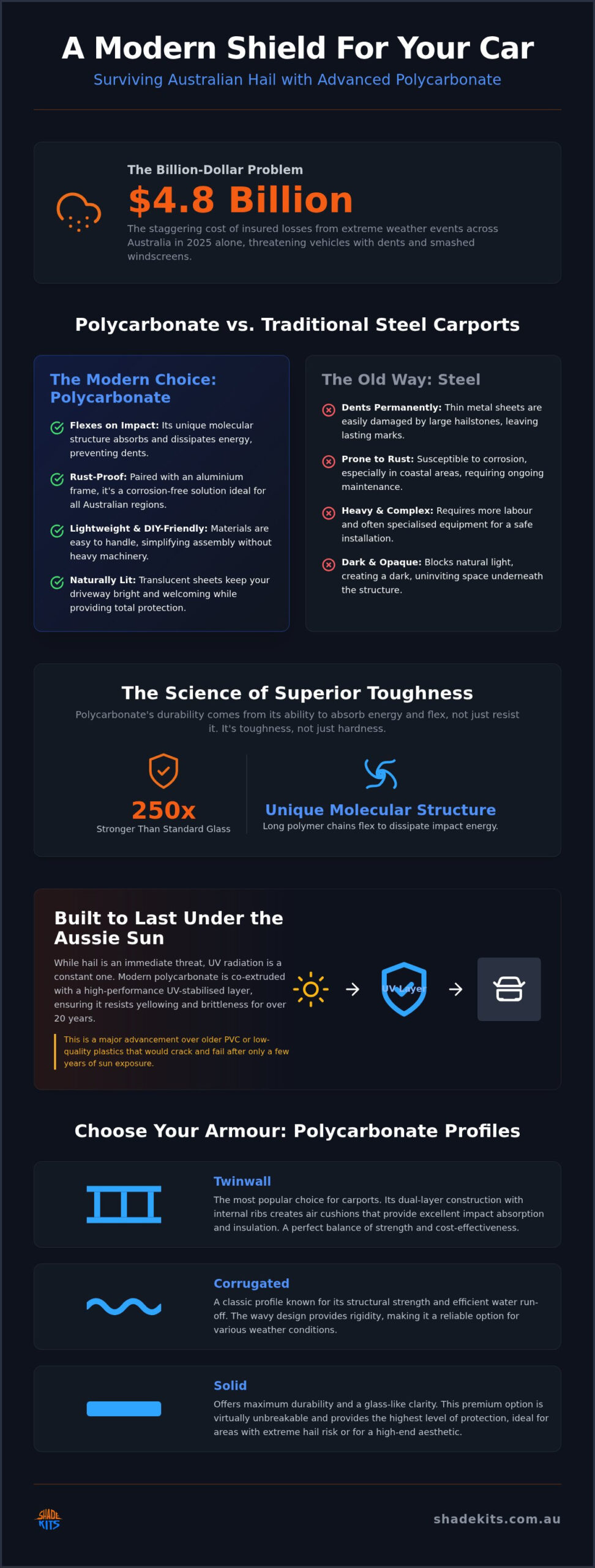
While steel has been the go-to for decades, it carries several drawbacks. Traditional metal carports are heavy and prone to rust, especially in coastal Australian regions. Perhaps most importantly, thin metal sheets tend to dent permanently when struck by large hailstones. Polycarbonate works differently. Its molecular structure allows it to absorb and dissipate impact energy, springing back into shape rather than deforming. When you pair these sheets with a lightweight, rust-proof aluminium frame, you create a maintenance-free structure that is easy to handle during a DIY installation.
Impact strength is defined as the amount of energy required to fracture a material under high-speed stress. To put this into perspective, polycarbonate is roughly 250 times stronger than standard glass of the same thickness. This resilience is why it is the preferred choice for polycarbonate carport hail protection in high-risk zones. Quality roof sheets must comply with the AS/NZS 4256.3 standards. This ensures the material has been tested for the specific structural and weather-resistance requirements needed to survive our local climate for the long term.
When we discuss the durability of a shelter, many people confuse hardness with toughness. In the context of polycarbonate carport hail protection, toughness is the ability of a material to absorb energy and deform plastically without fracturing. The Impact Resistance of polycarbonate is a result of its unique molecular structure. It consists of long polymer chains that are naturally tangled; this allows the material to flex and “give” when struck by a high-velocity object like a hailstone. Instead of the energy being concentrated at the point of impact, it is dissipated across the sheet.
This “bounce factor” is what prevents catastrophic failure during intense supercell storms. While a heavy hailstone might leave a permanent dent in a thin steel roof or cause glass to shatter into dangerous shards, it will typically bounce off a polycarbonate surface. The thickness of the material plays a significant role here. For example, 6mm Twinwall polycarbonate is a popular choice because it uses two layers of material separated by vertical ribs. This internal structure creates a series of air cushions that further absorb the kinetic energy of falling ice, protecting the vehicle underneath from even the most aggressive weather events.
There is a common myth that all plastic roofing eventually goes brittle and cracks. This was often true for older, cheaper PVC products, but modern polycarbonate is a different beast entirely. High-quality sheets are now UV-stabilised on at least one side, ensuring they remain flexible and clear for decades. If you are concerned about the long-term viability of your shelter, it is worth exploring our carport kits which utilise these advanced materials to ensure your investment lasts as long as your home.
While hail is the immediate threat, UV radiation is the silent enemy of structural integrity. Without protection, sun exposure can break down the polymer bonds, leading to yellowing and eventual failure. To prevent this, premium sheets use a co-extrusion process. This fuses a concentrated UV-protective layer into the surface of the sheet while it is being manufactured. This layer keeps the hail-resistant properties intact by shielding the core material from solar degradation. For a deeper dive into these environmental challenges, you can read our Hail Protection for Cars Pillar.
Some homeowners worry that a polycarbonate roof will be deafening during a typical Aussie downpour. Actually, because the material is less resonant than thin-gauge steel, the sound of rain is often more of a dull thud than a metallic ring. Beyond acoustics, the multiwall design of Twinwall sheets provides a helpful air gap for thermal insulation. If you choose a tinted or solar-control option, you can reduce heat gain under the carport by up to 50%. This keeps your car significantly cooler on those 40 degree January afternoons, preventing interior trim from fading and making the vehicle much more comfortable to enter.
Selecting the right profile is a balance between aesthetic preference, budget, and the specific level of polycarbonate carport hail protection you require. While all polycarbonate is impact-resistant, the way the sheet is manufactured changes how it handles structural loads and environmental stress. In Australia, most manufacturers offer specific hail warranties that cover fracturing from stones up to a certain diameter, usually around 25mm. However, the lifespan of that warranty often depends on whether you have chosen a profile suited to your local wind and storm conditions.
The profile you select also dictates the structural requirements of your aluminium frame. Rigid profiles allow for wider spacing between rafters, which creates a cleaner, more open look. Conversely, thinner or more flexible sheets may require additional purlins to prevent sagging or “oil canning” over time. Understanding these differences ensures your DIY project remains a long-term asset rather than a maintenance burden.
Twinwall is characterised by a “box” or “fluted” internal structure, consisting of two thin layers of polycarbonate joined by vertical ribs. This design is the go-to for modern carport kits because it offers an exceptional strength-to-weight ratio. The internal air pockets act as a buffer, absorbing the energy of hail strikes while providing better thermal insulation than single-layer sheets. Because Twinwall is naturally rigid, it has superior spanning capabilities, meaning you need fewer support bars during assembly. It is a central feature in our DIY Carport Kits Australia Guide because it simplifies the installation process for homeowners.
If you prefer a premium, “glass-like” appearance, solid polycarbonate is the ideal choice. It provides total clarity and is virtually unbreakable, making it a favourite for high-end architectural carports. While it is heavier than Twinwall, its impact resistance is unmatched. On the other end of the spectrum, corrugated polycarbonate is a cost-effective solution for basic utility structures. It is easy to match with existing corrugated metal roofing on your home, ensuring a seamless visual transition. While corrugated sheets are thinner, their curved shape adds inherent structural strength, though they generally offer less thermal insulation than multiwall options. Choosing between these comes down to whether you prioritise a sleek, flat-roof look or a traditional Aussie utility aesthetic.
Successful installation begins long before you pick up a drill. You must first check your local council requirements, as carports are typically classified as Class 10a structures under the National Construction Code. While regulations vary between different local government areas across the country, ensuring your concrete slab is level and structurally sound remains a universal priority. Choosing a factory-direct solution from Shade Kits simplifies this preparation phase. These kits arrive with pre-drilled holes and components cut exactly to size, removing the risk of measuring errors on site and ensuring your polycarbonate carport hail protection is built on a solid foundation.
Getting the structure square is non-negotiable. If the frame is skewed, the roof sheets won’t sit correctly in the glazing bars. This creates unnecessary tension that can lead to stress fractures or leaks during a storm. Use the 3-4-5 rule or a laser level to verify your corners are exactly 90 degrees before tightening your final bolts. Fastening is another area where precision matters. You must use fasteners equipped with EPDM washers. These rubberised seals prevent water ingress while allowing the polycarbonate to expand and contract as the temperature fluctuates. Without them, the material might buckle or crack during the first intense heatwave.
Aussie storms aren’t just about falling ice; they bring massive wind loads that can be just as damaging. Uplift is a significant threat during a supercell. Wind rushing under the roof can act like a wing, trying to rip the structure off the ground. This is why it’s vital to ensure your polycarbonate sheets are fully engaged with the glazing bars and all locking caps are snapped into place. This ensures the integrity of your polycarbonate carport hail protection by preventing the wind from getting a “grip” on the material edges. For a final safety audit before the storm season hits, consult our Carport Checklist.
If you’re looking for a structure that balances ease of assembly with professional-grade durability, explore our latest DIY carport kits to find the right fit for your home.
Choosing the right supplier is just as important as selecting the right materials. Shade Kits positions itself as the logical expert for Australian-designed DIY solutions, focusing on transparency and dependability. We understand that local homeowners need structures built to last, not just something that looks good on paper. By offering factory-direct pricing, we eliminate the middleman. This ensures you get access to higher-grade, UV-stabilised materials and robust aluminium frames at a price point that makes sense for your budget.
The “No Middleman” advantage is central to our philosophy. Traditional retailers often add significant markups to cover their own overheads and sales commissions. By shipping directly from the factory, we can invest more into the structural integrity of every component. You receive rust-proof aluminium frames and high-grade polycarbonate that has been specifically engineered for the intense Australian sun. It is a pragmatic way to get a professional-grade result without the typical professional-grade price tag.
Our range is designed for maximum versatility. Whether you need a compact single shelter or a sprawling double structure for the family fleet, we provide a kit that fits. We offer nationwide delivery, ensuring that whether you are looking for carport kits in Sydney or Adelaide, you can access premium polycarbonate carport hail protection. This factory-to-door approach ensures that your components arrive in perfect condition, ready for a straightforward weekend assembly.
Not everyone has the space or the legal permission to build a permanent structure. The CarCave is a foldable, non-permanent solution that changes the game for those who cannot commit to a fixed building. It is perfect for renters, apartment dwellers, or anyone needing seasonal protection during the peak storm months. Despite its flexibility, it is designed to withstand rain, sun, and hail strikes with ease. One of its greatest advantages is that it typically avoids the need for a building permit, making it an immediate solution for urgent vehicle defence.
Investing in a high-quality shelter pays for itself over time. When you consider the cost of a modern insurance excess or the rapid depreciation of a car with “hail pox,” the value of a permanent shield is clear. A well-constructed carport keeps your vehicle in showroom condition regardless of the weather. We encourage you to browse our full carport range to find the specific size and style that suits your property. Taking the DIY leap is a rewarding process that provides long-term peace of mind for your pride and joy.
The unpredictable nature of Australian weather means a hailstorm is often a matter of “when” rather than “if.” By choosing polycarbonate carport hail protection, you are investing in a high-performance polymer shield that absorbs impact energy rather than denting like traditional metal. We have explored how the right profile, such as UV-stabilised Twinwall, ensures your structure remains clear and flexible despite our intense sun. You now have the knowledge to navigate council requirements and the confidence to tackle a DIY installation that adds genuine value to your home.
Securing your vehicle doesn’t have to be a complex or overpriced process. Our factory-direct Australian kits remove the middleman, ensuring you receive high-grade components without the retail markup. With UV-stabilised polycarbonate roofing and nationwide delivery across Australia, professional-grade protection is more accessible than ever. Whether you choose a permanent structure or a foldable alternative like the CarCave, the goal is a vehicle that stays in showroom condition for years to come.
Protect your vehicle today with a Shade Kits DIY Carport and enjoy the peace of mind that comes with a well-defended driveway. Your pride and joy deserves a shield that won’t let it down.
Yes, modern polycarbonate is engineered to survive significant impact without fracturing. Because it is roughly 250 times stronger than glass, it can withstand the velocity of large hailstones common during the Australian storm season. For the best polycarbonate carport hail protection, ensure your material complies with Australian Standard AS 4256.5. This testing confirms the sheet can handle the energy of a hailstrike without the catastrophic failure seen in older plastic materials.
Polycarbonate is often superior for hail defence because of its ability to flex. While Colorbond and other thin-gauge metals are structurally sound, they tend to dent permanently when struck by ice. Polycarbonate acts like a spring; it absorbs the impact energy and returns to its original shape. This “bounce factor” prevents the permanent “hail pox” look that can significantly devalue your vehicle and require expensive roof panel replacements.
Modern polycarbonate roofing does not go yellow or brittle if it is specifically UV-stabilised for Australian conditions. High-quality sheets use a co-extrusion process that fuses a protective layer into the surface. This shield blocks 99% of harmful UV radiation, preventing the chemical breakdown of the polymer chains. This ensures the roof remains clear and impact-resistant for decades, unlike the cheaper PVC products of the past that were prone to cracking after a few summers.
You should check the technical specifications provided by your supplier to confirm the warranty details. Most reputable Australian manufacturers provide a specific hail warranty that covers fracturing from stones up to 25mm in diameter. Look for products that explicitly mention compliance with AS 4256.5. This standard is the benchmark for structural reliability in our climate. If a kit doesn’t mention impact testing or UV stabilisation, it may not be suitable for long-term protection.
It is a common misconception that plastic roofing is louder than metal. In reality, polycarbonate is less resonant than thin-gauge steel. During a downpour or hailstorm, the sound is typically a duller thud rather than a sharp metallic ring. Multiwall or Twinwall structures are particularly effective at dampening noise because the internal air gaps act as an acoustic buffer. This makes the area underneath much quieter and more comfortable during heavy weather events.
A thickness of 6mm is generally considered the “sweet spot” for residential carports. Specifically, 6mm Twinwall polycarbonate offers the best balance of weight, cost, and impact resistance. The internal ribbing provides the structural rigidity needed to handle wind loads and hail strikes without requiring heavy, expensive support frames. While solid sheets can be thicker and stronger, 6mm multiwall is the standard for most reliable DIY kits because it is easier to handle during assembly.
Yes, most permanent carports are classified as Class 10a buildings and require council approval. Regulations vary depending on your state and the size of the structure. For example, some Victorian councils allow small carports without a permit, while Queensland often requires structural certification due to high-wind risks. If you want to avoid the permit process, a non-permanent solution like the CarCave is often exempt because it is considered a temporary, foldable structure.
A high-quality kit featuring an aluminium frame and UV-stabilised roofing typically lasts between 20 and 25 years. Aluminium is naturally rust-proof, which is a major advantage in coastal Australian regions. When combined with polycarbonate carport hail protection that resists solar degradation, the structure remains functional and visually appealing for decades. Regular maintenance, such as clearing the gutters and occasionally hosing down the roof sheets, will help maximise this lifespan.