
Why pay a $15,000 premium for a custom-built extension when your home’s existing wall is already half the job done? For many Australians, the dream of a permanent vehicle shelter often stalls at the first quote for professional labour or the confusing maze of local building permits. You’ve likely felt that frustration when looking for attached carport kits that offer both style and structural integrity without the heavy price tag of a traditional builder. It’s a common concern, especially when you consider that trade rates in 2026 can sit as high as $110 per hour.
We understand that you want a solution that’s as resilient as it is easy to assemble. This guide will help you select, plan, and install the perfect attached carport kit to shield your car from extreme UV rays and coastal salt spray while boosting your property’s street appeal. We’ll explore the latest 2026 council exemptions across different states, compare the longevity of aluminium frames against steel, and walk through the methodical steps needed for a professional DIY finish. By the end, you’ll have a clear, practical plan to transform your driveway into a functional, protected space.
An attached carport kit is a structural extension designed to fix directly to your home’s existing exterior wall or fascia. Unlike a freestanding Carport, which requires a full set of support posts, these kits use your house as a primary anchor point. This simple shift in design offers a more permanent, integrated feel that mimics a traditional garage extension without the heavy costs of custom construction. For many Australian families, choosing attached carport kits is the most practical way to secure a vehicle while working within the constraints of a standard residential block.
The primary drawcard here is efficiency. By utilising an existing wall, you immediately reduce the physical footprint of the structure. This is particularly vital for narrow driveways where every centimetre counts. Beyond saving space, this design offers superior structural stability. Because the kit is braced against a solid brick or timber-framed wall, it gains significant resistance against the lateral wind forces common in coastal or open-plain regions. It’s a robust solution that feels like a natural part of your home’s architecture rather than a temporary add-on.
Deciding between an attached or freestanding model usually comes down to your driveway’s width and the layout of your home. If you’re dealing with a narrow 10m lot, a freestanding structure might take up too much room with its double row of posts. An attached kit clears that space, making it easier to open car doors without hitting a metal pole. You’ll need to evaluate your home’s attachment point, whether it’s a sturdy brick wall or a timber fascia, to ensure it can handle the load. While you’ll spend a bit more on specialised mounting hardware, you’ll save significantly on the cost of extra posts and the manual labour required to install them.
A well-planned carport should look like it was built with the house, not bolted on years later. Attached kits achieve this by allowing you to match roof pitches and profiles directly to your home’s roofline. This creates a seamless transition that can actually increase your property’s market value. Many homeowners also use these structures as a versatile transition zone. It provides a dry, shaded path from the car to the front door, which is a massive win during a summer downpour. By choosing materials that complement your existing cladding, you turn a simple car shelter into a stylish architectural feature.
Choosing the right materials for your shelter isn’t just about the initial look. It’s about how the structure performs after five years of exposure to the relentless Australian sun and salt air. While many traditional options rely on heavy steel, modern attached carport kits have pivoted towards high-grade aluminium and polycarbonate. This combination offers a specific set of advantages that address the most common headaches for homeowners: rust, heat, and difficult installation.
If you live within a few kilometres of the ocean, salt-air corrosion is your primary enemy. Galvanised steel is often touted for its strength, but once the protective zinc coating is scratched during assembly or by flying debris, rust can take hold quickly. Aluminium is different. It naturally resists corrosion by forming a protective oxide layer, making it virtually immune to the ‘tea staining’ and structural rot that plagues steel in maritime environments. Beyond its lifespan, aluminium is significantly lighter. This weight advantage is crucial for DIY projects. It allows a two-person team to safely lift and position rafters without needing to hire specialised lifting gear or additional labour. A powder-coated finish ensures the frame retains its sleek colour for decades with nothing more than an occasional wash with a garden hose.
Traditional metal roofing can turn a driveway into a dark, stifling tunnel. UV-resistant polycarbonate roofing solves this by allowing natural light to filter through while blocking the harmful rays that cause car paint to oxidise and interiors to crack. This creates a bright, usable workspace for weekend maintenance while keeping the vehicle significantly cooler than a metal-roofed structure would. Many Australians worry about hail, but high-impact polycarbonate is engineered to absorb energy. It can withstand the force of significant hailstones that would leave permanent dents in thin metal sheeting. This resilience makes it a dependable choice for regions prone to sudden summer storms.
By selecting a kit that uses these advanced materials, you’re investing in a structure that remains low-maintenance and visually appealing for the long haul. If you’re ready to see how these materials look in a finished design, you can browse our range of durable carports to find the right fit for your home’s exterior.
Selecting the right structure involves more than just picking a design that looks good on paper. Because attached carport kits become a permanent fixture of your home, you need to account for both your current vehicle and any future upgrades. A standard single carport typically measures 3m in width, while a double requires 6m. However, you should also consider the “swing room” for doors. If you have a narrow driveway, an attached model is ideal because it eliminates a row of posts, but you still need enough clearance to exit the vehicle comfortably without brushing against the house wall.
Height is often the most overlooked factor during the planning phase. While a standard sedan fits almost anywhere, modern Australian 4WDs often feature roof racks, awnings, or snorkels that push the total height well above 2.2m. If you’re planning to house a caravan or a boat, you’ll need even greater clearance. Always measure your vehicle at its highest point before committing to a kit height. Customisation also plays a role in the final result. Most high-quality kits allow you to choose powder-coated colours that match your existing gutters and fascia, ensuring the addition looks like an intentional part of the original build.
Start by identifying your attachment point. If you’re fixing to a timber fascia, ensure it’s structurally sound and at a height that allows for the necessary roof pitch. You also need to account for ground slope. If your driveway falls away from the house, your posts will need to be longer to keep the roof level and functional. Drainage is another critical factor. Ensure the runoff from your new roof won’t pool near your home’s foundations or overwhelm your existing downpipes. Taking these measurements accurately now prevents expensive adjustments during the installation phase.
The Skillion roof, or flat roof, is the most popular choice for modern Australian homes. It offers clean, minimalist lines and is generally more cost-efficient and easier to install. It works perfectly for contemporary architecture where a simple, unobtrusive look is preferred. On the other hand, a Gable roof provides a traditional peaked design that often matches older Australian homesteads. Gables offer better airflow, which can be a significant advantage in hotter climates by allowing trapped heat to escape more easily. To see the different styles available, you can Explore our full range of carport kits to find a profile that suits your property.
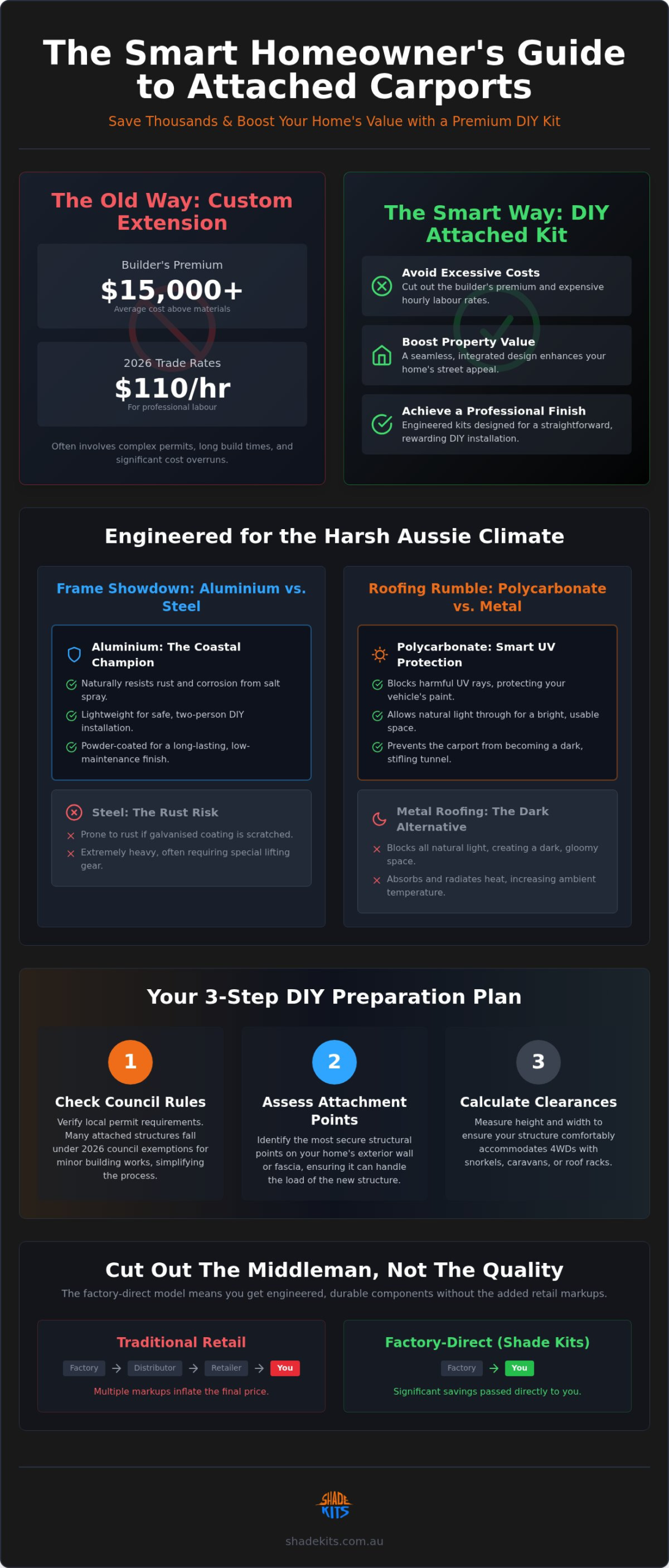
Before the first bolt is tightened, your priority is ensuring the project complies with local regulations. As of late 2026, many local government areas have updated their requirements for residential structures. In Brisbane, for instance, double carports measuring 6m wide generally require a block width of at least 15m for approval. Meanwhile, in Western Australia, you don’t typically need a registered builder for carport projects valued under $50,000, but a council permit is still a non-negotiable requirement. Checking these setbacks and permit rules early prevents costly legal headaches or the need to dismantle your work later.
Once the paperwork is sorted, you can focus on the physical preparation. Most attached carport kits are designed for efficiency, but they still require a solid foundation. You’ll need to decide between pouring a full concrete slab or using individual pier footings for the support posts. If your driveway is already paved, pier footings are often the simpler DIY path. You’ll also need to gather a specific set of tools. Beyond a standard power drill, ensure you have a high-quality spirit level, an impact driver for structural fasteners, masonry bits for brickwork, and at least two sturdy ladders to manage the overhead components safely.
The method you use to join the structure to your home depends on your roofline. Fascia mounting is a popular choice for low-set homes because it allows you to use specialised brackets to gain extra height, ensuring even a tall 4WD can clear the entrance. If you’re mounting directly to a brick wall, you must ensure you’re anchoring into solid masonry rather than just the mortar joints. For timber-clad homes, finding the internal structural studs is essential for a secure fit. To ensure you haven’t missed a step in the planning phase, refer to The Essential Australian Carport Checklist for a detailed walkthrough of the technical requirements.
When your factory-direct kit arrives, the delivery driver will typically unload the long-span aluminium profiles and roofing sheets as close to the installation site as possible. Your first task is organising these components. Lay everything out and check it against the packing list to ensure every bracket and fastener is accounted for. This inventory process might take an hour, but it saves significant time during the 1-2 day assembly process. Remember to handle the long polycarbonate roofing sheets with care, especially if there’s a breeze. These materials are engineered for durability, but they are most vulnerable to damage before they are securely fastened to the frame.
Ready to start your home improvement project? You can browse our full range of DIY-friendly carport kits to find the right size and style for your property.
When you’re comparing attached carport kits, the biggest difference often comes down to the supply chain. Many Australian retailers act as middlemen, adding a significant markup to products they didn’t actually manufacture. Shade Kits operates on a factory-direct model. This means you’re getting higher-grade aluminium and advanced UV-resistant polycarbonate roofing without the inflated price tag. Because we control the production process, we ensure every component is engineered specifically for the intensity of the Australian sun and those sudden, heavy hailstorms that can catch any homeowner off guard. It’s about providing a premium product that’s accessible to the everyday DIYer.
Support doesn’t end when the delivery truck leaves. We provide comprehensive documentation and direct assistance to ensure your project is a success. You can Check our delivery options across Australia to see how we get these precision-engineered kits to your doorstep, whether you’re in a metropolitan hub or a regional area. Our focus is on making the logistics as smooth as the installation itself, ensuring you have everything needed to complete your attached carport kits project with confidence.
While a permanent attached structure is the primary goal for most, some properties have unique needs for guest parking or additional vehicles. This is where a foldable CarCave becomes an invaluable addition to your home’s defences. It provides a temporary but highly effective defence against the elements, particularly during peak storm seasons when hail is a constant threat. If you’re concerned about the increasing frequency of severe weather events, our Hail Protection for Cars Guide offers deeper insights into defending your vehicle beyond a fixed structure. It’s a versatile solution for those who need extra protection without committing to a second permanent build.
Investing in a high-quality aluminium kit isn’t just about protection; it’s a strategic move for your property’s future. A stylish, permanent carport adds genuine street appeal and resale value. By choosing the DIY route, you’re also pocketing the savings that would otherwise go to professional installation fees. With trade labour rates in 2026 often exceeding $100 per hour, the return on investment for a self-installed kit is substantial. For a detailed breakdown of how these costs compare to custom-built alternatives, explore our Aluminium Carport Prices Australia Guide. It’s a transparent look at how to achieve professional results while maintaining a sensible budget.
Building a shelter for your vehicle shouldn’t be a complex or overpriced ordeal. By selecting high-quality attached carport kits, you’ve chosen a path that balances structural integrity with significant cost savings. You now understand how to navigate local council permits, measure for 4WD clearances, and utilise the existing strength of your home’s walls. Aluminium frames and UV-resistant roofing ensure your investment stands up to the harsh Australian sun and coastal conditions for decades.
Shade Kits is here to support your DIY journey with factory-direct pricing on all aluminium kits and reliable Australia-wide delivery on all DIY kits. Our designs focus on simplified assembly so you can achieve professional results without the high cost of trade labour. It’s time to add genuine value to your property and give your vehicle the permanent protection it deserves. Browse Our Range of Durable Attached Carport Kits today and start your home improvement project with confidence.
Most attached carport kits require some form of council approval because they are permanent structural additions to your home. Regulations vary between local government areas, but size often determines the requirement. For instance, in South Australia, a structure under 15 square metres might be exempt, while New South Wales often allows open-sided structures up to 25 square metres behind the building line. You should always verify local setback rules and permit requirements before starting your project.
You can certainly install these kits yourself if you have basic home improvement skills and a second pair of hands. Choosing a DIY approach allows you to save on professional labour costs, which typically range from $60 to $110 per hour in 2026. In Western Australia, you don’t even need a registered builder for carport projects valued under $50,000. If you’re comfortable using a drill and working on a ladder, self-installation is a practical option.
Attached kits are engineered with integrated gutter systems and downpipes to manage heavy Australian downpours effectively. The key to successful drainage is ensuring the roof has the correct pitch, typically a minimum of 5 degrees for skillion designs. This slope allows water to flow freely into the guttering rather than pooling on the roof. During installation, you’ll need to direct the runoff into your existing stormwater system or a suitable drainage point on your property.
Powder-coated aluminium is the superior choice for coastal properties due to its natural resistance to salt-air corrosion. Unlike galvanised steel, which can develop rust if the protective coating is scratched, aluminium forms its own protective layer that prevents structural rot. This makes attached carport kits made from aluminium a low-maintenance, long-term solution for maritime environments. It stays looking newer for longer and won’t suffer from the “tea staining” common in seaside areas.
These kits are versatile and can be attached to both metal and timber fascias using specialised structural brackets. If you’re fixing to a metal fascia, you’ll typically use internal stiffeners to ensure the load is distributed safely across the rafters. For timber fascias, it’s vital to check that the wood is structurally sound and free from rot. In both cases, the attachment point must be high enough to allow for the necessary roof pitch and vehicle clearance.
You’ll need a standard set of DIY tools including a cordless impact driver, a spirit level, and a tape measure. A high-quality hammer drill is essential for masonry attachments, along with a set of nut drivers for the structural fasteners. Because you’ll be working overhead, two sturdy A-frame ladders and a chalk line for marking out heights are also required. Most kits come with specialised drill bits, but having a spare set of metal bits is always helpful.
A single attached carport typically takes two people between one and two days to fully assemble. This timeline assumes you’ve already completed the ground preparation, such as pouring pier footings or a concrete slab. The first day is usually focused on mounting the wall brackets and standing the frame, while the second day involves securing the roofing sheets and finishing the guttering. Taking your time with the initial measurements ensures the rest of the assembly moves quickly.
Modern polycarbonate roofing is engineered for high impact resistance and can withstand significant hailstorms without cracking or shattering. These attached carport kits use materials designed to absorb energy, making them much more resilient than older plastic alternatives or thin metal sheeting that dents easily. While extreme, record-breaking hail can damage almost any material, polycarbonate remains the most dependable choice for Australian conditions. The UV-resistant coating also ensures the sheets don’t become brittle or discoloured over time.